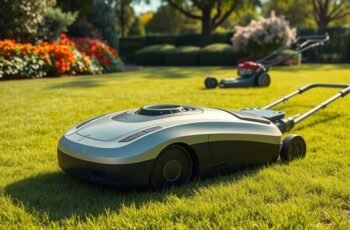
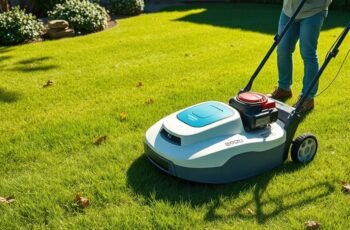
It’s often assumed that choosing between robot and cylinder mowers is a straightforward decision based solely on lawn size, but this oversimplifies the complex trade-offs involved. While robot mowers promise automation and environmental benefits, cylinder mowers excel with precision and professional finishes, especially on smaller areas. Exploring the nuances of their features, costs, and long-term impacts reveals that the best choice depends on specific lawn requirements and maintenance priorities—factors that merit closer examination.
Key Takeaways
- Robot mowers offer autonomous operation, while cylinder mowers require manual effort and maintenance.
- Robot mowers are more eco-friendly, quieter, and suitable for large or irregular lawns.
- Cylinder mowers provide precise, sharp-edged cuts ideal for professional-looking lawns.
- Initial costs for robot mowers are higher but offer long-term savings with reduced maintenance.
- Both systems contribute to efficient lawn care, but robot mowers have lower environmental impact and noise.
Understanding the Key Differences Between Robot Mowers and Cylinder Mowers
While both robot mowers and cylinder mowers serve the purpose of cutting grass, their design and operational mechanisms differ considerably, impacting their suitability for various lawn care needs. Robot mowers leverage artificial intelligence to navigate complex terrains and adapt to changing conditions, ensuring consistent coverage and precise trimming. This technology allows for autonomous operation, minimizing human intervention, and maintaining best lawn aesthetics. In contrast, cylinder mowers rely on a traditional cutting mechanism involving vertically rotating blades, offering a clean, precise cut essential for maintaining a well-manicured appearance. Their mechanical design emphasizes sharpness and accuracy, making them ideal for detailed grooming. Understanding these differences helps determine which mower type aligns with specific lawn aesthetics, operational preferences, and technological integration requirements.
How Robot Mowers Simplify Lawn Care and Save Time
Robot mowers substantially streamline lawn maintenance by automating routine tasks that typically require manual effort. They operate on pre-set schedules, ensuring consistent grass cutting, which enhances lawn aesthetics through uniform trimming. This automation reduces human labor, allowing for more efficient time management. Additionally, robot mowers contribute positively to environmental impact by using electric power, resulting in lower emissions compared to gas-powered alternatives. They also minimize soil disturbance and reduce noise pollution.
Robot mowers automate lawn care, boost efficiency, and promote eco-friendly, quiet, and uniform grass trimming.
- Continuous, precise mowing maintains a healthier, more attractive lawn
- Scheduled operation optimizes time and resource allocation
- Reduced emissions and noise support eco-friendly practices
The Advantages and Limitations of Cylinder Mowers for Traditional Lawn Maintenance
Cylinder mowers excel in delivering precise, clean cuts that promote healthy grass growth, but their maintenance demands can be substantial. While their cutting mechanism offers superior accuracy, the blades require frequent sharpening and adjustment to maintain performance. Understanding these trade-offs is essential for evaluating their suitability in traditional lawn care practices.
Precision Cutting Benefits
Cylinder mowers are renowned for their ability to produce exceptionally precise cuts, a feature that derives from their unique design where cylindrical blades rotate in unison against a stationary bed knife. This mechanism guarantees a clean, uniform cut, which is vital for maintaining a healthy, aesthetically pleasing lawn. The precision offered by cylinder mowers supports consistent grass height and promotes dense growth. Additionally, their compatibility with smart technology allows for more accurate control and peak cutting performance. From an environmental impact perspective, this precision reduces waste and over-cutting, contributing to sustainable lawn care practices.
- Achieves clean, sharp edges for professional-looking lawns
- Enhances grass health through uniform cutting
- Facilitates integration with eco-friendly, smart systems for efficiency
Maintenance and Limitations
While cylinder mowers excel in delivering precise cuts, their maintenance requirements and operational limitations warrant careful consideration. These mowers depend heavily on blade durability; over time, blades dull, reducing cut quality and necessitating regular sharpening or replacement. Unlike robot mowers, which may rely on batteries, traditional cylinder mowers often lack a battery component, but their manual or motorized operation can lead to increased wear on moving parts. Maintenance involves frequent attention to blade alignment, lubrication, and part replacement, which can be time-consuming and costly. Additionally, their manual operation limits efficiency on large or uneven terrains. Overall, while cylinder mowers offer superior cutting precision, their higher maintenance demands and limited adaptability highlight important operational constraints for traditional lawn care.
Which Mower Is Better for Small, Medium, or Large Lawns?
Determining the most suitable mower depends heavily on the size of the lawn in question. For small lawns, a robot mower offers high mower portability and efficiency, steering through tight spaces with ease. Medium lawns benefit from a cylinder mower’s precision and consistent cut, though portability becomes a consideration. Large lawns require a mower capable of covering extensive areas quickly; here, traditional cylinder mowers may struggle with maneuverability, while robot mowers can automate large sections but may need more time.
- Small lawns favor compact, highly portable robot mowers
- Medium lawns benefit from balance, combining precision and manageable size
- Large lawns demand efficient coverage, often favoring rugged, high-capacity mowers
Cost, Maintenance, and Long-Term Investment: Making the Right Choice
When evaluating mower options, cost, maintenance requirements, and long-term investment potential are critical factors that influence the overall value and sustainability of each choice. Robot mowers often entail higher initial costs but offer lower ongoing maintenance, which benefits long-term investment. They provide consistent lawn aesthetics with minimal human intervention, reducing labor costs. Conversely, cylinder mowers typically have lower upfront costs but demand more frequent maintenance and skilled operation, impacting long-term expenses. From an environmental impact perspective, robot mowers are generally more eco-friendly, thanks to their energy efficiency and reduced emissions, supporting sustainable lawn care. Understanding these factors helps determine which mower aligns best with priorities like lawn aesthetics, environmental impact, and budget constraints, ensuring a balanced, informed investment decision.
Factors to Consider When Choosing Between a Robot Mower and a Cylinder Mower
When selecting between a robot mower and a cylinder mower, we must evaluate cutting efficiency and precision, as these directly impact lawn quality. Maintenance requirements and long-term costs also influence overall investment value, dictating operational sustainability. By analyzing these factors, we can make a more informed decision aligned with specific landscape and budget considerations.
Cutting Efficiency and Precision
Choosing between a robot mower and a cylinder mower hinges considerably on their respective cutting efficiency and precision, as these factors directly impact the quality of the lawn. Robot mowers leverage artificial intelligence to optimize cutting patterns, ensuring consistent coverage even on complex terrains. They excel in maintaining uniform height and reducing overlap, which enhances overall efficiency. Cylinder mowers, on the other hand, provide highly precise cuts with sharp blades that deliver cleaner edges and a more manicured appearance, especially for formal lawns. Their mechanical design allows for consistent, sharp cuts, but they require manual control of cutting patterns.
- Robot mowers adapt their cutting patterns for maximum efficiency through AI algorithms
- Cylinder mowers produce cleaner, more precise edges for formal lawns
- Both tools’ cutting efficiency depends on blade sharpness and terrain complexity
Maintenance and Upkeep
Have you considered how maintenance requirements differ markedly between robot mowers and cylinder mowers? Robot mowers generally demand less manual intervention but require attention to battery lifespan, which impacts operational longevity. Over time, battery degradation necessitates replacements to maintain efficiency. Conversely, cylinder mowers rely heavily on blade sharpening, as dull blades compromise cut quality and can strain the motor. Regular blade maintenance is essential for peak performance and reduces the risk of uneven cutting. Additionally, robot mowers often have automated cleaning features, reducing upkeep efforts, while cylinder mowers require more frequent manual maintenance. Both systems benefit from routine checks, but the nature of upkeep—battery management versus blade sharpening—differs considerably and should factor into your decision-making process.
Cost and Investment
The initial investment for a robot mower is generally higher than that of a cylinder mower, primarily due to advanced technology and automation features. The cost reflects cutting-edge battery technology, which enhances runtime and efficiency but increases upfront expenses. Over time, however, operational savings may offset initial costs, especially considering reduced labor. When evaluating investment, consider environmental impact; robot mowers tend to be more eco-friendly due to lower emissions and quieter operation.
- Higher initial purchase price driven by sophisticated sensors and automation
- Battery technology advancements influencing long-term operational costs
- Environmental benefits reducing potential regulatory or disposal costs
Frequently Asked Questions
Are Robot Mowers Suitable for Uneven or Hilly Terrains?
Robot mowers can handle uneven or hilly terrains, but their terrain adaptability varies. We find that mower stability on slopes depends on design features, making some models more suitable for challenging landscapes, ensuring consistent mowing performance.
How Do Mower Types Impact the Environment and Sustainability?
We believe mower types considerably influence eco-friendliness; electric models powered by renewable energy reduce emissions, while traditional gas mowers contribute to pollution. Embracing eco-friendly technology guarantees a sustainable future, but the choice impacts environmental health profoundly.
Can Robot Mowers Handle Thick or Tall Grass Effectively?
Robot mowers struggle with thick or tall grass, especially on challenging terrain. Their effectiveness depends on grass thickness and terrain adaptability, but generally, they’re less suitable for dense, overgrown areas compared to traditional mowers.
What Safety Features Are Included in Robot and Cylinder Mowers?
Both robot and cylinder mowers incorporate safety sensors to detect obstacles and prevent accidents. They also feature emergency stop functions, ensuring immediate shutdown if safety is compromised, thereby enhancing operational security and minimizing user risk during use.
How Do Noise Levels Compare Between Robot and Cylinder Mowers?
Imagine a whispering breeze—our robot mowers excel in noise reduction, producing markedly lower sound levels than cylinder mowers. This technical advantage minimizes disruption, offering quieter operation and a more peaceful outdoor environment for users.
Conclusion
Ultimately, choosing between a robot mower and a cylinder mower depends on evaluating size, maintenance, cost, and sustainability. We weigh the convenience of automation against the precision of traditional cutting, balancing upfront investment with ongoing effort. We prioritize efficiency over manual labor, environmental impact over initial expenditure, and long-term value over immediate cost. We analyze these factors carefully to align our decision with our lawn’s needs, our maintenance preferences, and our sustainability goals.