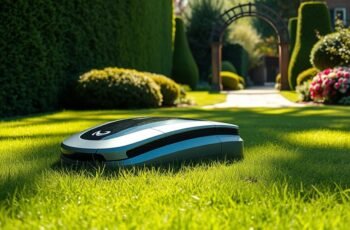
Did you know that nearly 60% of homeowners with larger lawns are now considering robotic mowers to cut maintenance time? As we evaluate different models, it’s essential to analyze your yard’s size, terrain, and specific lawn conditions to guarantee you select a mower that offers peak performance and durability. Understanding these factors helps you avoid costly mistakes and find a solution tailored to your needs—yet, knowing which features truly matter can be complex.
Key Takeaways
- Assess your yard size, terrain, and lawn conditions to select a mower with appropriate capacity and features.
- Prioritize advanced navigation, obstacle avoidance, and connectivity for efficient, autonomous operation.
- Consider your budget, warranty options, and long-term costs for reliable performance and value.
- Check battery capacity and charging times to ensure sufficient runtime and scheduling flexibility.
- Choose models with convenience features like noise reduction, remote monitoring, and environmental efficiency.
How Do You Determine Your Yard’s Size and Terrain?
How do you accurately determine your yard’s size and terrain? To start, we recommend measuring the entire area with precise landscaping tools like a measuring tape or a laser distance meter, ensuring accuracy for garden design. Map out the boundaries carefully, noting any slopes, inclines, or uneven patches that could affect mower performance. Analyzing terrain features helps identify obstacles and challenging zones, guiding your choice of mower capabilities. Using these measurements, you can assess whether a robot lawn mower’s cutting capacity matches your yard’s size. Properly understanding terrain variations also influences the mower’s navigation system needs. This detailed evaluation ensures you select equipment suited to your yard’s specific conditions, optimizing efficiency while minimizing potential issues.
What Features Should You Prioritize in a Robot Lawn Mower?
After accurately evaluating your yard’s size and terrain, it’s important to focus on features that guarantee efficient and reliable operation. Smart navigation is essential; it enables the mower to systematically cover the entire area, avoid obstacles, and adapt to complex yard layouts. Look for models with advanced sensors that map your lawn precisely. Weather sensors are equally important—they allow the mower to respond to rain or humidity, preventing unnecessary runs during bad weather and protecting the equipment from damage. These features enhance autonomy, reduce maintenance, and improve cutting consistency. Prioritizing smart navigation and weather sensors ensures your robotic mower performs at its best, maintains your lawn’s health, and minimizes user intervention, making it a smart investment for a well-manicured yard.
How Much Should You Budget for a Robot Lawn Mower?
Budgeting for a robot lawn mower requires careful consideration of both your yard’s size and the features you prioritize, as these factors substantially influence the overall cost. Pricing options vary widely, from budget models under $500 to premium units exceeding $2,000, with features like GPS navigation and advanced sensors affecting price. It’s crucial to evaluate warranty coverage, as more extensive warranties can add value by reducing potential repair costs over time. Some brands offer extended warranties or service plans, which can be worth the investment for peace of mind. When setting your budget, consider not only the initial purchase price but also long-term costs such as replacement parts and maintenance. A well-informed budget ensures you select a mower that balances affordability with essential features and reliable warranty coverage.
Which Mower Types Are Best for Different Lawn Conditions?
When selecting a robot lawn mower, it’s important to take into account how lawn conditions influence performance—flat lawns generally accommodate most models, while uneven terrain demands more robust, obstacle-avoidant designs. Thick grass can challenge certain mowers’ cutting capacity, requiring models with higher power or specific blade configurations. Analyzing these factors guarantees we choose equipment optimized for each unique landscape.
Flat Lawns Suitability
For flat lawns, selecting the right robot mower involves considering models that excel in uniform terrain and can efficiently handle consistent cutting patterns. These mowers often have superior robot mower compatibility with features like precise boundary sensors and effective navigation systems tailored for smooth surfaces. When evaluating options, lawn shape considerations are vital; simple, rectangular lawns benefit from models with straightforward boundary wire setups and predictable mowing paths. Additionally, a mower’s ability to maintain a consistent cut across flat terrain hinges on its cutting width, battery capacity, and adaptive algorithms that optimize coverage. Since flat lawns do not pose elevation challenges, focus is on selecting a mower with robust navigation that guarantees thorough coverage without overlap or missed patches, maximizing efficiency on uniform, level ground.
Uneven Terrain Challenges
Have we considered how uneven terrain fundamentally influences the choice of a robot lawn mower? It’s essential because such conditions demand models with robust navigation and obstacle handling. Mowers with adaptive wheels and higher torque are better suited, ensuring consistent cutting despite slopes or dips. When selecting a mower, we must also factor in ease of robot mower maintenance, especially since uneven ground can accelerate wear on wheels and motors. Turf repair techniques become relevant after mowing, as uneven terrain can cause patches or damage. Regularly inspecting and repairing the turf helps maintain a healthy lawn and prolongs mower lifespan. Fundamentally, choosing the right mower for uneven terrain involves evaluating its ability to handle complexity and planning for ongoing maintenance to sustain ideal performance.
Thick Grass Considerations
Thick grass presents a distinct challenge for robot lawn mowers, requiring models that can handle increased resistance and maintain consistent cutting performance. Mowers equipped with robust motors and sharp blades are essential to effectively trim dense, tall grass without bogging down. Automated scheduling becomes critical here, ensuring the mower operates during ideal times to prevent overgrowth and reduce strain on the machine. Safety sensors are essential, especially in thick grass, as they help detect obstacles hidden beneath the foliage, preventing accidents. Additionally, models with adaptive cutting algorithms can adjust their speed and cutting height based on grass density, ensuring thorough coverage. Selecting a mower designed for thick grass involves prioritizing durability, intelligent scheduling, and advanced safety features for reliable, safe, and efficient lawn maintenance.
How Do You Evaluate Battery Life and Charging Needs?
To effectively evaluate battery life and charging needs, we focus on battery capacity and runtime to guarantee the mower can cover the entire lawn without frequent recharging. We also consider charging time requirements to minimize downtime, along with power management features that optimize energy use. Analyzing these factors helps us select a mower that maintains consistent performance with efficient energy use.
Battery Capacity and Runtime
When evaluating a robot lawn mower’s battery capacity and runtime, it’s essential to take into account both the mower’s typical cutting sessions and the size of your lawn. Larger lawns require longer runtimes, so opting for batteries with higher capacity guarantees continuous operation, especially with automated scheduling. Additionally, consider noise levels during extended mowing periods, as quieter models often have smaller batteries but may still suffice for smaller properties. Battery capacity is often measured in watt-hours (Wh), affecting overall runtime.
| Battery Capacity | Typical Runtime | Suitable Lawn Size |
|---|---|---|
| 100 Wh | 30 minutes | Small gardens |
| 200 Wh | 1 hour | Medium lawns |
| 300 Wh | 2 hours | Large properties |
| 400+ Wh | 2+ hours | Extensive lawns |
Charging Time Requirements
How quickly a robot lawn mower recharges after each session is a critical factor in planning its use, especially for larger properties or frequent mowing schedules. Longer charging times can disrupt maintenance frequency, potentially leaving patches of overgrown grass that compromise garden aesthetics. To evaluate battery life and charging needs effectively, we consider the mower’s charging speed relative to its runtime. Fast-charging models minimize downtime, ensuring consistent coverage and reducing the gap between mowing sessions. For properties with intricate landscapes or high aesthetic standards, shorter recharge times support more precise maintenance. Conversely, longer charging times may require scheduling adjustments, especially if the mower needs to complete multiple zones in a single day. Ultimately, balancing charging time with runtime ensures ideal lawn health and visual appeal.
Power Management Features
Evaluating a robot lawn mower’s battery life and charging needs requires a close examination of its power management features, which directly influence operational efficiency and maintenance planning. Key factors include battery capacity, recharge time, and the efficiency of power usage during mowing. Features like remote control enable manual intervention for maximum energy use, while safety sensors prevent unnecessary battery drain by halting operation in unsafe conditions. To illustrate, consider the following:
| Feature | Impact on Power Management | Consideration |
|---|---|---|
| Remote control | Allows manual control | Reduces unnecessary runs |
| Safety sensors | Stops mower if unsafe | Prevents energy waste in hazards |
| Battery capacity | Longer runtime | Ensures longer mowing sessions |
What Additional Features Enhance Lawn Maintenance Convenience?
Adding advanced features to a robot lawn mower can considerably enhance the convenience and efficiency of lawn maintenance. Smart connectivity allows us to control and monitor mowing schedules remotely via smartphone apps, providing real-time updates and adjustments. This integration simplifies task management, especially for larger or irregularly shaped lawns. Noise reduction is another critical feature, as quieter operations minimize disturbance to household members and neighbors, enabling mowing during more flexible hours. These enhancements improve user experience by offering greater control and comfort while reducing environmental impact. When selecting a mower with these features, consider the compatibility with your devices and the effectiveness of noise-dampening technology. Ultimately, these added functionalities streamline lawn care, saving time and effort with precision and ease.
Frequently Asked Questions
How Noisy Are Robot Lawn Mowers During Operation?
Robot lawn mowers are generally quiet, with noise levels comparable to a conversation or background music, making them substantially less disruptive than traditional mowers. Their sound comparison reveals a gentle, consistent operation ideal for noise-sensitive environments.
Are Robot Mowers Suitable for Uneven or Hilly Lawns?
Like a skilled mountain climber, robot mowers excel in terrain adaptability and slope handling, but their effectiveness on uneven or hilly lawns varies. We recommend models with advanced sensors and higher torque for peak performance.
What Maintenance Is Required for Robot Lawn Mowers?
We regularly check battery life to guarantee peak performance and replace or recharge as needed. Additionally, we perform blade maintenance by cleaning, sharpening, or replacing blades to maintain a clean cut and extend mower longevity.
Can Robot Mowers Handle Thick or Tall Grass?
Robot mowers often struggle with thick or tall grass, resembling a snail trying to sprint through a jungle. Their mower power limits them, making thick grass a challenge that demands either manual help or a sturdier mower.
How Secure Are Robot Mowers From Theft or Vandalism?
Robot mowers incorporate theft prevention and security features, such as PIN codes and alarms, making them reasonably secure from vandalism or theft. However, additional precautions like GPS tracking enhance overall security, deterring potential threats effectively.
Conclusion
In essence, choosing the right robot lawn mower is like assembling a finely tuned orchestra—each feature must harmonize with your yard’s unique landscape. By carefully analyzing size, terrain, features, and budget, we can guarantee a seamless, efficient mowing experience. When we match the mower’s capabilities to our lawn’s needs, we set the stage for a lush, well-maintained yard that performs like a symphony—precise, reliable, and effortless.