Studies show that over 60% of first-time robotic mower buyers overlook vital factors, leading to suboptimal performance. As we evaluate options, understanding your lawn’s size, terrain, and obstacles becomes essential for selecting a model that offers the right balance of battery life and features. Making an informed choice can considerably impact your satisfaction and long-term investment, so it’s important to weigh key specifications and common pitfalls before proceeding.
Key Takeaways
- Assess lawn size, terrain, and obstacles to choose a mower with suitable battery capacity, deck size, and navigation features.
- Prioritize safety features like obstacle sensors, emergency stop buttons, and boundary detection for beginner-friendly operation.
- Compare prices, read reviews, and consider warranties to find the best value and reliable brands within your budget.
- Ensure proper installation of boundary wires and charging stations, and perform regular maintenance for optimal performance.
- Avoid overlooking terrain limitations, battery capacity, or compatibility issues to prevent operational issues and ensure longevity.
How to Assess Your Lawn Size and Terrain for a Robot Mower
Before selecting a robot mower, it’s essential to accurately evaluate your lawn’s size and terrain, as these factors directly influence the model’s suitability and performance. Determining lawn dimensions involves measuring the total area to find the mower’s required coverage capacity and battery life. Larger lawns demand more robust models with extended runtime and larger cutting decks. Terrain obstacles, such as slopes, trees, or flower beds, must also be considered, as they impact maneuverability and navigation algorithms. Steep inclines or uneven ground may require specialized suspension or higher torque motors. Understanding both lawn dimensions and terrain obstacles allows us to select a robot mower that can efficiently handle the specific challenges of your yard, ensuring best performance and longevity.
Key Features to Look for in Beginner-Friendly Robotic Mowers
When selecting a beginner-friendly robotic mower, reliable navigation systems are essential to guarantee efficient coverage and obstacle avoidance. Safety features, such as sensors that detect humans or pets and automatic shutoffs, are critical for secure operation. Evaluating these core functionalities helps optimize performance and user confidence in the mower’s usability.
Easy Navigation Systems
How do robotic mowers efficiently navigate complex lawn terrains while minimizing user intervention? They rely on sophisticated navigation systems that prioritize navigation accuracy and obstacle detection. Advanced sensors and algorithms enable precise path planning, ensuring thorough coverage without repeated passes. Obstacle detection sensors identify objects in real-time, adjusting the mower’s course instantly to prevent collisions. These features reduce the need for manual adjustments and help the mower adapt to uneven terrain, narrow passages, or landscaped features. A reliable navigation system minimizes missed spots and overlaps, promoting efficient mowing. For beginners, choosing a mower with robust obstacle detection and high navigation accuracy ensures seamless operation across various lawn conditions, making maintenance simpler and the mowing process more effective.
Safety Features Included
Robotic mowers equipped with advanced safety features are designed to operate reliably in diverse lawn conditions while minimizing risk to users and pets. Child safety is paramount; many models include sensors that detect motion or obstacles, preventing accidental activation when children are nearby. An emergency stop function is essential, allowing immediate halting of operation via a dedicated button or remote control, guaranteeing quick response to unexpected hazards. These features reduce the likelihood of injury and enhance overall safety, especially for households with children or pets. Additionally, obstacle detection systems can pause mowing when contact or proximity is detected, further minimizing risks. Incorporating these safety features ensures that beginner-friendly robotic mowers deliver efficient performance without compromising safety standards.
How to Set Your Budget and Choose the Right Price Range
Establishing a realistic budget is essential for selecting a robot lawn mower that meets both your operational needs and financial constraints. Effective budget planning involves analyzing features relative to cost and employing strategic pricing strategies to optimize value. Consider the following:
Set a realistic budget by balancing features, long-term costs, and market value for the best robot lawn mower choice.
- Feature prioritization based on your lawn’s size and complexity
- Long-term cost analysis, including maintenance and replacement parts
- Market research to identify price-performance ratios among brands
- Investment level aligned with durability, battery life, and smart capabilities
Tips for Installing and Maintaining Your Robotic Lawn Mower
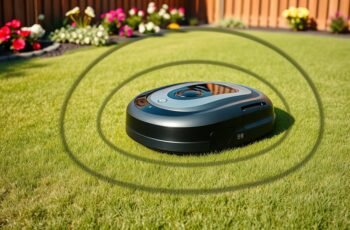
Proper installation and ongoing maintenance are vital to maximizing the efficiency and longevity of your robotic lawn mower. Correct setup guarantees ideal lawn mowing and consistent garden upkeep, preventing operational issues. Essential steps include precise boundary wire placement and secure charging station positioning. Regular maintenance involves cleaning blades, checking sensors, and updating firmware to sustain performance.
| Task | Purpose |
|---|---|
| Boundary wire adjustment | Guarantee accurate perimeter detection |
| Blade inspection | Maintain cutting efficiency |
| Firmware updates | Enhance operational stability |
| Sensor cleaning | Improve obstacle detection |
| Battery monitoring | Maximize lifespan and performance |
Adhering to these practices minimizes downtime and preserves the mower’s efficiency, making certain reliable garden maintenance and ideal lawn mowing results.
Common Mistakes to Avoid When Buying Your First Robot Mower
When selecting a robot mower, we must carefully consider battery life to guarantee it can handle the size of your lawn without frequent recharging. Ignoring terrain compatibility can lead to operational failures, especially on uneven or complex landscapes. Addressing these factors upfront helps prevent costly mistakes and optimizes long-term performance.
Overlooking Battery Life Limits
Have you considered how battery life impacts the overall effectiveness of a robot mower? Battery capacity directly influences operation duration, while charging times determine how quickly the mower can resume work. Overlooking these limits can lead to incomplete mowing sessions or frequent downtime.
Key considerations include:
- Ensuring the battery capacity matches your lawn size for extended runtime
- Evaluating charging times to minimize idle periods
- Recognizing that higher capacity batteries often mean longer charging durations
- Balancing battery size against mower weight and maneuverability
Understanding these factors helps prevent performance gaps and ensures continuous coverage. Optimizing battery capacity and charging times guarantees your mower maintains consistent operation, avoiding the common mistake of selecting a model that can’t handle your lawn’s demands efficiently.
Ignoring Terrain Compatibility
Ignoring terrain compatibility can substantially hinder a robot mower’s performance, especially on uneven or complex landscapes. A terrain mismatch occurs when the mower’s design doesn’t accommodate specific features like steep slopes or irregular terrain. Many models have slope limitations, which, if ignored, can lead to mechanical stress, inefficient cutting, or even safety hazards. Failing to assess the terrain beforehand may result in frequent stalls or damage, reducing the mower’s lifespan and effectiveness. It’s vital to evaluate the landscape’s incline and surface type to select a model with appropriate slope capabilities. By understanding these technical parameters, we guarantee the mower operates reliably without risking operational failure due to unanticipated terrain challenges. Proper terrain compatibility is essential for consistent, safe, and efficient mowing.
How to Find the Best Deals and Read Customer Reviews
To secure the best deals on a robot lawn mower, we must systematically compare pricing across multiple retailers and explore available discounts, such as seasonal sales or bundle offers. Employing effective pricing strategies involves tracking price fluctuations and leveraging price match policies. Simultaneously, analyzing customer feedback provides critical insights into product reliability and performance, ensuring value for investment. To optimize decision-making, consider these factors:
- Cross-referencing prices on reputable platforms
- Monitoring promotional campaigns and seasonal discounts
- Evaluating customer reviews for consistency and authenticity
- Prioritizing products with high satisfaction ratings and detailed feedback
Frequently Asked Questions
Are Robotic Mowers Suitable for Uneven or Hilly Lawns?
Robotic mowers can handle uneven or hilly lawns if they have robust battery life and adaptive mowing patterns. We analyze terrain features and select models with higher torque and longer runtime, ensuring efficient, consistent coverage without strain.
How Noisy Are Robotic Lawn Mowers During Operation?
Imagine a whisper in the wind—that’s roughly how quiet robotic lawn mowers are. Their noise levels and motor sounds are minimal, typically comparable to a soft conversation, making them ideal for noise-sensitive environments.
Can Robotic Mowers Handle Thick or Tall Grass?
Robotic mowers can handle thick or tall grass effectively if they have sufficient mower power, but extremely dense or tall grass may challenge their blades and motor, requiring models with higher power ratings for peak performance in varying grass thickness.
What Safety Features Should I Check Before Purchasing?
Did you know 85% of robotic mower accidents involve lack of safety features? We check for sensors that detect obstacles, emergency stop functions, and secure battery life to guarantee safe, efficient mowing patterns and prevent potential hazards before buying.
How Long Do Robotic Mowers Typically Last?
Robotic mowers typically last 3-8 years, depending on battery lifespan and maintenance. Regular maintenance, such as blade checks and battery care, extends their longevity, ensuring peak performance over their expected lifespan.
Conclusion
In summary, choosing the right robot lawn mower is like planting the seed for a well-tended garden—careful planning and informed decisions guarantee lush, uniform growth. By analyzing your lawn’s landscape, prioritizing key features, and staying vigilant with maintenance and reviews, we set the stage for a seamless mowing experience. Remember, a thoughtful investment today cultivates a landscape that thrives tomorrow, transforming your yard into a meticulously managed masterpiece with the precision of a seasoned gardener.