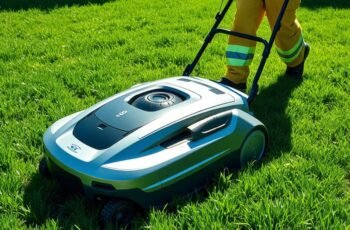
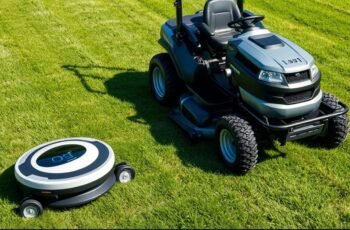
Time, the relentless arbiter of productivity, often dictates our lawn care routines, yet technological advancements challenge this norm. When comparing the efficiency of robot lawn mowers to manual methods, it becomes clear that automation can markedly reduce the time investment required for maintenance. Understanding the nuances of these time savings, however, involves analyzing various factors that influence performance and suitability. As we explore these differences, you’ll discover why many consider robot mowers a strategic upgrade for optimizing lawn care efficiency.
Key Takeaways
- Robot mowers operate autonomously for multiple sessions daily, significantly reducing overall lawn maintenance time.
- They complete mowing in 30 minutes to two hours, faster than manual sessions lasting 30-60 minutes.
- Frequent, scheduled mowing prevents overgrowth, decreasing manual trimming and cleanup efforts.
- Advanced navigation and obstacle avoidance enable efficient coverage, saving time on complex or irregular lawns.
- Properly calibrated robots with high-capacity batteries ensure continuous operation, maximizing time efficiency on large areas.
How Do Robot Lawn Mowers Save Time Compared to Manual Mowing?
While manual mowing requires scheduled effort and physical labor, robot lawn mowers considerably reduce the time investment by operating autonomously and continuously. This automation enhances lawn aesthetics through consistent cutting, preventing uneven growth and patchiness. Unlike traditional methods, these devices can run multiple sessions daily, maintaining a pristine appearance with minimal human intervention. Additionally, robot mowers operate at low noise levels, allowing for frequent, discreet mowing without disrupting daily routines or neighbors. Their precise navigation systems optimize coverage, reducing redundant passes and ensuring efficient use of time. Overall, the combination of autonomous operation, enhanced lawn aesthetics, and minimal noise disturbance markedly shortens the time required for lawn maintenance compared to manual mowing, offering a practical, time-saving solution for landscape management.
Average Mowing Time for Traditional Lawn Care Methods
Traditional lawn care methods typically require an average mowing time of 30 to 60 minutes per session for a standard residential yard. This duration depends heavily on factors like lawn size, equipment efficiency, and operator proficiency. Mowing duration directly impacts lawn health, as uneven or infrequent cutting can stress grass and compromise soil conditions. Proper mowing frequency and technique promote healthier turf and peak soil aeration. Key considerations include:
- Lawn size and complexity
- Equipment power and maneuverability
- Operator experience and efficiency
- Variability in soil conditions affecting cutting speed
While manual methods can be time-consuming, they allow for detailed attention to lawn health and soil conditions, ensuring peak grass growth. However, these factors contribute to the variability in average mowing time across different residential landscapes.
How Long Do Robot Lawn Mowers Typically Take to Mow a Lawn?
Robot lawn mowers substantially reduce the time required to maintain a lawn compared to manual methods. Typically, they complete mowing sessions within 30 minutes to two hours, depending on lawn size and complexity. For lawns under half an acre, many models finish in about 30-60 minutes, providing consistent coverage without interruption. Their efficiency supports maintaining a uniform lawn aesthetic, as they mow frequently and evenly. Noise levels are generally low, often around 60-70 decibels, minimizing disruption during operation. This allows for flexible scheduling and less disturbance, even during active hours. The precise timing depends on factors like grass height and mower navigation capabilities, but overall, robot mowers considerably cut down on maintenance time while ensuring a neat, uniform appearance with minimal noise disturbance.
Factors That Influence Robot Mower Efficiency and Speed
Several key factors directly impact the efficiency and speed of robot lawn mowers, with terrain complexity, grass height, and mower specifications playing significant roles. Weather conditions influence mowing performance, as rain or high humidity can reduce traction and increase mowing time. Grass height affects cutting efficiency; taller grass requires more power and time, especially if uneven. Mower specifications, such as blade design, battery capacity, and navigation algorithms, determine how quickly and effectively the mower operates.
- Terrain complexity (slopes, obstacles)
- Weather conditions (rain, humidity)
- Grass height and density
- Mower technical features (battery, blades)
Comparing Daily and Weekly Time Savings With Robot Mowers
Analyzing daily versus weekly mowing schedules reveals significant impacts on consistent lawn maintenance and operational flexibility. Daily mowing guarantees uniform grass height and reduces manual intervention, while weekly schedules may introduce irregularities and increased labor. Understanding these differences helps optimize time savings and maintenance consistency for various user needs.
Consistent Lawn Maintenance
How does the frequency of lawn maintenance impact time savings when using robot mowers? Frequent mowing guarantees a more uniform cut, promoting healthier turf and simpler lawn care routines. Daily trimming maintains consistent grass height, reducing the need for extensive cleanup and adjustments, which benefits garden design by preserving aesthetic appeal. Weekly mowing, however, can lead to overgrowth, requiring more time-consuming interventions and disrupting the lawn’s visual harmony.
Key points include:
- Daily mowing minimizes the need for manual trimming and edging
- More consistent grass height supports healthier growth
- Reduces overall maintenance time by preventing overgrowth
- Promotes uniform appearance, enhancing garden design
Ultimately, increased frequency in robot mower use streamlines lawn care, providing predictable, efficient time savings.
Time Flexibility Benefits
Comparing daily and weekly mowing schedules with robot mowers reveals significant differences in time flexibility and efficiency. Daily mowing allows for more consistent turf management, enhancing user engagement through frequent, manageable sessions. Weekly schedules, however, require less frequent intervention but risk uneven growth. Community feedback indicates users appreciate the adaptability of daily mowing for busy lifestyles, while others favor weekly routines for simplicity. The table below illustrates these distinctions:
| Schedule Type | Time Commitment | User Engagement Impact |
|---|---|---|
| Daily | 15–30 min/day | High, frequent interaction |
| Weekly | 1–2 hours/week | Lower, less engagement |
| Flexibility | Adjustable | Meets diverse user needs |
This analysis emphasizes that daily schedules maximize time flexibility, optimizing lawn health and user satisfaction through tailored routines.
How to Maximize Your Robot Lawn Mower’s Time Benefits
To fully leverage the time-saving potential of your robot lawn mower, it’s essential to optimize its operational parameters and maintenance routines. Properly adjusting mowing schedules based on garden design and seasonal planting ensures efficient coverage and reduces unnecessary overlaps. Regularly calibrate sensor settings to adapt to varying terrain and obstacles, preventing operational delays. Additionally, scheduling maintenance such as blade sharpening and battery checks minimizes downtime.
Optimizing mowing schedules, calibrating sensors, and routine maintenance maximize your robot mower’s efficiency and minimize downtime.
To maximize efficiency, consider:
- Tailoring mowing patterns to complement garden design and reduce trimming time
- Adjusting mowing frequency in response to seasonal planting growth rates
- Utilizing programmable zones to focus mowing on high-traffic areas
- Conducting routine diagnostics to identify and address potential issues proactively
Real-Life Examples of Time Saved Using Robot Mowers
Real-life implementations of robot lawn mowers demonstrate significant time savings across diverse yard sizes and complexities. In practical scenarios, users report reducing manual mowing time by up to 80%, thanks to consistent, scheduled operation. Proper grass type selection plays a vital role, as resilient, low-maintenance grasses ensure maximum mowing efficiency and minimal lawn mower maintenance. Automated mowing reduces the need for trimming and edging, further conserving time. Additionally, the ability of robot mowers to adapt to various terrain and grass conditions streamlines lawn care routines. These examples highlight that, with appropriate grass selection and routine maintenance, robot mowers deliver measurable time savings, especially when compared to traditional methods that demand more frequent manual intervention and upkeep.
Are Robot Mowers Suitable for Large or Complex Lawns?
We need to take into account whether robot mowers can effectively navigate complex terrains, especially in areas with obstacles or irregular layouts. Battery capacity and coverage area are critical factors when evaluating their performance on large lawns, influencing mowing duration and frequency. Additionally, cutting efficiency must be assessed to determine if these devices can maintain quality results across extensive or intricate landscapes.
Maneuverability in Complex Areas
Are robot mowers capable of efficiently maneuvering large or intricately shaped lawns? Yes, but their effectiveness depends on obstacle navigation and terrain adaptability. Modern models employ advanced sensors and algorithms to handle complex terrain, allowing them to navigate around obstacles like trees, flower beds, and uneven ground. Their ability to adapt to varied surface conditions ensures thorough coverage without manual intervention. Key aspects include:
- Precise obstacle detection and avoidance mechanisms
- Adaptive algorithms for irregular terrain
- Multi-directional navigation for complex layouts
- Efficient path planning to minimize mowing time
These features enable robot mowers to operate effectively even in challenging environments, making them suitable for large or complex lawns when equipped with sophisticated obstacle navigation systems and terrain adaptability capabilities.
Battery Life and Coverage
When evaluating robot lawn mowers for large or complex lawns, battery life and coverage are crucial factors. Battery longevity directly influences the mower’s ability to operate continuously without frequent recharging, which is essential for extensive coverage areas. High-capacity batteries enable extended mowing sessions, reducing downtime and increasing overall efficiency. However, the required coverage area can vary considerably, and not all models sustain sufficient battery life for large properties. For complex lawns with irregular shapes or obstacles, efficient battery management becomes even more imperative to ensure thorough mowing without interruption. Ultimately, selecting a mower with optimized battery longevity aligned with the specific coverage area ensures reliable performance, minimizes operational disruptions, and maximizes time savings across diverse lawn configurations.
Cutting Efficiency on Large Lawns
When considering the suitability of robot lawn mowers for large or complex lawns, evaluating their cutting efficiency becomes essential. These machines must maintain consistent lawn aesthetics while minimizing noise pollution. On large terrains, efficiency depends on blade design, power, and navigation algorithms. Key factors include:
- Cutting pattern accuracy, ensuring even coverage across intricate lawn layouts
- Power and blade sharpness, critical for dense or tall grass
- Navigation algorithms, which affect the mower’s ability to handle slopes and obstacles
- Noise levels, influencing the potential for noise pollution in residential areas
While robot mowers are generally effective for large lawns, their effectiveness diminishes with highly complex landscapes, requiring strategic placement or additional manual trimming. Proper evaluation ensures peak performance and lawn quality maintenance.
Key Considerations for Choosing a Time-Saving Lawn Care Solution
Selecting the appropriate time-saving lawn care solution requires a careful analysis of several vital factors that influence both efficiency and long-term performance. First, it’s imperative to distinguish fact from lawn care myths, such as the belief that robotic mowers require minimal seasonal maintenance. In reality, seasonal adjustments optimize mower performance and lifespan. We must evaluate terrain complexity, compatibility with existing infrastructure, and automation capabilities. Durability and reliability are essential, especially considering weather variations that impact mowing schedules and energy consumption. Additionally, understanding the system’s ability to adapt to lawn growth patterns ensures consistent results. By scrutinizing these factors, we can choose solutions that minimize manual effort, maximize efficiency, and deliver sustainable, long-term benefits for lawn management.
Frequently Asked Questions
Can Robot Lawn Mowers Operate in All Weather Conditions?
Robot lawn mowers generally aren’t suitable for all weather conditions due to limited weather adaptability; heavy rain or snow impairs terrain handling, risking damage or inefficiency. We recommend monitoring weather forecasts for ideal operation and safety.
How Often Should I Schedule Maintenance for Optimal Time Savings?
We suggest maintenance every 2-4 weeks for ideal scheduling; neglecting this can negate time savings. Regular checks guarantee efficiency, highlighting the irony that minimal effort maximizes convenience, underscoring the importance of consistent maintenance.
Do Robot Mowers Require Supervision During Mowing Sessions?
We believe robot mowers generally don’t need supervision thanks to autonomous navigation and battery life management. However, occasional oversight guarantees peak performance, especially during initial setup or challenging terrain, maximizing efficiency and minimizing downtime.
Are There Safety Features to Prevent Accidents With Pets or Children?
Like a vigilant guardian, our robot mowers feature advanced sensors, ensuring pet safety and child protection by stopping instantly when detecting obstacles. These safety features minimize risk, offering a technically reliable solution for secure, autonomous lawn maintenance.
How Do Robot Mowers Handle Uneven or Sloped Terrains?
Robot mowers employ advanced terrain adaptation and obstacle maneuvering technologies, allowing them to efficiently handle uneven or sloped terrains by adjusting cutting height and maneuvering around obstacles, ensuring consistent lawn maintenance without human intervention.
Conclusion
In summary, adopting robot lawn mowers transforms lawn care into a near-instantaneous process, saving us hours each week—hours we can reinvest in more critical pursuits or leisure. Their efficiency surpasses manual methods by leaps and bounds, reducing effort and maximizing time savings exponentially. With ongoing advancements, these devices are evolving into indispensable tools—redefining what’s possible in lawn maintenance and freeing us from the tyranny of time-consuming mowing routines.