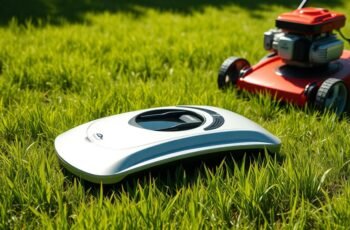
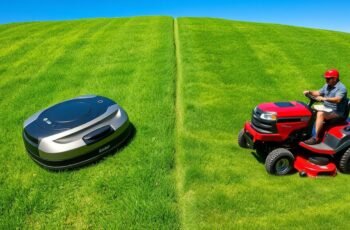
When comparing the costs of robot mowers and conventional models, it’s important to contemplate both initial investment and ongoing expenses. While robot mowers typically require a higher upfront payment, their lower maintenance and energy costs can alter the overall financial picture. Understanding how these factors balance out over time helps determine which option offers better value for different budgets and lawn sizes, prompting us to examine the long-term implications more closely.
Key Takeaways
- Robot mowers typically cost $600–$2,000, while conventional push mowers range from $200–$400, affecting initial budget choices.
- Long-term, robot mowers have lower maintenance and fuel costs, potentially offsetting their higher upfront price.
- Conventional mowers may incur higher repair and fuel expenses over time compared to the lower ongoing costs of robot mowers.
- For small lawns, robot mowers are quieter and more cost-effective; large lawns may favor conventional mowers for efficiency.
- Total cost-effectiveness depends on initial investment, maintenance, energy, and repair costs, with robot mowers often offering better long-term value.
How Do Robot Mower and Conventional Mower Costs Compare Initially?
When comparing the initial costs of robot mowers and conventional mowers, the differences are substantial and rooted in their distinct technologies and features. Robot mowers typically have a higher purchase price, often ranging from $600 to $2,000, due to advanced automation, sensors, and navigation systems. Conventional mowers are generally less expensive upfront, with push models costing $200-$400 and riding mowers reaching $3,000 or more. Safety concerns play a role here: robot mowers include safety features like obstacle detection, which can add to costs, but they also reduce human risk during operation. Additionally, environmental impact influences initial costs; robot mowers are designed to be eco-friendly, often requiring less fuel or electricity initially, which can justify their higher upfront investment.
What Are the Long-Term Expenses of Robot Mowers Versus Traditional Mowers?
When examining long-term expenses, maintenance and repair costs are essential factors, as robot mowers generally require less frequent service but may have higher replacement parts for specific components. Fuel and energy consumption also differ considerably, with traditional mowers relying on gasoline and robot mowers depending on electricity, which impacts ongoing costs. Analyzing these aspects helps clarify which mower type offers better economic value over time.
Maintenance and Repair Costs
Although robot mowers often have higher upfront costs, their long-term maintenance and repair expenses tend to be lower than those of traditional mowers, primarily due to their simplified mechanical components and fewer moving parts. Battery longevity plays a vital role; high-quality batteries generally last several years, reducing replacement frequency and cost. Additionally, spare parts for robot mowers are often standardized and more readily available, simplifying repairs. In contrast, traditional mowers require regular servicing of engines, blades, and belts, which can accrue significant expenses over time. The reduced complexity of robot mowers results in fewer breakdowns and less frequent repairs, ultimately lowering ongoing maintenance costs. While initial investments are higher, the streamlined design and durable components contribute to more predictable, lower long-term expenses.
Fuel and Energy Expenses
Robot mowers generally operate more efficiently in regard to energy consumption compared to traditional gas-powered mowers, which rely heavily on fuel over the long term. Their power efficiency stems from optimized motor technology and intelligent routing algorithms, reducing unnecessary energy use. Battery longevity is a key factor in long-term costs; high-quality batteries maintain performance over many charge cycles, decreasing replacement frequency. Conversely, traditional mowers incur ongoing fuel expenses, which fluctuate with fuel prices and usage patterns. While initial costs for robot mowers may be higher, their reduced energy costs and minimal maintenance expenses balance this out over time. Overall, robot mowers offer a more predictable and cost-effective energy profile, with consistent power efficiency and longer-lasting batteries driving down long-term fuel and energy expenses.
How Does Maintenance and Repair Impact Overall Costs for Both Mower Types?
Maintenance and repair costs considerably influence the overall expense of both robot and conventional mowers, though they impact each differently. For robot mowers, factors like battery lifespan are critical, as replacing batteries can be costly but is typically needed every few years. Warranty coverage plays a significant role in mitigating repair expenses, often covering major components within the initial years. Conventional mowers, on the other hand, tend to require more frequent repairs to engine parts, blades, and fuel systems, leading to ongoing expenses. While their repair costs can be higher over time, these are often predictable and easier to budget for. Overall, understanding warranty terms and component longevity helps us evaluate long-term maintenance costs for both mower types more accurately.
Which Mower Offers Better Value for Different Budget Ranges?
When evaluating value across different budget ranges, it’s essential to take into account both upfront costs and long-term expenses. For lower budgets, conventional mowers generally provide immediate affordability, but they often incur higher ongoing costs for fuel, maintenance, and repairs. Conversely, robot mowers tend to have higher initial prices but reduce operational costs over time.
Consider these factors:
- Upfront expenditure: Robot mowers require a significant initial investment, whereas conventional mowers are more budget-friendly initially.
- Long-term savings: Robot mowers typically lower ongoing costs, especially with less fuel consumption and minimal maintenance.
- Safety and environmental impact: Robot mowers are safer, with fewer safety concerns, and they have a reduced environmental impact due to electric power.
Are There Hidden Costs Associated With Robot or Conventional Mowers?
While initial costs are often the primary consideration when choosing between robot and conventional mowers, it’s important to recognize that both options can entail hidden expenses that influence overall affordability. Hidden expenses may include maintenance costs, battery replacements, or unexpected repairs that aren’t covered under standard warranty coverage. For robot mowers, these costs can arise from replacing batteries or sensors, which can be costly over time. Conventional mowers may incur expenses for engine repairs or parts not included in basic warranty coverage. Additionally, extended warranties can help mitigate some of these hidden costs, but they come with their own upfront costs. Understanding the potential for these hidden expenses is vital to evaluating the true long-term affordability of either mower type.
How Can Homeowners Decide Which Mower Fits Their Budget and Lawn Care Needs?
To determine the best mower for our budget and lawn, we need to assess both upfront costs and ongoing expenses, including maintenance and energy use. Lawn size plays a vital role, as larger areas may justify investing in a robotic mower with higher initial costs but lower long-term labor. By analyzing these factors, homeowners can make a precise decision that aligns with their financial limits and lawn care requirements.
Budget Compatibility Assessment
Evaluating which mower best fits a homeowner’s budget and lawn care needs requires a careful comparison of upfront costs, ongoing maintenance expenses, and feature sets. To do this effectively, consider these factors:
- Warranty coverage: Longer warranties often indicate higher quality and lower potential future costs, impacting overall affordability.
- Brand reputation: Established brands tend to offer reliable performance and better customer support, reducing unexpected expenses.
- Initial investment versus long-term savings: While robot mowers may have higher upfront costs, their lower maintenance and operation costs can offset initial expenses over time.
Lawn Size Considerations
Determining the appropriate mower for your lawn size is essential in aligning your budget with your lawn care needs. Larger lawns typically demand more powerful equipment to maintain desired lawn aesthetics efficiently, whether with a robot mower or conventional mower. Noise levels also vary; robotic mowers are generally quieter, making them suitable for noise-sensitive environments. To better understand the considerations, see the table below:
| Lawn Size | Suitable Mower Type | Key Factors |
|---|---|---|
| Small | Robot mower | Cost-effective, quiet operation, precise |
| Medium | Both options viable | Balance of noise, power, and budget |
| Large | Conventional mower | Higher capacity, faster coverage, noise |
Choosing based on lawn size ensures you meet your aesthetic goals while staying within budget constraints.
Maintenance and Operating Costs
Understanding the ongoing costs associated with different mower types is essential for homeowners aiming to align their choices with their budgets and lawn maintenance needs. With robot mowers, key factors include battery life, which impacts replacement frequency and charging costs, and noise levels, often considerably lower than conventional mowers, reducing disturbance costs. Conventional mowers, on the other hand, typically involve higher fuel and maintenance expenses.
Consider these factors:
- Battery replacement frequency for robot mowers affects long-term costs.
- Fuel and oil consumption for traditional mowers can increase operating expenses.
- Noise levels influence permitted mowing hours and potential neighbor disputes, indirectly affecting costs.
Evaluating these costs helps homeowners decide which mower aligns with their budget and lawn care priorities.
Frequently Asked Questions
What Is the Typical Lifespan of Robot Versus Conventional Mowers?
We find robot mowers typically last 5-8 years, thanks to battery longevity and lower maintenance frequency, whereas conventional mowers often endure 8-12 years but require more frequent repairs and upkeep, impacting overall lifespan.
Are There Financing Options Available for Robot Mowers?
We find that many retailers offer flexible financing options and payment plans for robot mowers, making them more accessible. These options enable consumers to spread costs over time, enhancing affordability without compromising on advanced features and convenience.
How Do Warranty Periods Differ Between Mower Types?
We find that robot mower warranties often offer coverage for 1-2 years, reducing repair costs early on, while conventional mowers tend to have longer warranties, typically 3-5 years, which can lower repair costs over time.
Do Robot Mowers Increase Property Value?
A picture is worth a thousand words, and robot mowers boost landscaping aesthetics with sleek, uniform cuts, enhancing property value. Their maintenance convenience appeals to buyers seeking modern, low-effort solutions, potentially increasing your home’s market appeal.
What Are the Environmental Impacts of Each Mower Type?
We find robot mowers considerably reduce noise pollution and carbon footprint compared to conventional mowers, which emit more noise and greenhouse gases. This makes robot mowers a more environmentally friendly choice, promoting cleaner air and quieter neighborhoods.
Conclusion
In evaluating costs, we see that while robot mowers require a higher initial investment—say, $1,200—they can save us money over time through lower energy and maintenance expenses. For instance, a homeowner with a medium-sized lawn might spend $300 annually on a traditional mower’s fuel and repairs, versus minimal costs with a robot mower. Ultimately, considering upfront costs against long-term savings helps us choose the best mower aligned with our budget and lawn care goals.