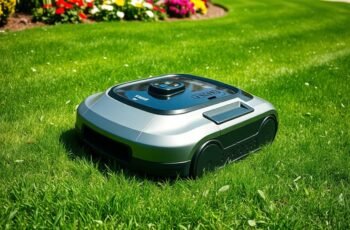
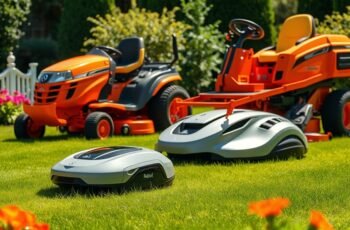
Many believe that choosing between a robot mower and a lawn care service is simply a matter of budget, but the truth might be more complex. Both options promise a tidy yard, yet their methods and impacts differ markedly—one relies on quiet, automated precision, the other on human expertise and effort. As we explore their strengths, limitations, and suitability for various landscapes, you’ll see why this decision isn’t as straightforward as it seems.
Key Takeaways
- Robot mowers offer continuous, uniform cutting with minimal effort, ideal for small or detailed lawns.
- Lawn care services handle larger, complex terrains with comprehensive tasks like edging and fertilizing.
- Robot mowers have higher initial costs but lower ongoing maintenance compared to recurring lawn service fees.
- Lawn services provide professional shaping and detailed care, especially for uneven or extensive landscapes.
- Robot mowers are eco-friendly, quiet, and energy-efficient, reducing environmental impact for smaller yards.
How Do Robot Mowers and Lawn Care Services Differ in Functionality?
While both robot mowers and lawn care services aim to keep your yard tidy, they do so in fundamentally different ways that highlight their unique functionalities. Robot mowers rely on advanced automated technology, guiding your lawn with sensors and algorithms that mimic a human touch. They continuously trim, maintaining an even, healthy grass height. Lawn care services, on the other hand, deploy human crews with equipment, offering a thorough approach—mowing, edging, fertilizing—all in one visit. Environmentally, robot mowers have a smaller impact, often operating quietly and with low energy consumption, reducing emissions and noise pollution. This automation promotes sustainable lawn maintenance, making them a more eco-friendly choice for those seeking efficiency paired with environmental consciousness.
Which Option Saves You More Time and Effort?
When it comes to freeing up your schedule and reducing the hassle of lawn maintenance, the choice between a robot mower and a lawn care service can considerably impact how much time and effort you need to invest. Robot mowers operate quietly, often blending seamlessly into your garden aesthetics without disturbing the peace, making them ideal for regular, unattended trimming. They consistently maintain a neat, manicured look with minimal oversight, saving you countless hours. In contrast, lawn care services can be more time-consuming upfront, involving scheduling, driving, and coordination. While they can handle larger or more complex landscapes, they require active involvement on your part. Overall, a robot mower generally saves more effort and time, especially if you value tranquility and a well-kept garden with minimal intervention.
What Are the Costs and Maintenance Requirements for Each?
Considering the costs and maintenance needs, robot mowers typically demand a significant upfront investment but tend to be more economical over time due to their minimal ongoing expenses. They require little more than occasional blade replacements and software updates, preserving equipment durability. Lawn care services, on the other hand, involve recurring costs for labor, fuel, and potential equipment breakdowns, impacting garden aesthetics with inconsistent service quality.
Here’s a quick breakdown:
- Initial Investment – Robot mowers have a higher purchase price but reduce long-term costs.
- Maintenance – Robot mowers need minimal upkeep; lawn services require regular scheduling.
- Durability – Robot mowers are built to withstand weather, ensuring consistent performance.
- Cost Efficiency – Over time, robot mowers often save money while maintaining a pristine lawn.
How Do Quality and Lawn Results Compare?
The quality of lawn results from a careful balance of precision, consistency, and timing, whether using a robot mower or hiring a traditional lawn care service. Robot mowers deliver a uniform cut, enhancing aesthetic appeal with neat, evenly trimmed grass, while their frequent, small trims promote healthier growth. Traditional services may provide expert shaping and detailed care, creating a lush, manicured look. Environmentally, robot mowers typically have a lower impact—they operate quietly and use less energy, reducing emissions. Lawn care services might rely on fuel-powered equipment, increasing carbon footprint. Ultimately, both methods can achieve beautiful lawns, but robot mowers excel in maintaining a consistent, eco-friendly appearance, emphasizing sustainability and minimal disruption to the environment.
Which Is Better Suited for Different Lawn Sizes and Types?
Ever wonder which lawn maintenance method adapts best to your yard’s size and terrain? For smaller, intricate lawns, robot mowers excel, maintaining garden aesthetics without disrupting delicate plant arrangements. Larger, uneven terrains benefit more from a professional lawn care service, which can navigate complex landscapes and adapt to varied grass types.
Robot mowers are ideal for small, intricate lawns, ensuring beauty without disturbing delicate plants.
Consider these factors:
- Size and complexity—robot mowers are perfect for compact, manageable spaces.
- Terrain—rough or hilly areas often require professional expertise.
- Garden aesthetics—precision trimming supports a pristine look with minimal disturbance.
- Environmental impact—robot mowers reduce emissions, making them more eco-friendly for small yards, while larger lawns may need environmentally conscious mowing practices from services.
Frequently Asked Questions
Are Robot Mowers Suitable for Uneven or Hilly Terrains?
Robot mowers can handle uneven, hilly terrains thanks to their terrain adaptability and slope navigation features; we’ve seen them conquer slopes up to a certain degree, making outdoor maintenance easier on challenging landscapes.
How Environmentally Friendly Are Robot Mowers Compared to Traditional Services?
Sure, robot mowers are eco-friendly heroes—minimizing noise pollution and reducing carbon footprints—making traditional lawn care look like a loud, smog-belching relic. Who knew cutting grass could be so green and serene?
Can Robot Mowers Handle Different Grass Types Effectively?
We find that robot mowers, with their adaptive technology, handle different grass types remarkably well, adjusting for variations in grass consistency. Their mower adaptability guarantees a smooth, even cut, no matter the grass’s unique texture or height.
What Safety Features Do Robot Mowers Include to Prevent Accidents?
Like vigilant guardians, robot mowers wield safety sensors and an emergency stop, acting swiftly to halt when danger lurks. These features guarantee our yard patrols are secure, preventing accidents and giving us peace of mind while they work.
How Does Weather Impact the Performance of Robot Mowers?
Weather conditions can substantially impact robot mower performance, causing delays or reduced mowing accuracy during rain, snow, or high humidity. We find that extreme weather challenges the mower’s sensors and blades, emphasizing the need for weather-aware features.
Conclusion
Ultimately, choosing between a robot mower and a lawn care service is like picking between a superhero sidekick and a seasoned hero—each has its own superpowers. For routine upkeep, our little robotic helper is a game-changer, transforming lawn care into a breeze. But for those tricky, sprawling terrains, a professional service is your ultimate champion. Whichever path you take, remember, your lawn’s transformation will be nothing short of legendary—like turning a jungle into a lush paradise overnight!