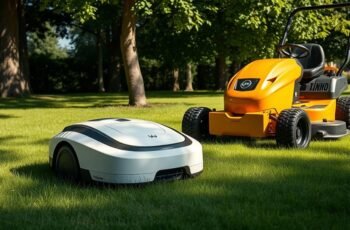
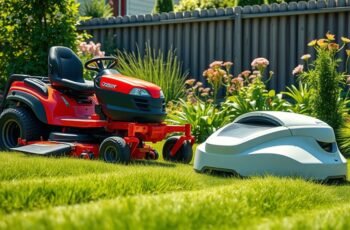
Studies show that robotic lawn mowers can reduce manual labor by up to 80%, offering a significant shift in lawn care efficiency. While they promise consistent, precise cuts with minimal effort, weighing their advantages against traditional models involves complex considerations. From upfront costs to environmental impact, understanding how these options differ can directly influence long-term satisfaction and maintenance. This comparison reveals nuanced trade-offs that are essential to making an informed decision—something we’re enthusiastic to explore further.
Key Takeaways
- Robot mowers offer automated, precise, and uniform lawn trimming with minimal effort, unlike traditional mowers requiring manual operation.
- They typically have higher upfront costs but lower ongoing expenses and environmental impact compared to traditional gas-powered models.
- Robot mowers provide convenience with smart navigation and user-friendly controls, suitable for small to medium, flat yards.
- Traditional mowers excel in complex, large, or uneven landscapes, offering more control for detailed landscaping tasks.
- Maintenance for robotic mowers is less frequent due to self-sharpening blades, but regular cleaning and battery checks are still necessary.
What Are the Main Differences Between Robot and Traditional Lawn Mowers?
While both robot and traditional lawn mowers serve the same fundamental purpose—maintaining a well-kept lawn—they differ markedly in their design, operation, and technological capabilities. Robot mowers are autonomous devices equipped with sensors and programmable features, enabling precise, consistent trimming that enhances lawn aesthetics. They operate quietly, substantially reducing noise levels compared to traditional mowers, which rely on internal engines and mechanical components that generate substantial noise pollution. Traditional mowers are manually operated, often requiring more effort and time, with less control over cutting patterns. In contrast, robot mowers offer automated, uniform coverage, contributing to a more manicured appearance with minimal human intervention. These distinctions underscore fundamental differences in efficiency, environmental impact, and the overall aesthetic quality of the maintained lawn.
How Do Robot and Traditional Mowers Compare in Cost?
Cost considerations play a significant role when comparing robot lawn mowers to traditional models, as initial investment and ongoing expenses vary substantially. An extensive cost analysis reveals that robot mowers typically have higher upfront costs due to advanced technology and autonomous features, with purchase options ranging from mid-range to premium prices. In contrast, traditional mowers generally involve lower initial purchase prices but incur ongoing costs such as fuel, maintenance, and replacements. Over time, these recurring expenses can offset the initial savings of a traditional mower. When evaluating purchase options, it’s important to take into account both short-term affordability and long-term operational costs. While robot mowers demand a larger initial investment, their lower maintenance and labor costs can balance out expenses, making them a potentially cost-effective solution over the lifespan of the equipment.
Which Type Offers Better Convenience and Ease of Use?
Robot lawn mowers are designed to maximize convenience through automation and minimal user intervention, making them highly accessible for users seeking ease of operation. Their smart navigation systems enable precise, efficient coverage, reducing the need for manual adjustments and oversight. The user interface on these devices often features intuitive controls, smartphone connectivity, and customizable settings, streamlining the mowing process. This contrasts sharply with traditional mowers, which require manual operation and physical effort. The automation capabilities of robot mowers mean users spend less time on maintenance and more on other tasks. Overall, the combination of smart navigation and user-friendly interfaces makes robot mowers superior in delivering a hassle-free, convenient lawn care experience.
How Do Performance and Lawn Quality Vary Between the Two?
We observe that robot mowers typically offer consistent cutting patterns and precise edge trimming due to their automated navigation, leading to uniform lawn appearance. In contrast, traditional mowers often produce variable results depending on operator skill, which can impact lawn health and uniformity. Evaluating these differences helps determine the overall quality and long-term effects on lawn well-being.
Cutting Precision and Pattern
While traditional mowers rely on manual control and fixed cutting paths, robotic lawn mowers utilize advanced algorithms and sensors to achieve precise, uniform cuts across varied terrain. This technology enhances aesthetic appeal by maintaining consistent grass height and trimming edges neatly. Robotic mowers systematically cover the entire lawn, reducing the risk of missed spots or uneven patches. Their patterning results in a more deliberate, grid-like cut, which contributes to a cleaner overall appearance. Additionally, robotic mowers operate with noise reduction, allowing for quieter, more discreet trimming that minimizes disturbance. In contrast, traditional mowers’ manual operation can lead to inconsistent cuts and less refined patterns. Overall, robotic mowers provide superior cutting precision and a more visually pleasing, uniform landscape.
Lawn Uniformity and Health
The consistency of lawn appearance and overall grass health considerably depends on the mowing method employed. Robot mowers tend to produce more uniform cuts, promoting consistent lawn color and minimizing uneven growth. Their precise, frequent trimming prevents grass from becoming too tall or stressed, reducing soil compaction by limiting heavy foot traffic. Traditional mowers, however, may cause irregular patches if not carefully managed, leading to variations in lawn color and increased soil compaction in high-traffic areas. Proper mowing height and frequency directly influence turf health and resilience. Additionally, regular, even cutting encourages dense, healthy growth, while uneven mowing can weaken grass blades and soil structure. Overall, robotic mowing supports superior lawn uniformity and health through consistent performance and minimized soil disturbance.
- Uniformity in grass height and color
- Reduced soil compaction through consistent mowing
- Prevention of uneven patches and stress areas
- Enhanced turf density and resilience
- Continuous, precise trimming promoting healthy growth
Edge Trimming Effectiveness
How effectively do robotic and traditional mowers handle edge trimming, and what implications does this have for lawn quality? Robotic mowers excel in boundary control, utilizing boundary wires to precisely navigate along edges, ensuring consistent edge trimming. However, their limited cutting width often results in less thorough edge coverage compared to traditional mowers, which rely on manual or riding operation to trim edges more thoroughly. Traditional mowers typically produce cleaner, sharper boundary lines due to their ability to focus on edge areas directly. This difference impacts overall lawn uniformity, with robotic mowers potentially leaving uneven or untrimmed borders that require manual touch-ups. Consequently, the choice between the two hinges on the importance of boundary control and the desired level of edge trimming precision for lawn aesthetics.
What Are the Environmental Impacts of Robot vs. Traditional Mowers?
Advancements in lawn-care technology have prompted a comparison of the environmental impacts between robot and traditional mowers. Robot mowers typically produce lower air pollution due to electric operation, reducing emissions compared to gas-powered traditional mowers. They also considerably decrease noise pollution, minimizing disturbance in residential areas. However, the production and disposal of batteries pose environmental concerns, including resource extraction and waste management issues. Traditional mowers contribute more to air pollution through exhaust emissions and generate higher noise levels, affecting both human health and wildlife. Additionally, fuel consumption in traditional mowers results in greater greenhouse gas emissions. Overall, robot mowers offer a cleaner, quieter alternative, but their environmental footprint depends on battery lifecycle management and energy sources.
Robot mowers reduce emissions and noise but depend on battery lifecycle and energy sources for their environmental impact.
- Lower emissions and noise levels
- Reduced air and noise pollution
- Battery lifecycle impacts
- Emissions from fuel combustion
- Energy consumption considerations
What Maintenance Is Required for Each Mower Type?
Both robot and traditional mowers require routine maintenance to guarantee peak performance, with blade sharpening being vital for effective cutting in both cases. Battery health and power system checks are particularly essential for robot mowers, whereas traditional mowers demand regular oil changes and engine inspections. Additionally, consistent cleaning routines help prevent debris buildup that can impair functionality across both mower types.
Blade Sharpening Needs
While traditional mowers rely heavily on regular blade sharpening to maintain cutting efficiency, robotic lawn mowers generally require less frequent maintenance due to their design. The primary focus for traditional mowers is consistent blade maintenance, ensuring sharpness to maximize cutting performance and prevent uneven grass height. Robotic mowers, with their self-sharpening blades or durable materials, reduce the need for frequent intervention, but periodic checks are still advisable.
Key aspects include:
- Regular inspection of blade edges for dullness or damage
- Scheduled sharpening to restore peak cutting efficiency
- Use of high-quality sharpening tools or replacement blades
- Monitoring for uneven cuts indicating blade dullness
- Adjustments to blade alignment to prevent uneven wear
These practices are essential for maintaining effective blade maintenance and consistent cutting efficiency across both mower types.
Battery & Power Checks
Regular battery and power system checks are essential for guaranteeing ideal performance and longevity of both traditional and robotic mowers. For battery longevity, we evaluate charge cycles, voltage levels, and overall health, preventing capacity loss over time. Regular monitoring ensures the battery maintains peak power output, directly influencing power efficiency during operation. In robotic mowers, inspecting battery connections and ensuring proper charging routines help maximize runtime and reduce degradation. Traditional mowers rely on engine diagnostics, such as inspecting fuel systems and air filters, but also benefit from checking electrical components for consistent power delivery. Consistent power checks enable early detection of issues, safeguarding against unexpected failures and maintaining efficient operation. Overall, diligent power system maintenance extends equipment lifespan and sustains top efficiency in both mower types.
Regular Cleaning Routines
How often should we clean our mowers to guarantee ideal performance and longevity? Regular cleaning is essential for excellent lawn care and maintaining garden aesthetics. For robotic mowers, we recommend cleaning the cutting deck and sensors weekly to prevent grass buildup and ensure precise navigation. Traditional mowers require more thorough maintenance: cleaning the air filter, removing grass clippings from blades, and checking for debris in vents monthly. Both types benefit from blade inspections and sharpening every 20-25 hours of use to sustain cutting efficiency. Neglecting routine cleaning can lead to decreased performance, increased wear, and uneven cuts. Consistent maintenance preserves mower functionality, supports healthy turf growth, and enhances the overall appearance of your lawn. Proper routines are critical for achieving professional-grade results.
Which Mower Is Better Suited for Different Yard Sizes and Types?
Determining the most suitable mower for different yard sizes and types hinges on understanding the operational capabilities and limitations of each option. Traditional mowers excel in larger, complex landscapes, providing precision control necessary for detailed garden landscaping and diverse terrain. They are effective for targeted pest control, especially in larger areas where manual intervention allows for strategic application. Conversely, robot lawn mowers are better suited for small to medium yards with uniform surfaces, offering continuous, autonomous operation that maintains consistent grass height. Their limitations include difficulty navigating dense shrubbery or uneven terrain, which can impact garden landscaping efforts. For pest control, traditional mowers allow for targeted trimming that can reduce pest habitats more effectively in varied environments. The choice depends on yard size, landscape complexity, and specific maintenance needs.
How to Decide Which Lawn Mower Fits Your Needs and Budget?
Choosing the right lawn mower involves evaluating both your specific yard requirements and your budget constraints. To make an informed decision, consider factors like smart technology integration, noise pollution levels, and operational costs. Smart technology in robotic mowers offers automated scheduling and boundary mapping, reducing manual effort. Traditional mowers, however, typically lack these features but may be more cost-effective upfront. Noise pollution is a key differentiator; robotic models often operate more quietly, minimizing disturbance. Budget considerations include initial purchase price, maintenance, and energy consumption. It’s crucial to match the mower’s capabilities with your yard’s size and terrain while balancing these factors.
Evaluate yard size, budget, noise, and smart tech features to choose the ideal lawn mower.
- Yard size and terrain compatibility
- Smart technology features
- Noise pollution levels
- Budget constraints
- Long-term maintenance costs
Frequently Asked Questions
Are Robot Mowers Suitable for All Types of Terrain?
We find that robot mowers offer limited terrain versatility, excelling on flat, even surfaces, but struggling with steep slopes or uneven terrains. Their mower adaptability depends on terrain complexity, often requiring specific models for peak performance.
How Do Noise Levels Compare Between Robot and Traditional Mowers?
We find robot mowers considerably quieter than traditional mowers, with noise comparison revealing reduced disturbance. Their advanced safety features, including sensors and obstacle detection, further enhance safety, making robot mowers a more considerate and secure option.
Can Robot Mowers Handle Complex or Irregular Lawn Shapes?
Around 80% of robot mowers excel at complex or irregular lawn shapes, thanks to advanced sensors and mowing precision. They adapt efficiently, ensuring thorough coverage without missing tricky edges or obstacles, unlike traditional mowers.
What Safety Features Do Robot Lawn Mowers Have?
Robot lawn mowers feature safety sensors that detect obstacles and humans, enhancing protection, while their battery life guarantees extended operation, minimizing risks during unattended mowing. These technical features prioritize safety and efficiency in lawn maintenance.
Do Robot Mowers Require Wi-Fi or Internet Connection?
We’ve investigated the theory that robot mowers need Wi-Fi; it’s false for most models. Typically, they require minimal connectivity, mainly for app control or updates, making them compatible with smart home systems without constant internet dependence.
Conclusion
In weighing our options, we see the choice resembles a chess game—strategic and tailored to our unique landscape. Whether we opt for the precision of a robot or the robustness of a traditional mower, each has strengths aligned with specific needs. Like a master gardener tending diverse plots, selecting the right mower guarantees a healthy, vibrant lawn. Ultimately, informed decisions cultivate not just grass, but peace of mind and efficiency.