Did you know that advances in lawn care technology now offer two very different solutions for maintaining your yard? Robot mowers are equipped with sophisticated sensors and programming that enable autonomous operation, while push mowers rely on manual effort and mechanical precision. Choosing between these options involves analyzing design complexity, operational efficiency, and long-term costs. Understanding these differences can profoundly impact your lawn’s health and your time investment—so, what factors should guide your decision?
Key Takeaways
- Robot mowers offer automated, scheduled lawn care, saving time and effort, while push mowers require manual operation and control.
- Robot mowers are ideal for medium to large lawns, providing consistent mowing, whereas push mowers are better for small, intricate areas.
- Robot mowers have higher upfront costs but lower long-term maintenance, with eco-friendly, zero-emission operation.
- Push mowers are cost-effective initially, easier to maneuver, and suitable for precise edging and detailed trimming.
- Robot mowers promote healthier turf with less soil disturbance, supporting sustainable lawn care compared to traditional push mowers.
How Do Robot Mowers and Push Mowers Differ in Design and Operation?
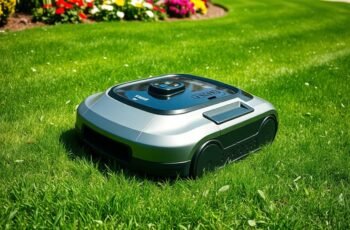
While both robot mowers and push mowers serve the primary function of cutting grass, their designs and operational mechanisms differ markedly. Robot mowers leverage advanced battery technology, typically lithium-ion, enabling continuous operation with minimal maintenance. Their compact, low-profile design facilitates autonomous navigation across uneven terrain, guided by sensors and boundary wires. In contrast, push mowers rely on manual operation, requiring ergonomic design features such as adjustable handles and lightweight materials to reduce user fatigue. The robot mower’s integrated sensors and programmable algorithms optimize mowing patterns, whereas push mowers depend solely on user input for direction and speed. These structural and technological differences substantially influence usability, efficiency, and maintenance requirements, highlighting the contrast between automated precision and manual control.
What Are the Key Advantages of Using a Robot Mower?
Robot mowers offer significant time-saving benefits through automated operation, reducing manual effort and scheduling constraints. They maintain a lawn with consistent cutting patterns, promoting healthier turf growth and uniform appearance. This automation enables continuous, precise lawn care without user intervention, optimizing maintenance efficiency.
Time-Saving Automation
Automation considerably enhances lawn maintenance efficiency by reducing the time and effort required for regular mowing tasks. Robot mowers leverage artificial intelligence algorithms to optimize mowing patterns, adapt to obstacles, and adjust to grass growth rates, guaranteeing energy-efficient operation. Advances in battery technology provide longer operational periods and faster recharge cycles, minimizing downtime. These systems automate scheduling, enabling mowing during off-peak hours, which saves significant manual labor. The integration of AI and improved batteries ensures continuous, precise coverage without operator intervention.
| Feature | Benefit |
|---|---|
| Artificial intelligence | Adaptive mowing, obstacle avoidance, pattern optimization |
| Battery technology | Longer runtime, rapid recharge, consistent power |
| Smart scheduling | Reduced manual oversight, autonomous operation |
| Energy efficiency | Lower operational costs, eco-friendly |
| Maintenance automation | Minimal upkeep, predictive diagnostics |
Consistent Lawn Care
Have you considered how maintaining a consistently well-manicured lawn can enhance your property’s overall appearance and health? Robot mowers excel in delivering uniform cut quality, ensuring improved lawn aesthetics through precise, scheduled mowing cycles. This consistent maintenance prevents grass from becoming overgrown or uneven, promoting healthier root growth and better resilience against pests and diseases. Additionally, robot mowers operate quietly and with minimal emissions, markedly reducing environmental impact compared to traditional push mowers. Their ability to continuously trim grass maintains an even height, avoiding the stress caused by sporadic mowing. Overall, adopting a robot mower supports a consistently attractive, healthy landscape while promoting eco-friendly lawn care practices.
What Are the Benefits of Choosing a Push Mower?
A push mower offers precise lawn control, allowing us to target specific areas and adjust cutting patterns easily. It typically has a lower initial purchase cost compared to robotic models, making it more accessible for budget-conscious users. This combination of affordability and manual precision makes push mowers a practical choice for detailed lawn management.
Greater Lawn Control
While robot mowers offer consistent cutting patterns, push mowers provide superior control over lawn appearance due to their manual operation. This allows us to tailor mowing techniques directly, impacting lawn aesthetics considerably. Precise control means we can adjust cutting height for different grass types or sections, creating a more uniform and visually appealing lawn. Additionally, manual operation enables meticulous edging and trimming, which robotic mowers often struggle with. From an environmental perspective, push mowers can be optimized for fuel or manual power, reducing emissions and energy use. The benefits include:
- Customizable mowing zones for detailed landscape design
- Precise trimming along edges and obstacles
- Enhanced ability to adapt to varying terrain conditions
This level of control ensures a finely manicured lawn that aligns with specific aesthetic preferences while minimizing environmental impact.
Lower Initial Cost
Choosing a push mower often results in a considerably lower initial investment compared to robotic models. The upfront cost primarily reflects the absence of advanced smart technology, which notably increases the price of robotic mowers. Push mowers rely on mechanical components rather than electronic sensors and automation, reducing manufacturing expenses. From an environmental impact perspective, push mowers generate no electricity consumption during operation, unlike robot mowers that require charging stations and energy. This lower initial cost also means fewer ongoing maintenance expenses related to electronics and sensors. For homeowners on a budget, opting for a push mower offers a technically simpler, more affordable solution that minimizes upfront financial risk while maintaining effective lawn care without the added environmental footprint of smart technology.
How Do Costs Compare Between Robot Mowers and Push Mowers?
Although the initial purchase price considerably influences overall cost, evaluating long-term expenses reveals notable differences between robot mowers and push mowers. Robot mowers often involve higher upfront costs due to advanced battery technology, which enhances energy efficiency and longevity. Over time, savings emerge through reduced labor and maintenance needs. Push mowers typically incur ongoing costs for fuel or electricity, and manual operation increases labor time. Additional considerations include:
- Battery technology improvements extending robot mower lifespan and reducing replacement frequency
- Consistent cutting height adjustments minimizing the need for manual intervention
- Lower maintenance costs for robot mowers, as fewer moving parts and simpler upkeep are required compared to push mowers
Which Mower Is Better for Small, Medium, or Large Lawns?
Determining the most suitable mower depends heavily on the size of the lawn, as each type offers distinct advantages aligned with specific area requirements. For small lawns, push mowers excel due to their maneuverability and precision, especially on varied grass types like fine or ornamental grass. Medium lawns benefit from robotic mowers that efficiently handle moderate areas with minimal supervision. Large lawns demand robust, gas-powered push mowers for extensive coverage or high-capacity robotic models designed for larger spaces. The table below summarizes suitability:
| Lawn Size | Recommended Mower Type | Key Considerations |
|---|---|---|
| Small | Push mower (manual, electric) | Maneuverability, grass type |
| Medium | Robotic mower | Coverage, automation |
| Large | Gas push mower or high-capacity robotic mower | Power, endurance, terrain adaptation |
Choosing the right mower hinges on lawn size and grass type compatibility.
What Maintenance and Upkeep Are Required for Each Type?
Robotic mowers typically require minimal maintenance, primarily involving regular blade sharpening or replacement, cleaning of sensors and wheels, and periodic software updates to guarantee ideal performance. Ensuring optimal battery life is vital, so monitoring battery health and replacing batteries when capacity declines helps maintain runtime. Blade replacement should be scheduled based on usage and blade wear to prevent uneven cutting and motor strain. Additionally, keeping sensors free of debris ensures proper navigation and obstacle detection.
- Sharpen or replace blades regularly to maintain cutting efficiency
- Clean sensors and wheels to prevent malfunction
- Monitor battery health and replace as needed to sustain runtime
How Do Ease of Use and Convenience Differ?
Ease of use and convenience are critical factors that differentiate robotic mowers from push mowers, primarily due to their design and automation capabilities. Robotic mowers leverage smart technology, allowing them to operate autonomously based on pre-set schedules and boundary inputs. Their user interface, often accessible via smartphone apps, simplifies task management and customization, reducing manual intervention. In contrast, push mowers require physical effort, manual starting, and direct control, which can be time-consuming and physically demanding. Robotic models typically feature intuitive controls, programmable mowing patterns, and sensors that detect obstacles, enhancing convenience. This integration of smart technology streamlines lawn maintenance, making robotic mowers more user-friendly and less labor-intensive, whereas push mowers depend heavily on user skill and physical effort.
What Factors Should You Consider When Choosing the Right Mower?
Choosing the right mower involves evaluating several critical factors to guarantee it meets your lawn’s specific requirements and your personal preferences. Key considerations include the mower’s ability to maintain garden aesthetics, minimize soil impact, and adapt to terrain.
Selecting the right mower ensures your lawn stays healthy, beautiful, and well-maintained.
When selecting, consider:
- Cutting width and height adjustments to maintain uniformity and preserve aesthetic appeal
- Blade type and mowing pattern to reduce soil compaction and prevent damage
- Power source and runtime to ensure consistent performance without harming delicate soil layers
These factors influence the mower’s precision, efficiency, and overall lawn health. A well-chosen mower balances aesthetic goals with soil preservation, ensuring your lawn remains vibrant and healthy over time.
Is a Robot Mower a Good Investment for Your Lawn Care?
While the initial investment may seem higher, a robot mower can be a cost-effective addition to your lawn care routine due to its automation and low maintenance requirements. Modern battery technology, particularly lithium-ion cells, enhances operational efficiency and extends runtime, reducing the need for frequent recharging. Additionally, robot mowers typically feature energy-efficient motors that consume less power compared to traditional push mowers. From an environmental standpoint, they produce zero emissions during operation, markedly lowering your lawn’s carbon footprint. Their precise cutting patterns minimize waste and soil disruption, promoting healthier turf. Though the upfront cost is notable, the long-term savings on fuel, labor, and maintenance, combined with environmental benefits, make robot mowers a technically sound investment for sustainable, low-maintenance lawn care.
Frequently Asked Questions
How Long Does a Robot Mower Typically Last Before Needing Replacement?
Typically, robot mowers last around 3 to 5 years, depending on battery longevity and maintenance frequency. Proper care, like regular blade checks and software updates, can extend lifespan, ensuring consistent performance before replacement becomes necessary.
Are Robot Mowers Suitable for Uneven or Hilly Terrains?
Like a skilled climber, robot mowers navigate uneven terrains with advanced sensors, demonstrating excellent terrain adaptability. Their battery lifespan remains consistent even on hilly landscapes, making them reliable for diverse yard topographies.
What Safety Features Are Incorporated Into Robot Mowers?
Robot mowers incorporate safety sensors to detect obstacles and prevent collisions, while emergency stops allow immediate halting of operation if necessary, ensuring user safety and protection for pets and children during automated mowing processes.
Can Robot Mowers Handle Different Grass Types Effectively?
Like skilled artisans, robot mowers adapt to turf diversity and grass variability, employing advanced sensors and cutting algorithms that optimize performance across different grass types, ensuring effective, precise mowing regardless of terrain complexity or grass density.
How Does Weather Impact the Performance of Robot and Push Mowers?
Weather conditions profoundly impact mower durability and performance; robots excel in dry, mild weather but struggle in rain or extreme heat, while push mowers handle diverse weather better, though exposure can damage components over time.
Conclusion
While robot mowers promise effortless lawn care with advanced tech, they often require a hefty initial investment and complex setup—ironically, for the convenience they offer. Push mowers demand physical effort but excel in control and affordability, especially for smaller spaces. Ultimately, choosing between them hinges on lawn size, budget, and desired control. Sometimes, the most automated solution still leaves you doing the hard work—just with a fancy gadget by your side.