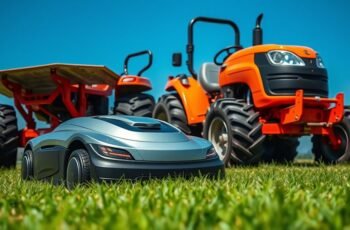
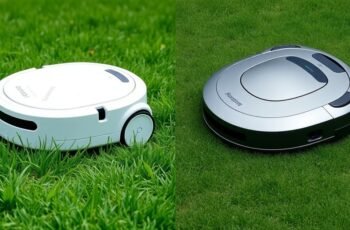
When choosing between robot mowers and zero-turn mowers, understanding their distinct technical features and operational efficiencies is essential. Each offers unique advantages suited to specific lawn sizes and terrain complexities, but the decision involves more than just power and size. As we examine their design, functionality, and long-term costs, it becomes clear that selecting the right equipment can considerably impact maintenance, productivity, and overall landscape management—yet, the ideal choice depends on your particular needs and expectations.
Key Takeaways
- Robot mowers are compact, autonomous, and eco-friendly, ideal for small or complex lawns; zero-turn mowers are larger, manual, suited for expansive areas.
- Powered by batteries and electric motors, robot mowers operate quietly; zero-turn mowers typically use gasoline engines for higher power.
- Robot mowers navigate using sensors and GPS, offering autonomous, systematic coverage; zero-turn mowers are manually controlled with steering wheels.
- Suitable for small, flat lawns or large, intricate landscapes depending on terrain complexity and desired automation level.
- Robot mowers require less maintenance but have limited cutting power; zero-turn mowers are robust but need regular engine and blade servicing.
What Are Robot Mowers and Zero-Turn Mowers? A Quick Overview
Robot mowers are autonomous, battery-powered devices designed to maintain lawns with minimal human intervention by steering and cutting grass based on pre-programmed patterns or sensor inputs. They use sophisticated algorithms to optimize mowing paths, ensuring even coverage and improved lawn aesthetics. These devices operate quietly and precisely, reducing the need for manual trimming and enhancing the overall appearance of your yard. Regarding environmental impact, robot mowers are energy-efficient, emitting no exhaust fumes, and often feature recyclable batteries, contributing to eco-friendliness. Their consistent, targeted cutting reduces over-mowing and grass waste, promoting healthier turf. Zero-turn mowers, in contrast, are gas-powered, highly maneuverable machines suited for large-scale tasks. Overall, robot mowers offer a sustainable, efficient solution for maintaining visually appealing lawns.
How Do Robot Mowers and Zero-Turn Mowers Differ in Design and Operation?
Robot mowers typically feature compact, low-profile designs with integrated sensors and wireless connectivity, enabling autonomous operation within designated areas. In contrast, zero-turn mowers are larger, with a rigid frame and steering mechanisms that allow precise, high-speed maneuvering around obstacles. Their cutting systems differ as well, with robot mowers employing electric blades powered by onboard batteries, while zero-turns often utilize gas-powered motors driving larger, faster blades through hydraulic or mechanical systems, and their navigation relies on programmed paths versus sensor-based perception.
Design Structures and Size
While both robot mowers and zero-turn mowers are designed for efficient turf maintenance, their structural architectures and sizes differ markedly, reflecting their distinct operational philosophies. Robot mowers are compact, lightweight, with integrated batteries optimized for battery efficiency, allowing autonomous operation within confined or complex terrains. Zero-turn mowers are larger, with a robust chassis supporting powerful engines, and their blade design prioritizes high-speed, precise cutting. The table below highlights these distinctions:
| Feature | Robot Mower | Zero-Turn Mower |
|---|---|---|
| Size & Structure | Small, modular, enclosed units | Large, open frame |
| Power & Battery Use | Efficient batteries, onboard charging | Gasoline/diesel engines, high fuel capacity |
| Blade Design | Low-profile, safety-focused blades | High-speed, heavy-duty blades |
These differences underscore their tailored approaches to turf management.
Cutting Mechanisms and Power
The primary distinction between robot mowers and zero-turn mowers lies in their cutting mechanisms and power sources, which are tailored to their specific operational modes. Robot mowers utilize electric motors powered by advanced battery technology, often lithium-ion, offering quiet, eco-friendly operation with consistent power delivery. Their cutting mechanisms typically involve rotating blades mounted on a deck, with adjustable cutting height settings that can be electronically controlled for precision. In contrast, zero-turn mowers rely on gasoline engines or larger batteries, providing higher power output necessary for rapid, large-scale cutting. Their cutting decks feature multiple blades with adjustable cutting height controls, allowing for rapid adaptation to different turf conditions. This fundamental difference in power and cutting design reflects their distinct purposes and operational efficiencies.
Navigation and Movement Systems
Navigation and movement systems are key differentiators that determine how robot mowers and zero-turn mowers operate across varied terrain. Robot mowers rely on advanced sensor arrays, GPS, and boundary wires to navigate precisely, optimizing battery technology for efficient, autonomous operation. Their movement is methodical, covering lawns systematically to guarantee complete coverage. Zero-turn mowers, on the other hand, use a steering wheel and dual hydraulic cylinders to pivot sharply, enabling rapid, agile turns on open terrain. Their design emphasizes direct manual control rather than autonomous navigation. Noise levels differ considerably: robot mowers operate quietly due to electric motors and minimal moving parts, whereas zero-turn mowers produce higher noise levels because of larger engines and mechanical complexity. This distinction impacts usability and suitability for different environments.
Which Mower Is Better for Small, Flat Lawns?
For small, flat lawns, precision and consistency are critical factors in choosing the right mower, as they directly impact the quality of the cut and overall lawn health. Robot mowers excel in maintaining uniformity through programmed patterns, while zero-turn mowers offer manual control for targeted trimming. Ease of use also plays a role, with robot mowers providing automated operation that minimizes effort, whereas zero-turn models require some skill for best maneuvering.
Precision and Consistency
When evaluating precision and consistency for small, flat lawns, robot mowers generally excel due to their systematic, grid-based cutting patterns that guarantee uniform coverage. Advanced artificial intelligence enables these mowers to adapt to lawn variations, maintaining a steady trim. Battery technology guarantees sustained operation with minimal interruptions, supporting precise, continuous mowing cycles.
Key factors include:
- Pattern Accuracy: Robot mowers follow programmed paths, reducing overlaps and missed spots.
- Adaptive Algorithms: AI-driven navigation corrects for uneven terrain or obstacles, maintaining consistency.
- Battery Efficiency: High-capacity batteries enable longer, more precise operation without sacrificing coverage quality.
In contrast, zero-turn mowers rely on manual steering, which can introduce variability, especially in tight, detailed areas.
Ease of Use
While zero-turn mowers require manual operation that demands skillful steering and constant attention, robot mowers are designed for ease of use, especially on small, flat lawns. They typically feature intuitive controls, often accessible via remote control apps, allowing users to start, stop, or modify mowing schedules remotely. Their autonomous operation minimizes user input, with sophisticated sensors ensuring precise navigation and detection of boundaries. Battery life is a critical factor; most robot mowers offer extended operation times suitable for small lawns, with quick recharge cycles. Unlike zero-turn mowers, which need active steering and continuous oversight, robot models provide consistent mowing without user intervention, simplifying lawn maintenance. This makes robot mowers a more user-friendly, low-maintenance option for small, flat terrains.
Choosing Between a Robot Mower and Zero-Turn for Larger or Complex Landscapes
Choosing between a robot mower and a zero-turn mower for larger or complex landscapes hinges on analyzing their respective capabilities to handle extensive or intricate terrain. Robot mowers excel in managing large areas through advanced battery technology, which guarantees longer runtimes and quicker recharge cycles, ideal for sustained mowing tasks. They operate at notably lower noise levels, allowing for discreet, continuous operation, even in noise-sensitive environments. Conversely, zero-turn mowers are designed for precision and agility, making them better suited for complex landscapes with obstacles or varied terrain. They provide superior control and maneuverability but require more active operation. When considering these options, evaluate terrain complexity, required mowing frequency, and environmental noise constraints to determine the best fit for your landscape’s demands.
Cost, Maintenance, and Long-Term Investment: What Should You Expect?
Understanding the financial and maintenance implications of robot mowers versus zero-turn mowers is essential for making an informed long-term investment. Robot mowers typically involve lower ongoing maintenance costs due to fewer moving parts, but reliance on advanced battery technology means eventual battery replacements are necessary—impacting long-term expenses. Zero-turn mowers, on the other hand, require more regular maintenance, including engine servicing, blade sharpening, and hydraulic system checks. Warranty coverage varies considerably; robot mowers often include limited warranties on batteries and motors, while zero-turn mowers may offer extended coverage on engine components. Carefully evaluating warranty terms and the expected lifespan of key components helps determine overall cost-effectiveness, ensuring that your investment aligns with your landscape’s size, terrain, and your maintenance capacity.
Pros and Cons of Robot Mowers Versus Zero-Turn Mowers
Robot mowers excel in automation and efficiency, providing consistent, quiet operation with minimal human intervention, which makes them ideal for maintaining irregularly shaped or complex terrains. Their battery life typically supports daily mowing cycles, though longer sessions may require recharging. Noise levels are markedly lower than traditional mowers, reducing disturbance in residential areas. However, their limited cutting power can struggle with tall, dense grass or heavy debris.
Conversely, zero-turn mowers offer robust cutting capacity and high maneuverability, suitable for expansive, uniform lawns. Yet, they are less automated, generate more noise, and demand more upkeep. The choice hinges on terrain complexity, lawn size, and desired level of automation.
Which Mower Fits Your Lawn and Lifestyle Best? Key Factors to Consider
Selecting the right mower depends heavily on your lawn’s size, shape, and terrain complexity, as well as your personal preferences for automation and maintenance. For larger, irregularly shaped lawns, a zero-turn mower offers precise control, optimized for lawn aesthetics and quick coverage. Conversely, a robot mower suits smaller, flatter terrains, providing consistent mowing with minimal environmental impact due to electric operation.
| Factors | Suitable Mower Type |
|---|---|
| Lawn size & shape | Larger, irregular: Zero-turn |
| Terrain complexity | Uneven, complex: Zero-turn |
| Maintenance & automation | Low maintenance, automation: Robot |
| Environmental impact | Eco-friendly, electric: Robot |
Frequently Asked Questions
How Do Robot Mowers Handle Uneven or Hilly Terrain?
Robot mowers handle uneven terrain through advanced terrain adaptation, utilizing powerful motors and specialized wheels for slope handling. They actively adjust cutting height and maintain traction, ensuring effective mowing on hilly, uneven surfaces with minimal user intervention.
Are Zero-Turn Mowers Suitable for Very Small Lawns?
Zero-turn mowers aren’t ideal for very small lawns due to their heavy weight and larger size, which can cause turf damage and maneuverability issues, making them less efficient than smaller, lightweight mowers for compact lawn sizes.
Can Robot Mowers Mow During Rain or Wet Conditions?
Robot mowers generally aren’t rain-resistant, so we advise against wet condition mowing. Water can damage components and reduce safety, even if some models claim limited rain resistance; always check manufacturer guidelines for rain and wet conditions.
How Noisy Are Each Type of Mower During Operation?
Robot mowers operate silently with low noise levels and minimal sound emissions, making them ideal for quiet environments, whereas zero-turn mowers generate higher noise levels, producing louder sound emissions that can be disruptive during operation.
What Safety Features Are Included in Robot and Zero-Turn Mowers?
Think of safety features as vigilant guards; both mower types include safety sensors to detect obstacles and humans, plus emergency stop functions, ensuring quick shutdowns during hazards, making operation safer and more reliable for users and bystanders alike.
Conclusion
Ultimately, selecting between a robot mower and a zero-turn mower hinges on your lawn’s specific needs and your maintenance preferences. While some believe automation always trumps power, studies suggest that for large, complex landscapes, traditional zero-turns often deliver superior efficiency and control. Conversely, for smaller, well-manicured lawns, robot mowers offer silent, eco-friendly operation with minimal intervention. By analyzing your terrain’s complexity and your desired level of automation, you can make an informed, strategic choice that optimizes your landscape management.