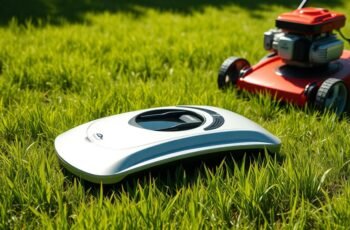
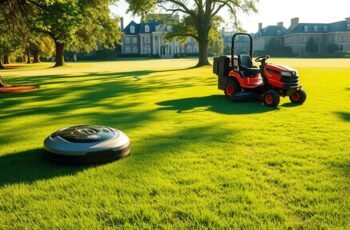
While ride-on mowers can cover large lawns rapidly, robot mowers excel in precision and minimal disruption, yet their mowing times vary considerably depending on yard size. Understanding these differences is key to selecting the right equipment for your landscape needs. We’ll explore how each mower type performs across different areas, factors that influence their efficiency, and practical tips to maximize your mowing time. Let’s examine what truly makes one option more time-efficient than the other.
Key Takeaways
- Ride-on mowers typically complete 1 acre in 20-30 minutes, significantly faster than robot mowers’ 1-2 hours for similar areas.
- Robot mowers operate in shorter, frequent sessions, while ride-on mowers achieve faster overall coverage due to higher speeds.
- Larger or complex terrains slow down robot mowers more than ride-on mowers, affecting total mowing time.
- Battery limitations can extend robot mowing durations, especially on larger or uneven lawns.
- Overall, ride-on mowers finish mowing tasks more quickly on flat, open areas, but robot mowers offer convenience and quieter operation.
How Do Mowing Times Compare Between Robot and Ride-On Mowers?
While both robot and ride-on mowers are designed to efficiently maintain lawns, their mowing times can differ considerably depending on several factors. Robot mowers typically operate in shorter, more frequent sessions, promoting better aesthetic improvements through consistent cutting. This approach results in a well-manicured appearance but may extend overall mowing time for larger areas. Ride-on mowers, on the other hand, cover larger sections quickly, reducing total mowing duration for extensive lawns. Additionally, noise levels play a role; robot mowers generally produce lower noise, allowing for more flexible scheduling without disturbing residents. However, their slower pace can mean longer total time, especially on larger properties. Overall, the choice impacts mowing time, balancing speed, aesthetics, and noise considerations.
Factors That Affect Mowing Speed and Efficiency
Several key factors influence the mowing speed and efficiency of both robot and ride-on mowers. Battery life is vital for cordless models, as limited capacity can restrict mowing duration and necessitate frequent recharging, reducing overall efficiency. Terrain adaptability also plays a significant role; uneven or complex landscapes demand more precise navigation and slower speeds, impacting total mowing time. For ride-on mowers, engine power and cutting deck design affect how quickly and effectively large areas are covered. Additionally, terrain features like slopes, obstacles, and grass density can hinder performance, regardless of mower type. Understanding these factors helps in selecting the right mower for specific yard conditions, ensuring ideal mowing speed and efficiency while minimizing downtime and energy consumption.
How Long Does a Robot Mower Take to Cover Different Yard Sizes?
The time it takes for a robot mower to cover a yard varies considerably based on the size and complexity of the area. For small to medium lawns, typically under 1 acre, mowing can take as little as 1-2 hours, depending on the mower’s cutting speed and navigation efficiency. Larger properties require longer, often 4-8 hours, but are usually completed in segments over several days. The robot’s mowing pattern influences lawn aesthetics, ensuring an even, manicured look with minimal disruption. Noise levels are generally low, allowing mowing during daytime or early evening without disturbance. Complex landscapes with many obstacles may extend mowing time, as the mower navigates around features. Overall, the size and terrain directly impact how long a robot mower takes to deliver ideal lawn aesthetics efficiently.
How Quickly Can Ride-On Mowers Complete a Lawn?
Ride-on mowers are designed to cut large areas quickly and efficiently, making them a popular choice for extensive lawns and commercial properties. Their mowing speed varies based on engine power, deck size, and terrain. Generally, a typical ride-on mower can cover:
- Up to 2 acres per hour on flat terrain
- Achieve a mowing speed of 4-6 miles per hour
- Complete a standard lawn (1 acre) in approximately 20-30 minutes
- Maintain consistent lawn aesthetics with precise cutting patterns
While these mowers are efficient, noise levels can be significant, impacting surroundings. Their speed allows for rapid completion of large lawns, but it’s essential to balance mowing efficiency with considerations for noise and lawn aesthetics to guarantee an ideal mowing experience.
Which Mower Saves You More Time Overall?
When comparing overall time savings, we focus on mowing speed efficiency, maintenance demands, and operating convenience. Robot mowers typically run continuously with minimal oversight, whereas ride-on mowers often require more setup and upkeep. Analyzing these factors helps determine which option truly saves you the most time in the long run.
Mowing Speed Efficiency
While both robot mowers and ride-on machines aim to complete lawns efficiently, their mowing speeds substantially influence overall time savings. Robot mowers typically operate at a steady, lower speed, maximized for energy efficiency and battery life, which can extend their cutting cycles but may increase total mowing time for larger areas. Conversely, ride-on mowers generally have higher speeds, reducing overall mowing duration, especially on flat terrain. However, their efficiency depends on factors like cutting height adjustments and battery capacity. To compare:
- Ride-on mowers often finish quicker due to higher top speeds.
- Robot mowers may take longer but can cut continuously without user intervention.
- Battery life limits robot mower runtime, impacting total mowing time.
- Consistent cutting height guarantees peak efficiency for both mower types, affecting overall speed.
Maintenance Requirements
Do maintenance routines considerably impact the overall time required to keep a lawn tidy? Yes, they do. Robot mowers generally require less maintenance, with minimal adjustments needed due to their compact design. Battery life plays an essential role, as degraded batteries reduce runtime and necessitate replacements, which can be be time-consuming. Ride-on mowers, however, demand more frequent checks of oil, filters, and blades, increasing maintenance time. Noise levels are also a factor; quieter robot mowers allow for maintenance without disturbing household routines, saving additional time. Overall, robot mowers tend to save time through lower maintenance requirements, especially with long-lasting batteries and quieter operation, whereas ride-on models involve more labor-intensive upkeep that can extend overall lawn care time.
Operating Convenience
Operating convenience considerably influences the overall time savings offered by each mower type. Robot mowers excel here due to their autonomous operation and minimal user intervention. Key factors include:
- Battery lifespan: Longer-lasting batteries enable extended mowing sessions without frequent recharges, reducing downtime.
- Noise levels: Lower noise levels allow for early morning or late evening operation, maximizing available time without disturbing surroundings.
- Ease of setup: Robot mowers typically require initial programming, whereas ride-on mowers demand manual operation each session, impacting overall efficiency.
- Maintenance simplicity: Fewer parts and automated diagnostics in robot mowers streamline upkeep, saving time on repairs and adjustments.
Tips for Maximizing Mowing Efficiency With Either Option
Maximizing mowing efficiency with either a robot mower or a ride-on involves careful planning and proper setup. Effective garden design plays a vital role, as a well-structured landscape minimizes obstacles and creates clear mowing paths, reducing turf damage and time spent maneuvering. Additionally, factoring in weather impact is essential; mowing during ideal conditions prevents issues like soil compaction or uneven cutting caused by wet or windy weather. Regularly maintaining equipment—such as blade sharpening and battery checks—ensures consistent performance. For robot mowers, programming schedules aligned with the garden’s growth cycle enhances coverage efficiency, while for ride-on mowers, strategic route planning minimizes overlaps. Combining thoughtful garden design with awareness of weather patterns greatly improves overall mowing efficiency, regardless of the equipment used.
Frequently Asked Questions
How Does Terrain Affect Mowing Time for Both Mower Types?
Terrain challenges and grass density markedly impact mowing time for both mower types; uneven or hilly terrain slows robot mowers more, while dense grass increases ride-on mower efficiency, though both struggle with complex, challenging landscapes.
Do Weather Conditions Impact Mowing Speed and Efficiency?
Weather impact considerably affects mowing speed; rain can reduce efficiency by up to 30%, especially for robot mowers, as wet grass hampers cutting precision and speed, while ride-on mowers maintain more consistent performance in various weather conditions.
What Maintenance Routines Influence Mowing Time?
We find that regular blade sharpening and timely fuel replacement are essential maintenance routines influencing mowing time, as sharp blades cut efficiently, and fresh fuel guarantees consistent engine performance, minimizing downtime and optimizing overall mowing speed and effectiveness.
Can Robot Mowers Handle Complex Yard Layouts Efficiently?
Like a seasoned knight with a map, our robot mowers use smart navigation and obstacle detection to handle complex yard layouts efficiently. They adapt seamlessly, ensuring thorough coverage without missing tricky corners or obstacles.
How Does Mower Battery Life Impact Overall Mowing Duration?
Battery capacity directly affects mowing efficiency, as larger capacity batteries allow longer operation times, reducing recharge frequency and enabling more thorough coverage, which ultimately extends overall mowing duration and guarantees consistent yard maintenance.
Conclusion
In conclusion, while ride-on mowers complete large lawns faster, robot mowers excel in maintaining smaller, intricate landscapes with minimal disruption. The key is matching mower type to yard size and complexity for maximum efficiency. Think of it like a race — speed matters, but consistency and suitability determine the overall time savings. By understanding these dynamics, we can choose the most effective mowing solution, balancing time, effort, and landscape needs.