Did you know that a robot lawn mower’s docking sensor must detect the station within a range of just a few centimeters with high precision? These sensors are critical for ensuring proper alignment, efficient charging, and obstacle avoidance. Understanding how they work involves examining various signal types and their integration into the mower’s navigation system. As we explore the technology behind these sensors, you’ll see how advancements are shaping more reliable and adaptable lawn care solutions.
Key Takeaways
- Docking sensors detect the mower’s position relative to the station using infrared, ultrasonic, magnetic, or optical signals.
- They enable precise landing, seamless docking, and obstacle avoidance during lawn maintenance.
- Regular cleaning and calibration are essential to prevent sensor failures caused by dirt, debris, or misalignment.
- Future sensor tech may combine multiple signals and integrate with smart home systems for improved accuracy.
- Effective docking sensors improve power efficiency, extend mower lifespan, and ensure reliable operation across various landscapes.
How Do Robot Lawn Mower Docking Sensors Work?
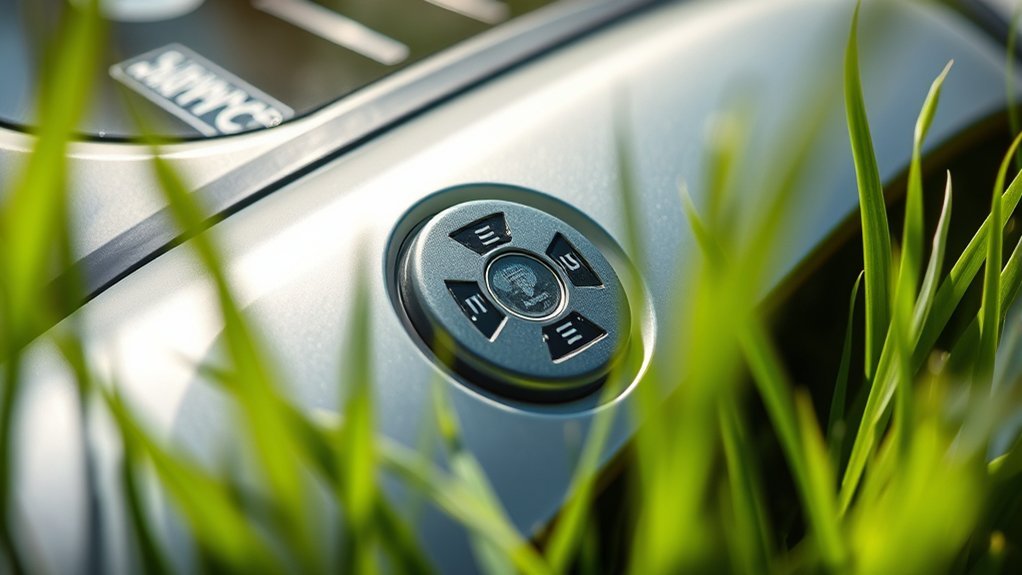
Robot lawn mower docking sensors operate by continuously scanning the environment to detect the presence and location of the docking station, using a combination of infrared, ultrasonic, or magnetic signals. These sensors precisely identify the station’s position, ensuring seamless lawn maintenance and efficient navigation within the garden design. Infrared beacons emit focused signals that the mower’s sensors detect, allowing accurate positioning, even around obstacles. Ultrasonic sensors measure distance by emitting sound waves and analyzing their echo, providing real-time feedback during lawn coverage. Magnetic signals, embedded in the ground or station, create a detectable field, guiding the mower back to its docking point. This technical interplay enhances the mower’s ability to maintain a well-groomed lawn, ensuring consistent lawn maintenance while respecting the landscape’s design.
Types of Docking Sensors Used in Robot Mowers
Various types of docking sensors are employed in robot mowers to guarantee precise and reliable station detection, each utilizing distinct sensing technologies to suit different lawn environments and user needs. Optical sensors use infrared or laser signals for accurate positioning, while magnetic sensors detect embedded field markers. Ultrasonic sensors measure distances to docking stations through sound waves, providing functional versatility. Capacitive sensors sense changes in electrical fields, enabling detection amid complex terrains. Sensor calibration is vital for maintaining accuracy, especially after software updates that may affect sensor performance. The choice of sensor impacts the mower’s ability to reliably locate its station, regardless of obstacles or environmental conditions. Proper understanding of these sensor types ensures excellent docking performance and longevity of the system.
| Sensor Type | Technology | Key Considerations |
|---|---|---|
| Optical | Infrared/Laser | Sensor calibration, environmental noise |
| Magnetic | Embedded field markers | Installation precision, soil conditions |
| Ultrasonic | Sound wave measurement | Obstacle interference, calibration accuracy |
| Capacitive | Electrical field detection | Terrain variability, software updates |
| Infrared/laser | Light signal detection | Alignment accuracy, ambient light effects |
The Role of Sensors in Ensuring Accurate Docking
Sensors play a critical role in achieving precise position detection, ensuring the mower aligns accurately with the docking station. Their obstacle avoidance capabilities prevent collisions during docking, enhancing safety and reliability. Accurate signal recognition allows the sensor system to distinguish the station’s cues from environmental noise, facilitating consistent and dependable docking performance.
Precise Position Detection
Accurate docking relies heavily on the ability to precisely detect the robot lawn mower’s position relative to its charging station. This precision depends on sensor calibration, ensuring that sensors interpret signals correctly and maintain accuracy over time. Proper calibration minimizes errors caused by sensor drift and environmental factors. Signal interference, from nearby electronic devices or metallic objects, can distort sensor readings, leading to misalignment. To counteract this, advanced systems incorporate filtering algorithms and shielding techniques that reduce noise and interference. Precise position detection involves analyzing multiple sensor inputs—such as infrared, ultrasonic, or magnetic signals—and integrating this data to determine the mower’s exact location. Maintaining calibration and mitigating interference are essential for seamless, reliable docking, ensuring the mower aligns perfectly with the station every time.
Obstacle Avoidance Capabilities
To guarantee seamless docking, obstacle avoidance capabilities rely on an array of sensors that actively detect and interpret environmental features around the mower. These sensors enable the mower to navigate precisely, avoiding obstacles that could compromise garden aesthetics or lawn health. They utilize techniques like infrared, ultrasonic, or LIDAR sensing to identify objects and measure distances accurately. Key aspects include:
- Differentiating between static objects (fences, walls) and moving obstacles (pets, people)
- Adjusting paths dynamically to prevent collisions
- Maintaining consistent mowing patterns for ideal lawn health
- Protecting delicate plants or features that could be damaged
This sensor integration ensures safe, efficient docking while preserving the visual appeal of your garden and promoting a healthy, well-maintained lawn.
Signal Recognition Accuracy
Achieving precise docking relies heavily on the ability of the mower’s sensors to correctly recognize and interpret signals emitted by the docking station. Signal recognition accuracy depends on rigorous sensor calibration, which guarantees consistent detection thresholds and minimizes false triggers. Proper calibration aligns sensor sensitivity with signal strength, reducing the impact of environmental variables. Signal interference, caused by obstacles, electronic devices, or reflective surfaces, can distort or weaken signals, leading to docking errors. Advanced sensors incorporate filtering algorithms and adaptive signal processing to distinguish genuine docking signals from noise. Consistent calibration and interference mitigation are essential for reliable communication, enabling the mower to accurately identify docking signals, improve docking precision, and prevent misalignment or missed docking attempts.
How Docking Sensors Help Prevent Mower Collisions
Docking sensors play a crucial role in preventing mower collisions by providing real-time positional data during the docking process. This data guarantees precise alignment, reducing the risk of impact with obstacles or the docking station itself. These sensors utilize advanced proximity detection, often employing infrared or ultrasonic technology, to accurately gauge distances and detect nearby objects. Properly functioning sensors contribute to safer lawn maintenance and help protect garden landscaping from accidental damage.
Key features include:
- Continuous obstacle detection during docking
- Accurate distance measurement for safe alignment
- Integration with mower navigation systems
- Real-time feedback to adjust approach trajectory
Common Causes of Docking Sensor Failures and How to Fix Them
Obstructions such as grass clippings, leaves, or debris can block the sensor’s line of sight, causing miscommunication with the docking station. Additionally, dirt, dust, or physical damage to the sensor’s lens or components can impair its functionality. Regular inspection and cleaning of these elements are essential to maintain reliable sensor performance.
Obstructions Blocking Sensor Path
Obstructions in the sensor’s line of sight are one of the most common reasons for docking sensor failures, as even small objects can interfere with the sensor’s ability to accurately detect the docking station. External factors like garden landscape features—such as low-hanging branches, tall grass, or garden decor—can obscure the sensor path. Weather effects, including snow, rain, or fog, may also cause false signals or blockages. To guarantee proper sensor function, it’s essential to:
- Regularly trim vegetation near the docking area
- Remove loose debris or objects that could block the sensor
- Clear snow, leaves, or water accumulation after adverse weather
- Maintain a clear, unobstructed path for consistent sensor detection
Proper maintenance of the environment helps prevent false readings and improves overall docking reliability.
Dirty or Damaged Components
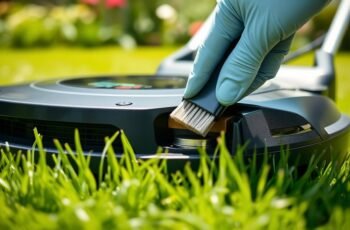
Dirty or damaged components are among the most frequent causes of docking sensor failures, as even minor grime buildup or physical defects can impair sensor accuracy and responsiveness. Dust, dirt, and debris on sensor surfaces hinder proper signal transmission, necessitating regular cleaning with a soft cloth and appropriate cleaner. Physical damage, such as cracks or misalignment, disrupts the sensor’s calibration and can cause false detections or complete failure to dock. When cleaning doesn’t restore functionality, sensor calibration may be compromised, requiring recalibration procedures or, if damage persists, component replacement. Ensuring all parts are intact and properly aligned is critical for ideal operation. Regular inspection and maintenance prevent sensor degradation, keeping your mower’s docking system reliable and responsive.
Tips for Maintaining and Calibrating Your Docking Sensor
To guarantee your robotic lawn mower reliably docks and undocks without interruption, regular maintenance and precise calibration of the docking sensor are essential. Proper calibration ensures the sensor accurately detects the docking station, maintaining lawn health and garden aesthetics. To achieve this, inspect the sensor for dust, debris, or misalignment, and clean with a soft cloth and isopropyl alcohol when necessary. When calibrating, verify the sensor’s alignment with the dock, adjusting mounting if needed.
- Confirm sensor surfaces are clean and free of obstructions
- Use manufacturer-recommended calibration procedures
- Test docking functionality after adjustments
- Schedule routine checks bi-weekly to maintain accuracy
How to Troubleshoot Docking Issues Step-by-Step
When your robotic lawn mower encounters docking problems despite a clean and calibrated sensor, systematic troubleshooting can identify and resolve the underlying issues. Begin by inspecting the docking station’s alignment within your garden design; uneven terrain or obstructions can disrupt sensor signals. Next, verify that the sensor’s position isn’t obstructed by debris or overgrown lawn, which can interfere with accurate detection. Test the sensor’s functionality by manually approaching the dock at various angles and distances, noting inconsistent responses. Review the mower’s calibration settings and ensure they match the manufacturer’s specifications. Also, examine surrounding lawn care techniques—watering patterns or recent landscaping might affect sensor performance. By methodically analyzing these elements, you can narrow down the cause of docking issues and restore efficient operation.
Upgrading or Replacing Your Robot Mower’s Docking Sensor
When upgrading or replacing your robot mower’s docking sensor, selecting a compatible component is crucial to guarantee proper communication with your unit’s control system. We’ll outline precise installation procedures to assure accurate sensor alignment and functionality, followed by troubleshooting tips for resolving common issues. This targeted approach helps maintain ideal docking performance and minimizes downtime.
Choosing Compatible Sensors
How can you guarantee your robot mower’s docking sensor remains reliable and accurate? Selecting compatible sensors requires precise attention to technical specifications and environmental compatibility. Ensure the sensor’s detection range matches your mower’s requirements, and verify compatibility with your model’s communication protocols. Consider sensors designed for outdoor conditions, resistant to dirt, grass, and weather elements. When choosing, keep in mind:
- Compatibility with your mower’s brand and model
- Detection range aligned with docking station placement
- Resistance to environmental factors (moisture, debris)
- Integration with your existing lawn care techniques and garden landscaping
This precision ensures consistent docking, minimizing maintenance and optimizing lawn care efficiency. Proper sensor selection safeguards against false detections, supporting a seamless, automated lawn management process.
Proper Installation Steps
Upgrading or replacing your robot mower’s docking sensor requires careful attention to the installation process to guarantee continued reliability and accuracy. Begin by turning off the mower and disconnecting power sources. Remove any debris or obstructions around the docking station to ensure clear sensor alignment. Mount the new sensor at the manufacturer-recommended height and angle, typically aligned with the docking station’s central axis, to optimize signal detection. Securely connect wiring, verifying proper insulation to prevent moisture ingress, especially if your garden landscaping includes moist or shaded areas. Confirm the sensor’s view isn’t obstructed by garden features or lawn fertilization equipment. Proper placement ensures consistent docking, preventing misalignments that could hinder routine maintenance or lawn care tasks. Precise installation maintains efficient operation and prolongs sensor lifespan.
Troubleshooting Sensor Issues
If your robot mower is experiencing docking failures or inconsistent charging, troubleshooting the sensor issues becomes essential. Faulty or misaligned sensors can disrupt navigation, affecting your garden landscape and lawn maintenance efficiency. To address this, consider upgrading or replacing the docking sensor if signs of damage, dirt, or misalignment are present.
Key steps include:
- Inspecting the sensor for physical damage or debris
- Verifying proper alignment with the docking station
- Testing sensor responsiveness with a multimeter
- Replacing the sensor if it shows electrical faults or persistent malfunction
Ensuring the sensor’s accuracy and functionality is critical for seamless docking, especially in complex garden landscapes where precise navigation is crucial for ideal lawn maintenance.
The Future of Docking Sensors: Innovations and Improvements
As technology advances, the future of docking sensors in robotic lawn mowers promises significant enhancements in accuracy, reliability, and integration. Innovations are focusing on multi-sensor arrays combining infrared, ultrasonic, and visual recognition to improve docking precision in complex terrains and low-light conditions. Enhanced smart home integration will enable real-time status updates, remote diagnostics, and seamless communication with home automation systems, optimizing mower performance. Additionally, improvements aimed at battery efficiency will leverage adaptive docking algorithms that minimize unnecessary movements, conserving power during the return process. These developments will foster more autonomous, efficient, and user-friendly systems, reducing maintenance needs and expanding operational capabilities. Overall, these innovations will guarantee docking sensors are more robust, intelligent, and integrated within the evolving landscape of smart home technology.
How Proper Sensor Function Extends Your Mower’s Battery Life
Maintaining precise sensor functionality is essential for optimizing a robotic lawn mower’s battery life, as these sensors directly influence operational efficiency. Accurate docking sensors ensure the mower navigates efficiently, reducing unnecessary movements that drain power. Proper sensor calibration prevents false detections, conserving battery during lawn maintenance and in complex garden design. Misaligned sensors can cause the mower to repeatedly search for the dock, increasing energy consumption. To maximize battery longevity, regularly:
- Clean sensor surfaces to prevent debris interference
- Calibrate sensors according to manufacturer specifications
- Update firmware for improved detection algorithms
- Adjust mower path planning for optimized navigation
These steps ensure sensors operate at peak performance, minimizing power waste and extending the mower’s operating time, especially in varied garden designs and lawn maintenance scenarios.
Frequently Asked Questions
Can Environmental Factors Like Weather Affect Docking Sensor Performance?
Weather interference can impact docking sensor performance, causing false signals or calibration issues; we recommend regularly checking and recalibrating sensors to guarantee reliable operation during adverse weather conditions.
Are There Compatibility Issues With Different Brands of Robot Mowers?
While some brand compatibility issues may arise, proper sensor calibration often guarantees seamless operation across models. We recommend verifying compatibility and calibrating sensors correctly to optimize docking performance, preventing misalignments regardless of mower brand differences.
How Do Docking Sensors Adapt to Uneven or Sloped Terrain?
We design docking sensors with advanced terrain adaptation, allowing precise obstacle detection on uneven slopes. This guarantees reliable docking, maintaining safety, efficiency, and consistent operation even on challenging terrains, thanks to sophisticated sensors and adaptive algorithms.
What Safety Features Are Integrated With Docking Sensors?
We integrate safety features with docking sensors through precise sensor calibration and obstacle detection systems, ensuring the mower halts or reroutes upon encountering obstructions, thereby preventing accidents and protecting both the device and surrounding objects.
Do Docking Sensors Require Regular Software Updates?
Docking sensors do require regular software maintenance and calibration to guarantee peak performance. We recommend updating firmware periodically to address bugs, enhance compatibility, and improve sensor accuracy, ultimately maintaining reliable docking and operational safety.
Conclusion
In the end, while advanced docking sensors promise seamless precision and obstacle avoidance, they remind us that even the most sophisticated technology isn’t infallible. Ironically, the more we rely on sensors to perfect our mowing routines, the more we realize that regular maintenance and vigilance are still essential. After all, no sensor can replace the fundamental need for human oversight—proof that, in technology as in life, perfection remains an elusive goal.