When considering whether a robot mower or a ride-on mower best suits your needs, it’s essential to analyze their design, operational efficiency, and suitability for your landscape. Each offers distinct advantages based on terrain, lawn size, and maintenance requirements. Understanding these differences can considerably impact your decision, especially as factors like environmental impact and feature customization come into play. We invite you to explore these aspects in detail to determine which option aligns more closely with your lawn care goals.
Key Takeaways
- Robot mowers excel for small to medium lawns with minimal effort, while ride-on mowers are better for large, uneven terrains.
- Robot mowers save time and physical effort through autonomous operation, unlike manual ride-on mowers.
- Ride-on mowers have higher upfront costs and maintenance but offer greater power for challenging terrains.
- Robot mowers are eco-friendly, producing less noise and emissions compared to gas-powered ride-on mowers.
- The choice depends on lawn size, terrain complexity, budget, and preference for automation versus manual control.
How Do Robot Mowers and Ride-On Mowers Differ in Design and Operation?
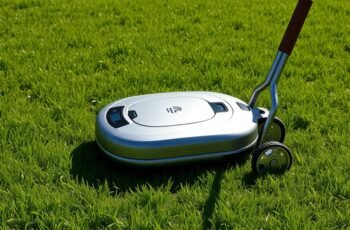
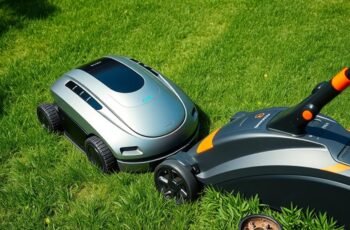
Although both robot mowers and ride-on mowers serve the primary function of lawn maintenance, their designs and operational mechanisms differ markedly. Robot mowers operate autonomously, featuring compact, low-profile bodies equipped with sensors for boundary detection and obstacle avoidance, emphasizing safety features like collision sensors and lift sensors. They are powered by rechargeable batteries, enabling precise, grid-like mowing patterns. Conversely, ride-on mowers are larger, seat-based machines driven manually, with mechanical blades operated via levers or pedals. Their safety features typically include emergency shut-offs and blade guards, but they require user oversight. Brand reputation influences reliability and safety standards for both types, with established brands offering advanced safety features and consistent performance. These design distinctions directly impact their functionality and suitability for different lawn sizes and terrains.
Which Mower Saves You More Time and Effort?
When evaluating which mower saves more time and effort, the key difference lies in their operational autonomy and physical demands. Robot mowers leverage smart technology, allowing them to operate independently with minimal user intervention, guided by sophisticated sensors and boundary inputs. Their intelligent algorithms optimize mowing patterns, reducing overlap and completing tasks quickly. The user interface on robot mowers offers streamlined controls, enabling scheduling and adjustments via smartphone apps, further minimizing manual effort. In contrast, ride-on mowers require physical operation, often involving manual steering and physical exertion, which increases time and effort. Overall, robot mowers, with their advanced smart technology and intuitive user interfaces, markedly reduce the time and physical effort needed to maintain a lawn, making them the more efficient choice for effortless landscaping.
How Do Costs and Maintenance Compare Between the Two Options?
Evaluating the costs and maintenance demands of robot mowers versus ride-on mowers reveals significant differences that can influence long-term investment decisions. Robot mowers leverage smart technology, reducing labor costs and requiring minimal user intervention, but they depend heavily on battery life, which affects operational efficiency and replacement frequency. In contrast, ride-on mowers involve higher initial purchase prices and more frequent maintenance, such as engine tune-ups, oil changes, and blade sharpening.
Robot mowers lower labor costs with smart tech but need battery replacements; ride-on mowers have higher upfront costs and maintenance needs.
- Initial purchase cost: Ride-on mowers tend to be more expensive upfront
- Maintenance frequency: Robot mowers require less frequent mechanical upkeep
- Battery replacement: Robot mowers may need battery replacements over time
- Smart technology updates: Periodic software updates for robot mowers
- Labor and downtime: Ride-on mowers may require more manual labor for maintenance
Which Mower Is Better for Larger or Sloped Lawns?
Determining which mower is better for larger or sloped lawns hinges on understanding each model’s power, maneuverability, and stability under challenging terrain conditions. Ride-on mowers generally provide superior power and stability, making them ideal for maintaining expansive areas with varied inclines, ensuring consistent cutting and ideal lawn aesthetics. They excel in maneuverability across uneven terrain but tend to generate higher noise levels, which could impact surrounding environments. Robot mowers, while quieter, often have limited power and may struggle with steep slopes or large, complex landscapes, potentially compromising lawn aesthetics. Their precision can be advantageous for detailed edging, but their stability on inclines can be a concern. Ultimately, larger or sloped lawns require a careful balance of power, stability, and noise considerations to determine the best fit.
What Are the Environmental Impacts of Robot Mowers vs. Ride-On Mowers?
Have you ever wondered how different lawn mowers impact the environment? Robot mowers, powered by electric power, markedly reduce emissions compared to ride-on mowers that rely on gasoline engines. They produce minimal noise pollution, making them less disruptive and more eco-friendly. Conversely, ride-on mowers emit greenhouse gases, contributing to air pollution and climate change. Additionally, electric robot mowers operate quietly, decreasing noise pollution in residential areas. However, the environmental impact also depends on the energy source for charging; renewable sources further lessen their footprint. Proper disposal of batteries and electronic waste remains essential to avoid soil and water contamination. Overall, robot mowers offer a more sustainable option, with lower emissions and noise pollution, but their environmental benefits depend on sustainable energy practices.
Which Mower Offers Better Features and Customization Options?
When comparing the customization capabilities of robot and ride-on mowers, we focus on programmable features such as cutting schedules, terrain adaptability, and sensor integration. Robot mowers typically offer advanced automation options, including boundary setting and obstacle avoidance, while ride-on mowers provide extensive manual control and accessory compatibility. Evaluating the range of features helps determine which mower type aligns best with specific lawn management needs.
Customization Capabilities Available
While both robot mowers and ride-on mowers offer a range of customization options, robot mowers tend to excel in adaptive features that enhance user control and functionality. Their integration of smart technology allows for precise adjustments through intuitive user interfaces, enabling tailored mowing schedules and zone control. Advanced sensors and programmable algorithms facilitate obstacle avoidance and adaptive mowing patterns, optimizing performance. Additionally, mobile app connectivity provides real-time monitoring and customization, often including weather adaptation and maintenance alerts. User interface design emphasizes simplicity and accessibility, allowing users to modify parameters effortlessly. These smart features promote efficiency and personalization, making robot mowers more adaptable to specific lawn requirements.
- Programmable mowing zones and schedules
- Real-time remote control via mobile apps
- Adaptive obstacle detection and avoidance
- Weather-based mowing adjustments
- User-friendly interface with customizable settings
Range of Features Offered
Robot mowers generally offer a broader and more sophisticated range of features compared to ride-on mowers, primarily due to their integration of smart technology and automation. They utilize advanced smart navigation systems, such as GPS and boundary sensors, enabling precise mowing patterns and obstacle avoidance. These systems allow for customizable mowing schedules, zones, and adaptive learning based on lawn size and shape. Battery efficiency is also a key feature, with intelligent power management optimizing runtime and recharge cycles, extending operational periods and reducing downtime. Many models include remote control via smartphone apps, real-time status updates, and programmable mowing paths. In contrast, ride-on mowers typically lack such automation and customization options, focusing more on manual control and basic functionality.
Frequently Asked Questions
Can Robot Mowers Handle Complex Lawn Terrains Effectively?
Robot mowers handle complex terrains with advanced sensors and adaptive navigation, ensuring terrain adaptability and mowing precision. They effectively manage slopes, obstacles, and uneven surfaces, providing consistent, high-quality cuts even on challenging lawn layouts.
How Safe Are Robot Mowers Around Children and Pets?
In summary, robot mowers are designed with child and pet safety in mind, featuring sensors to detect obstacles, halt operation instantly, and prevent accidents, ensuring safe operation around children and pets, much like a vigilant automaton.
Are Robot Mowers Suitable for All Grass Types?
Robot mowers are suitable for most grass types due to their mower adaptability, which includes adjustable cutting heights and blades designed for various grass textures, ensuring effective performance across diverse grass compatibility without damage or inefficiency.
What Is the Typical Lifespan of Each Mower Type?
A robot mower typically lasts 5-8 years with proper battery maintenance and durable components, while ride-on mowers often reach 10-15 years, depending on usage, maintenance, and build quality, demonstrating ride-on’s superior longevity in most cases.
Do Ride-On Mowers Require Special Storage Considerations?
Ride-on mowers require ample storage space and weather protection, especially during off-season periods. We recommend storing in a sheltered, dry area to prevent rust, corrosion, and damage from moisture, ensuring peak performance and longevity of the equipment.
Conclusion
Ultimately, the decision hinges on your lawn’s unique demands—will a sleek, autonomous robot quietly carve perfect patterns day after day, or will a rugged ride-on tackle challenging terrain with raw power? Imagine the landscape transforming—smooth, manicured, yet alive with eco-conscious technology or robust capability. As you weigh these options, consider how each machine’s design and features can redefine your outdoor experience, shaping a future where your lawn care becomes an effortless, precise science.