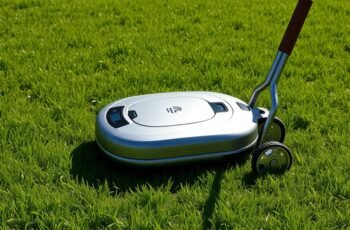
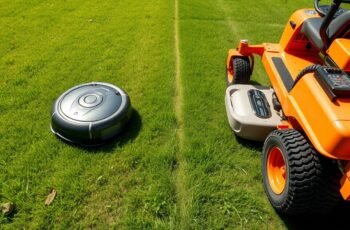
When considering lawn maintenance options, understanding the key differences between robot lawn mowers and ride-on mowers is essential. Each offers distinct advantages depending on the size, terrain, and your priorities for control and automation. We’ll explore how these machines compare in functionality, costs, and suitability to various lawn care needs, which can considerably influence your decision-making process. Let’s examine the critical factors that determine the best fit for your outdoor space and lifestyle.
Key Takeaways
- Robot mowers are automated, quiet, and ideal for small, flat lawns, while ride-on mowers offer manual control and higher power for large terrains.
- Robot mowers require minimal maintenance and have lower operating costs, unlike ride-on mowers which involve higher fuel and upkeep expenses.
- Ride-on mowers provide greater versatility for complex terrains and larger areas but come with higher initial investment.
- Robot mowers are suitable for users seeking convenience, automation, and low noise, whereas ride-on mowers suit those needing power and manual control.
- Choice depends on lawn size, terrain complexity, budget, and desired level of automation and labor reduction.
What Are the Main Differences Between Robot Lawn Mowers and Ride-On Mowers?
Although both robot lawn mowers and ride-on mowers serve the primary function of cutting grass, they differ considerably in design, operation, and suitability for various lawn sizes. Robot mowers emphasize automated efficiency, utilizing sensors and programmable schedules to maintain lawns with minimal human input. They operate autonomously, steering through complex terrains and adjusting to obstacles without manual control. In contrast, ride-on mowers provide manual control, allowing operators to steer and manage cutting paths directly, which is essential for precise, large-scale mowing. The choice between these tools hinges on lawn size and desired autonomy. Robot mowers excel in reducing labor and automating routine tasks, while ride-on mowers offer direct operator control, making them better suited for extensive or intricate landscapes requiring manual oversight.
Which Mower Is Better for Small or Flat Lawns?
When determining the best mower for small or flat lawns, robot lawn mowers often present a more practical and efficient option. Their integration of smart technology enables precise navigation and scheduling, optimizing coverage without human intervention. For flat terrains, robot mowers excel due to their consistent cutting patterns and ability to operate continuously. Additionally, these mowers feature considerably lower noise levels compared to ride-on models, making them suitable for residential areas with noise restrictions. Their compact design allows for easy maneuvering around obstacles, and smart technology ensures minimal overlap, conserving energy and time. Overall, for small or flat lawns, robot mowers offer a combination of technological sophistication and quiet operation, making them an ideal choice for low-maintenance landscaping.
How Do Maintenance and Operating Costs Compare?
Evaluating maintenance and operating costs reveals significant differences between robot lawn mowers and ride-on models. Robot mowers typically feature higher battery efficiency, which reduces the frequency and cost of battery replacements, but require minimal maintenance beyond blade sharpening and software updates. Their noise levels are considerably lower, decreasing the need for soundproofing measures and minimizing disturbance, which can be advantageous in noise-sensitive environments. Conversely, ride-on mowers involve higher initial costs, with ongoing expenses for fuel, engine oil, and regular mechanical maintenance. While they lack the battery efficiency of robot mowers, their larger fuel tanks and simpler engine designs can lead to predictable operating costs. Overall, robot mowers offer lower long-term expenses due to reduced operational complexity, but initial investment and maintenance specifics vary between models.
What Are the Advantages and Limitations of Each Type?
Robot lawn mowers excel in providing quiet, automated operation with minimal user intervention, making them highly suitable for maintaining small to medium-sized lawns efficiently. Their primary advantage lies in consistent, precise cutting, reducing manual labor and operational costs. However, limitations include restricted coverage area, difficulty *maneuvering* complex terrain or obstacles, and dependency on a stable power supply. In contrast, ride-on mowers deliver high productivity for larger lawns, offering robust power, faster coverage, and the ability to handle varied terrain and thick grass. Their drawbacks involve higher initial costs, increased maintenance, and greater noise levels. While Robot Mowers prioritize convenience and quiet operation, Ride-On Mowers excel in power and coverage, making each suitable for specific lawn types and user needs.
Which Mower Fits Your Lawn Care Lifestyle and Budget?
Choosing the right mower depends heavily on your specific lawn care routine, financial considerations, and the physical effort you’re willing to invest. For those prioritizing smart technology, robot lawn mowers offer advanced features like programmable schedules, sensors, and app connectivity, which can optimize mowing efficiency. Ride-on mowers, however, typically lack such automation but provide greater power and control for large or uneven terrains. Noise levels are a vital factor; robot mowers operate quietly, minimizing disruption, while ride-on mowers generate considerably more noise, which may influence your decision based on your environment. Budget-wise, robot mowers tend to have higher upfront costs but lower ongoing labor expenses, whereas ride-on mowers require a larger initial investment but may be more suitable for extensive lawns requiring frequent maintenance.
Frequently Asked Questions
Can Robot Mowers Handle Uneven Terrain or Steep Slopes?
We find that robot mowers generally struggle with uneven terrain and steep slopes due to limited terrain adaptability and slope capability. For such conditions, ride-on mowers offer superior performance, ensuring efficient, safe, and consistent mowing across challenging landscapes.
How Long Does the Battery Last on a Robot Lawn Mower?
Battery life typically ranges from 60 to 120 minutes, depending on model and grass density. We find that power efficiency improvements extend operation, making robots more reliable—like a steady heartbeat—ensuring consistent mowing performance for your lawn’s health.
Are Ride-On Mowers Suitable for Professional Commercial Use?
Ride-on mowers are suitable for commercial use due to their superior commercial durability and power, but they require significant investment. We consider cost efficiency and long-term performance essential, making them ideal for large-scale, professional landscaping projects.
What Safety Features Are Included in Both Mower Types?
Did you know 85% of modern mowers include safety features? Both mower types utilize sensor technology and safety sensors, which detect obstacles, prevent accidents, and automatically stop operation when risks are identified, ensuring user safety.
Can Both Mowers Operate in All Weather Conditions?
Both mowers have limited weather adaptability; rain can hinder operation and cause safety issues. Terrain limitations also restrict their use, with robot mowers generally better on flat terrain, while ride-on mowers handle more varied terrains but still face weather constraints.
Conclusion
Ultimately, choosing between a robot lawn mower and a ride-on depends on your lawn’s size, terrain, and your priorities. As the saying goes, “You get what you pay for,” so weigh initial costs against long-term benefits. Both options have their merits—automation for convenience, manual power for versatility. By aligning your lawn care needs with each mower’s features, you’ll guarantee a precise, efficient cut that suits your lifestyle and budget.