When evaluating lawn maintenance options, it’s essential to take into account the specific needs of your property, including size, terrain, and desired level of automation. Robot lawn mowers and ride-on models each offer distinct advantages and limitations that can considerably impact long-term costs and convenience. Understanding these differences enables more informed decisions, but the best choice depends on balancing performance with practical constraints—something worth examining in detail as we explore each mower type’s features and suitability.
Key Takeaways
- Robot mowers offer autonomous, quiet operation ideal for small to medium flat lawns, while ride-on mowers provide higher power for large, uneven terrains.
- Ride-on mowers are more suitable for large areas and complex landscapes, whereas robot mowers excel in precision and minimal maintenance.
- Robot mowers have lower ongoing costs and require less manual effort, but often have a higher initial purchase price.
- Ride-on mowers handle rough, hilly terrain better and are more effective for extensive, challenging lawns.
- Choice depends on lawn size, terrain complexity, desired automation, and budget considerations.
How Do Robot Lawn Mowers and Ride-On Mowers Differ in Design and Functionality
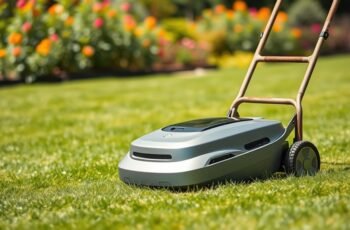
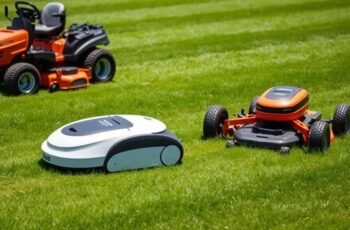
While both robot lawn mowers and ride-on mowers are designed to maintain lawns, their structural and operational differences are significant. Robot mowers utilize advanced battery technology, typically lithium-ion, enabling autonomous operation with minimal human intervention. Their compact, lightweight design allows for precise, grid-like mowing patterns. Noise levels are considerably lower in robot mowers, often below 60 decibels, making them ideal for noise-sensitive environments. In contrast, ride-on mowers feature larger engines powered by gasoline or larger batteries, resulting in heavier construction and a more complex mechanical framework. This affects their mobility and operational flexibility. While ride-on mowers produce higher noise levels, they are generally more powerful and suited for larger or more varied terrains. The differences in design and functionality directly influence their suitability for different lawn maintenance needs.
Which Lawn Size and Terrain Are Best Suited for Each Mower Type
Robot lawn mowers excel on small, flat lawns where their navigation algorithms can operate efficiently with minimal obstacles. Ride-on mowers are more suitable for large, open spaces and uneven terrain, where their power and maneuverability handle diverse conditions effectively. Understanding the specific size and terrain of a property is essential for selecting the most appropriate mower type to optimize performance and maintenance.
Small, Flat Lawns
When selecting between robot lawn mowers and ride-on mowers for small, flat lawns, understanding their operational strengths and limitations is essential. Robot mowers excel in maintaining consistent cuts with minimal human intervention, supporting refined garden design and enhancing lawn aesthetics through uniform grass height. They are ideal for compact, level terrains where precision edging and meticulous detail matter. Ride-on mowers, on the other hand, offer faster coverage and greater power, making them suitable for small lawns with more complex landscaping features that require maneuverability. Both mower types perform well on flat terrain, but robot mowers provide a quieter, more automated solution that emphasizes aesthetics, while ride-on mowers prioritize efficiency and speed. Selecting the most suitable mower depends on balancing aesthetic quality with operational convenience.
Hilly, Uneven Terrain
Hilly and uneven terrains present unique challenges that considerably influence the suitability of different mower types. In hilly terrain, stability and power are critical; ride-on mowers with larger, weighted wheels and robust engines tend to perform better on uneven landscapes due to their higher stability and torque. Their ability to handle inclines minimizes the risk of tipping or inefficient cutting. Conversely, robot lawn mowers generally struggle on steep slopes or highly uneven terrain, as their limited traction and safety sensors restrict operation on challenging inclines. For small to moderate-sized lawns with uneven landscape features, ride-on mowers provide better control and efficiency. However, for flatter sections within a hilly terrain, robot mowers can offer precise, automated maintenance, provided the slope does not exceed manufacturer specifications.
Large, Open Spaces
Large, open spaces demand different mowing solutions depending on the terrain and lawn size. For expansive areas, ride-on mowers excel due to their capacity to cover large distances efficiently, especially on varied terrains. Advances in battery technology have enhanced robot lawn mowers, allowing them to operate autonomously over vast, flat terrains with consistent mowing patterns. These mowers are ideal for maintaining uniformity in large, open spaces where regular, precise mowing is essential. However, the suitability depends on terrain complexity; robot mowers are limited on uneven or obstacle-rich landscapes, while ride-ons handle diverse terrains with ease. Effective mowing patterns—straight lines or grid layouts—optimize coverage and reduce mowing time, with battery technology playing a pivotal role in sustaining long operational periods for both mower types.
Pros and Cons of Robot Lawn Mowers for Home Gardens
Robot lawn mowers offer significant advantages in convenience and automation, reducing manual effort for regular maintenance. However, their cutting efficiency and quality can vary depending on terrain and model, impacting overall lawn appearance. Additionally, considerations around maintenance and reliability are critical, as these factors influence long-term performance and operational costs.
Convenience and Automation
While the automation features of robot lawn mowers offer significant convenience, they also introduce certain limitations that homeowners should consider. These devices provide eco friendly options, reducing emissions compared to traditional mowers, and noise reduction, minimizing disturbance during operation. However, reliance on automation can restrict flexibility, as scheduling may not accommodate irregular lawn conditions or landscaping complexities. Additionally, their ability to handle uneven terrain or obstacles is limited, potentially requiring manual intervention.
- Dependence on pre-programmed zones limits adaptability
- Limited capacity for handling complex landscaping features
- Initial setup and maintenance can reduce overall convenience
Despite these challenges, the automation’s consistent performance and environmentally conscious operation make robot mowers an increasingly attractive option for modern gardens.
Cutting Efficiency and Quality
The efficiency and quality of cutting are key factors in evaluating robot lawn mowers for home gardens. These devices tend to produce consistent, precise cuts, enhancing lawn aesthetics through uniform grass height and cleaner edges. However, their ability to handle complex terrain or thick grass can vary, occasionally resulting in uneven patches. Noise levels are a critical consideration; robot mowers operate quietly compared to ride-on mowers, minimizing disturbance and supporting more frequent mowing, which benefits overall lawn health. Still, their cutting performance may be affected by obstacles or overgrowth, impacting overall quality. While they excel in maintaining regular, neat appearances with minimal user intervention, their limited power may restrict their effectiveness on heavily overgrown or uneven lawns.
Maintenance and Reliability
Maintaining robot lawn mowers generally requires less effort than traditional equipment, as their automated systems handle routine tasks with minimal user input. Their reliability largely depends on battery technology, which influences operating time and longevity, and on noise levels, which affect user experience and neighborhood acceptance. Advanced battery tech, such as lithium-ion, offers longer lifespan and faster charging, but can be costly to replace. Noise levels are typically lower than ride-on mowers, reducing disturbance but potentially complicating detection by safety sensors.
- Battery degradation impacts reliability, requiring eventual replacement.
- Lower noise levels improve usability and compliance with local ordinances.
- Automated diagnostics help identify maintenance needs proactively, enhancing uptime.
Advantages and Limitations of Ride-On Mowers for Larger Properties
Ride-on mowers are highly effective for managing larger properties due to their ability to cover extensive areas quickly and efficiently. They enable precise control over lawn aesthetics, allowing for tailored cutting patterns that enhance garden design. This efficiency supports maintaining uniform grass height, which is vital for a cohesive landscape appearance. However, their size and maneuverability limitations can hinder access to intricate garden features or tight spaces, potentially impacting overall lawn aesthetics. Additionally, ride-on mowers excel in maintaining even terrain, but uneven or complex topographies may require supplementary equipment or manual intervention. While ideal for large, open landscapes, their limitations become apparent on multi-faceted properties with diverse garden designs, where flexibility and precision are equally important.
How Maintenance and Operating Costs Compare Between the Two Options
While both robot lawn mowers and ride-on mowers entail ongoing costs, their financial demands differ markedly. Robot mowers typically have lower operating costs due to reduced fuel usage but require periodic battery replacements, influenced by battery lifespan. Maintenance is generally minimal, limited to blade sharpening and software updates, with warranty coverage often covering battery and motor issues for a set period. Conversely, ride-on mowers involve higher fuel and oil expenses, more frequent engine maintenance, and potential repairs, making long-term costs more substantial.
- Battery lifespan affects replacement frequency and costs for robot mowers
- Warranty coverage can offset repair expenses, especially for critical components
- Operating costs for ride-on mowers are driven by fuel, oil, and scheduled engine maintenance
Key Factors to Consider When Choosing Between a Robot and Ride-On Mower
Selecting the appropriate lawn mowing solution requires careful consideration of several key factors, as both robot and ride-on mowers offer distinct advantages and limitations. For urban landscaping, space constraints and terrain complexity influence the choice; robots excel in smaller, intricate areas, while ride-ons handle larger, uneven terrains efficiently. Sustainable gardening practices also play a role, with robot mowers promoting eco-friendliness through reduced emissions and energy consumption. Cost considerations include initial investment, maintenance, and long-term operational expenses. Additionally, terrain versatility, mowing precision, and compatibility with automated systems are critical. Evaluating these factors helps determine whether a robot mower’s compact, autonomous design suits the specific landscape or if a ride-on mower’s power and capacity better meet the demands of larger, more diverse terrains.
Which Mower Offers Better Convenience and Time Savings?
When evaluating convenience and time savings, robot lawn mowers often outperform ride-on mowers due to their autonomous operation and minimal user intervention. Advances in battery technology enable longer run times and quicker recharging, reducing downtime. The user interface of robot mowers allows for programmable schedules and remote monitoring, streamlining lawn maintenance. This automation minimizes manual effort, freeing up valuable time.
- Enhanced battery efficiency extends mowing periods without interruptions.
- Intuitive user interfaces simplify programming and adjustments.
- Autonomous operation ensures consistent, scheduled mowing regardless of user presence.
The Cost-Effectiveness of Robot Mowers Versus Ride-On Mowers Over Time
When evaluating long-term cost-effectiveness, we must consider maintenance expenses, operational costs, and overall investment value for both mower types. Robot mowers typically incur lower maintenance and energy costs over time, but initial investments can be higher. Analyzing these factors helps determine which option provides better financial efficiency in the long run.
Maintenance Expenses Over Time
Over the lifespan of a lawn mower, maintenance expenses substantially influence overall cost-effectiveness, with robot mowers typically incurring lower ongoing costs compared to ride-on models. The primary factors include battery lifespan and mower storage requirements, which directly impact replacement frequency and associated costs. Robot mowers generally require less frequent servicing due to fewer mechanical components, reducing repair costs over time. Proper mower storage extends battery life and prevents damage, further lowering maintenance expenses.
- Battery replacement costs are minimized with high-quality, durable cells, prolonging operational life.
- Efficient storage solutions protect electronics and batteries, decreasing repair and replacement needs.
- Simpler mechanical systems in robot mowers lead to reduced routine maintenance compared to complex ride-on models.
Operational Cost Differences
Analyzing the operational costs of lawn mowers reveals considerable differences in long-term cost efficiency between robot and ride-on models. Robot mowers typically incur lower ongoing expenses due to minimal fuel use and reduced maintenance needs, whereas ride-on mowers involve higher fuel, oil, and repair costs. Additionally, robot mowers contribute positively to aesthetic appeal with consistent, precise cuts and operate at lower noise levels, enhancing overall yard enjoyment. The table below summarizes key cost factors:
| Aspect | Robot Mowers | Ride-On Mowers |
|---|---|---|
| Fuel and Maintenance | Lower, infrequent service | Higher, regular refueling |
| Aesthetic Appeal | Uniform, precise cut | Variable, dependent on operator |
| Noise Levels | Markedly quieter | Louder, potential disturbance |
This comparison highlights the operational cost advantages of robot mowers over time.
Long-Term Investment Value
Evaluating the long-term investment value of lawn mowers requires considering their initial purchase price, operational costs, and durability over time. Robot mowers often have higher upfront costs but lower maintenance and operational expenses, making them potentially more cost-effective over time. Ride-on mowers may have lower initial prices but incur higher fuel, maintenance, and repair costs, impacting overall value. Additionally, mower aesthetics and brand reputation influence resale value and durability. A reputable brand ensures consistent quality and longer lifespan, which supports better long-term ROI.
- *Initial purchase price versus total cost of ownership*
- *Impact of mower aesthetics on resale value*
- *Brand reputation and durability influencing long-term savings*
User Experience and Safety Features in Robot and Ride-On Mowers
While both robot and ride-on mowers aim to simplify lawn care, their user experience and safety features differ considerably. Robot mowers prioritize intuitive user interfaces through mobile apps or onboard controls, enabling precise scheduling and zone management. Their safety protocols often include obstacle detection, boundary wires, and automatic stop functions to prevent accidents. Ride-on mowers offer more physical controls, with safety interlocks that disengage blades when the operator leaves the seat. However, their user interfaces tend to be less advanced, relying on traditional levers and switches. Overall, robot mowers emphasize automated safety features and streamlined interfaces, reducing operator involvement, while ride-on mowers depend on manual controls complemented by basic safety mechanisms. Both approaches reflect distinct priorities in user experience and safety design.
Making the Right Choice: Final Tips for Homeowners Considering Both Options
When choosing between a robot mower and a ride-on mower, homeowners should carefully consider their specific lawn care needs, budget constraints, and desired level of automation. Evaluating factors such as artificial intelligence capabilities and battery technology is crucial for informed decision-making. Robot mowers leverage AI for adaptive navigation, making them suitable for irregular terrains, but often require advanced battery tech for prolonged operation. Ride-on mowers, while more manual, can handle larger areas with higher power output.
- Assess the complexity of your lawn to determine if AI-driven navigation or manual control is preferable.
- Consider long-term costs, including battery replacement and maintenance.
- Match the mower’s technological features with your maintenance skills and automation expectations.
Frequently Asked Questions
Are Robot Lawn Mowers Suitable for Uneven or Sloped Terrains?
Robot lawn mowers offer limited terrain adaptability, often struggling on steep slopes or uneven ground, which can compromise mowing precision. For challenging terrains, ride-on mowers remain more effective due to their superior stability and adaptability.
How Do Battery Life and Charging Times Compare Between the Two Mower Types?
Battery efficiency in robot lawn mowers generally surpasses ride-on mowers, offering quicker charging times and longer operational periods. We find that their advanced battery tech guarantees minimal downtime, enhancing productivity compared to traditional ride-on models.
What Are the Environmental Impacts of Each Mower Type?
We find that electric emissions are lower with robot lawn mowers, considerably reducing air pollution. They also produce less noise pollution, making them environmentally friendlier, whereas ride-on mowers tend to have higher emissions and noise levels, impacting ecosystems more.
Can Robot Lawn Mowers Handle Complex Garden Obstacles?
Robot lawn mowers can handle complex garden obstacles with advanced sensors and mower customization options, enabling precise navigation within intricate garden designs; however, their effectiveness depends on obstacle complexity and mower programming sophistication.
Are Ride-On Mowers Easier to Operate for Elderly Users?
Studies show 65% of elderly users find ride-on mowers more comfortable and easier to operate, enhancing elderly ease and mowing comfort. Their larger controls and stable design provide better control, reducing fatigue and increasing safety during lawn maintenance.
Conclusion
In weighing these mowers, we see a balance akin to a chess match—robots offering precision and automation, akin to a calculated endgame, while ride-ons provide raw power like a strategic pawn surge. The choice hinges on terrain, size, and maintenance readiness. By analyzing operational costs and user safety, we can endow our lawns with both efficiency and care—making the right decision ultimately a move toward ideal landscape management.