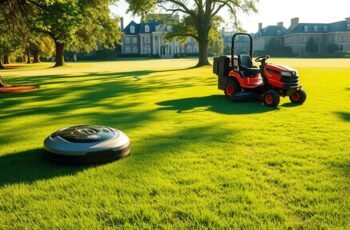
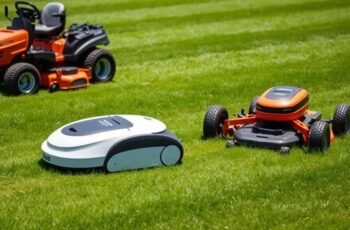
When choosing between robot mowers and self-propelled models, we must consider their respective mechanisms, power capabilities, and suitability for different lawn sizes and terrains. While robot mowers excel in quiet, eco-friendly, autonomous trimming, self-propelled units offer robust performance on challenging landscapes. Understanding these technical differences is essential for selecting equipment that aligns with long-term maintenance and environmental goals, prompting a closer look at their operational efficiencies and limitations in real-world applications.
Key Takeaways
- Robot mowers are quiet, eco-friendly, and ideal for small to medium lawns with obstacles, while self-propelled mowers handle larger, uneven terrains.
- Robot mowers offer autonomous, scheduled operation with low maintenance; self-propelled models require manual control and engine servicing.
- Robot mowers have higher upfront costs but lower ongoing expenses; self-propelled mowers involve fuel, higher repair, and maintenance costs.
- Robot mowers excel in precise, consistent cutting and obstacle navigation; self-propelled mowers provide higher power for dense or challenging grass.
- Environmentally, robot mowers produce minimal emissions; self-propelled models contribute more pollution and noise during operation.
How Do Robot Mowers and Self-Propelled Mowers Work?
While both robot mowers and self-propelled mowers are designed to automate lawn maintenance, they operate through fundamentally different mechanisms. Robot mowers rely on advanced battery technology, typically lithium-ion, enabling silent, wireless operation with minimal noise levels—often below 60 decibels—making them unobtrusive. They use embedded sensors and boundary wires to navigate and maintain the lawn autonomously, adjusting to obstacles and terrain in real-time. Conversely, self-propelled mowers are powered by internal combustion engines or larger batteries, requiring manual operation or remote control, with noise levels ranging from 80 to 100 decibels. Their propulsion systems involve mechanical drive wheels driven by either electric motors or gas engines, providing more direct control but producing more noise and emissions.
Comparing Performance: Power, Cutting, and Terrain Handling
We compare the power efficiency and strength of robot and self-propelled mowers to determine how well they handle demanding cutting conditions. Terrain adaptability and maneuverability are essential for maintaining consistent performance across varied landscapes. Analyzing these technical aspects helps identify which mower type offers superior performance in diverse environments.
Power Efficiency and Strength
When comparing power efficiency and strength, it becomes evident that robot mowers and self-propelled mowers differ markedly in their performance capabilities. Robot mowers rely heavily on advanced battery technology, providing sufficient power for routine grass cutting while maintaining low noise levels, which enhances efficiency and reduces disturbance. In contrast, self-propelled mowers typically feature larger engines, delivering higher strength for tackling thick, dense turf but at the cost of increased noise and energy consumption. This trade-off influences operational endurance and environmental impact.
| Feature | Robot Mower | Self-Propelled Mower |
|---|---|---|
| Battery Technology | Lithium-ion for efficiency | Gas-powered, high torque |
| Noise Levels | Low, quiet operation | Higher, louder operation |
| Power & Cutting Strength | Moderate, optimized for precision | High, designed for heavy-duty jobs |
Terrain Adaptability and Maneuverability
How do robot mowers and self-propelled mowers compare when it comes to steering through varied terrains and maneuvering with precision? Robot mowers excel in terrain adaptability due to their compact design, low center of gravity, and advanced sensors that navigate complex areas. Their battery life directly influences maneuverability, with longer-lasting batteries enabling sustained operation over uneven surfaces. Noise levels are markedly lower, allowing for discreet operation in sensitive environments. In contrast, self-propelled mowers offer more robust power for challenging terrains, but their larger size and heavier weight reduce agility on steep inclines or irregular ground. Maneuvering precision for self-propelled units depends on steering mechanisms; however, their higher noise output can be disruptive. Ultimately, terrain adaptability hinges on design and power management, with robot mowers providing quieter, more precise navigation in diverse terrains.
Which Mower Is Better for Small, Medium, or Large Lawns?
When evaluating mower options for varying lawn sizes, we focus on suitability, maneuverability, and operational complexity. Smaller lawns benefit from compact, easily navigable units, while larger areas demand models with higher efficiency and lower maintenance burdens. Analyzing these technical aspects helps determine which mower best balances ease of use and performance across different yard dimensions.
Suitability for Lawn Size
Determining the most suitable mower for different lawn sizes involves analyzing each model’s operational capacity and design features. Robot mowers excel on small to medium lawns due to their precise, consistent cutting patterns, which enhance lawn aesthetics without disturbing noise levels. Their limited power and battery life make them less effective for large areas. Conversely, self-propelled mowers are better suited for medium to large lawns, offering higher power, larger cutting decks, and efficient coverage. They can handle diverse terrain and maintain uniform cut quality, albeit with increased noise levels. For very large properties, a self-propelled mower’s greater capacity guarantees consistent performance, while robot mowers provide quiet operation on smaller plots. Careful assessment of lawn size and desired aesthetics guides the most suitable mower selection, balancing operational efficiency with noise considerations.
Maneuverability and Ease
Evaluating maneuverability and ease of use across different lawn sizes reveals distinct advantages for each mower type. Robot mowers excel in small to medium lawns due to their compact design, which allows precise navigation around obstacles. Advances in battery technology enhance their efficiency for sustained operation, while lower noise levels facilitate discreet mowing in tight spaces. Self-propelled mowers, however, offer superior maneuverability on larger properties, benefiting from adjustable steering and wider cutting paths. Their larger wheels enable better traversal over uneven terrain.
- Robot mowers’ compact form simplifies obstacle avoidance and tight corner navigation
- Battery technology in robot mowers reduces weight and improves agility
- Noise levels in robot mowers enable operation in noise-sensitive environments
- Self-propelled mowers handle varied terrain and larger areas with ease
- Ease of control and steering adjustments favor self-propelled models for extensive lawns
Maintenance and Operation
Which mower type offers more efficient maintenance and operation across different lawn sizes? Robot mowers excel in small to medium lawns due to their advanced battery technology, which allows for quick recharging cycles and minimal downtime. Their automated systems require regular blade checks and software updates, but overall maintenance remains low. Safety features, such as obstacle detection and automatic shutoff, enhance operational reliability. In contrast, self-propelled mowers demand more hands-on maintenance, including engine servicing, belt adjustments, and fuel management, which become increasingly cumbersome on larger properties. They also lack the integrated safety features found in robot models, making them less suitable for unattended operation. Overall, robot mowers provide a more streamlined, tech-driven approach to lawn maintenance, especially in varied lawn sizes.
Cost, Maintenance, and Longevity: What Are the Long-Term Impacts?
While both robot mowers and self-propelled mowers require upfront investments, their long-term costs differ markedly due to maintenance needs and longevity factors. A thorough cost comparison reveals that robot mowers generally have higher initial costs but lower ongoing maintenance, owing to fewer moving parts. In contrast, self-propelled mowers often incur higher repair costs over time, especially for engine and transmission components.
Key longevity factors include:
- Battery lifespan and replacement costs for robot mowers
- Durability of mechanical parts in self-propelled models
- Frequency of component wear and tear
- Cost of routine servicing and repairs
- Impact of environmental exposure on long-term performance
Understanding these elements helps evaluate total ownership costs and sustainability, guiding better investment decisions.
Pros and Cons of Robot Mowers vs Self-Propelled Mowers
Robot mowers and self-propelled mowers each present distinct advantages and drawbacks that influence their suitability for different users. Robot mowers excel with innovative features like programmable schedules and sensors, reducing manual effort and minimizing environmental impact through electric operation. Conversely, self-propelled mowers offer higher cutting power and versatility for uneven terrain, but often consume more fuel and produce emissions. The table below highlights key differences:
| Feature | Robot Mower | Self-Propelled Mower |
|---|---|---|
| Innovative Features | Autonomous navigation, sensors | Manual control, adjustable settings |
| Environmental Impact | Low emissions, electric-powered | Higher emissions, fuel-dependent |
| Terrain Compatibility | Flat, well-maintained lawns | Diverse terrains, steeper slopes |
| Maintenance & Cost | Lower ongoing maintenance, upfront tech | Higher maintenance, fuel costs |
These factors help determine which mower aligns with user priorities and environmental concerns.
Which Mower Fits Your Lifestyle and Lawn Care Needs?
Choosing the right lawn mower depends heavily on how we prioritize convenience, terrain, environmental impact, and maintenance requirements. For those valuing meticulous lawn aesthetics, robot mowers excel with consistent, precise cutting, maintaining a uniform appearance. Conversely, self-propelled mowers handle varied terrains better and offer faster coverage for larger areas. Noise levels are critical; robot mowers operate quietly, minimizing disturbance, whereas self-propelled models generate more noise, suitable for larger lawns. Consider these factors:
- Lawn size and complexity
- Desired lawn aesthetics and precision
- Terrain type and obstacles
- Environmental considerations, like noise and emissions
- Maintenance and operational convenience
Matching these factors with your lifestyle ensures the best performance and satisfaction, whether you prioritize low noise, high precision, or efficient coverage.
Frequently Asked Questions
Can Robot Mowers Handle Steep Slopes or Uneven Terrain?
Robot mowers can handle steep slopes and uneven terrain depending on battery life and cutting capacity; models with higher torque and advanced sensors navigate better, but limited battery life may restrict their efficiency on complex landscapes.
Are Robot Mowers Suitable for Lawns With Complex Landscaping?
While robot mowers excel in simplicity, their navigation can challenge intricate landscaping and garden design. We find they suit moderate complexity best, requiring careful planning and possibly supplemental tools for highly detailed or uneven terrains.
How Do Weather Conditions Affect the Performance of Each Mower Type?
Weather conditions impact both mower types’ performance consistency and weather resilience, with robot mowers often more susceptible to rain and extreme cold, potentially causing malfunctions, whereas self-propelled mowers handle diverse conditions more reliably, ensuring steady operation.
What Safety Features Are Included in Robot and Self-Propelled Mowers?
We analyze safety features like emergency stop buttons, obstacle sensors, and blade guards, noting that battery life impacts operational safety, while noise levels influence user awareness and nearby pet safety, ensuring thorough protection for both mower types.
Can Robot Mowers Be Integrated With Smart Home Systems?
We find that many robot mowers support smart home integration, enabling voice control via platforms like Alexa or Google Assistant, which allows seamless automation and remote management, enhancing efficiency and user convenience through detailed, technical connectivity options.
Conclusion
In weighing robot versus self-propelled mowers, we see each as a tool tailored to specific needs—much like choosing between a precision scalpel and a rugged chisel. Robot mowers excel in quiet, eco-friendly maintenance for small to medium lawns, while self-propelled models provide brute strength for larger, tougher terrains. Ultimately, selecting the right mower depends on your lawn’s size, terrain, and your commitment to sustainability versus power.