In designing effective robot mower systems, collision sensors play a critical role in obstacle detection and overall safety. Understanding the various sensor types, their strengths, and limitations helps us optimize performance and longevity. As technology advances, integrating smarter detection methods becomes essential. To fully grasp how these sensors contribute to autonomous lawn care, we need to examine their functions, maintenance, and future prospects in detail.
Key Takeaways
- Understand different collision sensor types: mechanical bumpers, optical, and infrared, and their suitability for various environments.
- Regularly maintain and calibrate sensors to ensure accurate obstacle detection and prevent false alarms.
- Troubleshoot common issues like misalignment, dirt, or power problems to improve sensor reliability.
- Choose sensors compatible with your mower’s system, emphasizing weather resistance and noise reduction features.
- Stay updated on future advancements like sensor fusion and AI integration for smarter, more autonomous mowing.
How Do Collision Sensors Help Robot Mowers Avoid Obstacles?
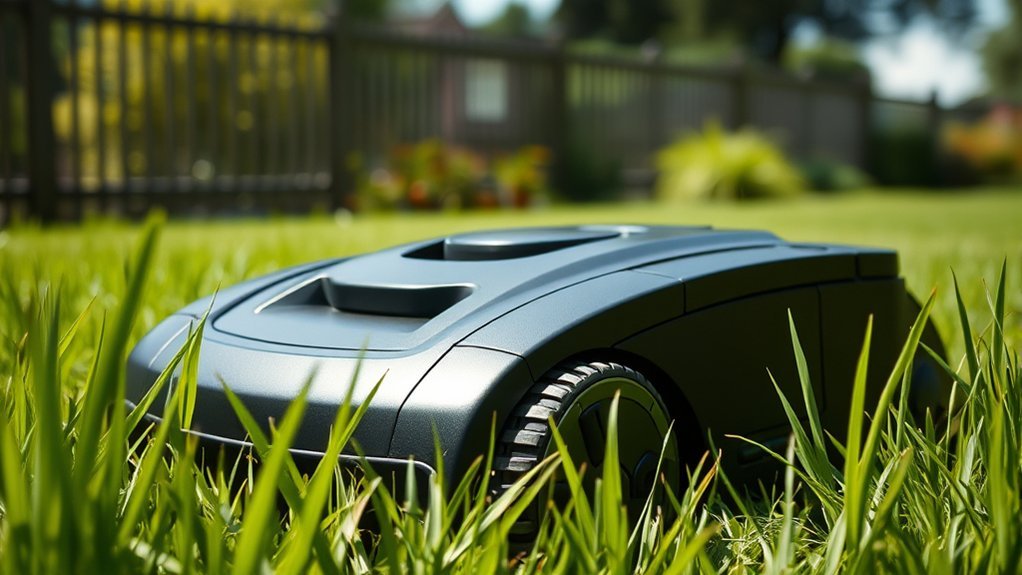
Collision sensors are integral to the functionality of modern robot mowers, providing real-time obstacle detection that enhances their efficiency and safety. These sensors analyze the garden layout, allowing the mower to adapt its mowing patterns dynamically. By detecting obstacles such as rocks, trees, or garden furniture, sensors prevent damage and guarantee continuous operation. They enable the mower to modify its path proactively, avoiding repeated collisions that could disrupt mowing efficiency. This real-time feedback facilitates precise navigation, especially in complex garden layouts with irregular shapes or dense vegetation. Consequently, collision sensors optimize the mower’s ability to follow planned mowing patterns, reducing manual intervention. Overall, these sensors are essential for maintaining consistent, safe, and efficient lawn care in diverse garden environments.
Types of Collision Sensors Used in Robot Mowers
In analyzing collision detection in robot mowers, we focus on three primary sensor types: mechanical bumper sensors, optical obstacle detection systems, and infrared collision sensors. Each employs distinct mechanisms for obstacle identification, influencing their responsiveness and accuracy. Understanding these differences is essential for optimizing mower performance and reliability.
Mechanical Bumper Sensors
Mechanical bumper sensors are a fundamental component in many robot mowers, providing a direct physical means of detecting obstacles. They activate upon contact, allowing the mower to promptly halt and redirect, thus preserving grass cutting precision. These sensors are typically composed of a cushioned bumper linked to a switch that triggers when pressed. Their simplicity ensures durability and reliability, especially in varied terrain and grass conditions. However, their mechanical nature means they are limited to contact-based detection, which could result in delayed obstacle response compared to other sensors.
| Feature | Description |
|---|---|
| Activation | Physical contact triggers sensor |
| Durability | Resistant to environmental factors |
| Response | Immediate obstacle detection |
| Limitations | No detection before contact |
| Application | Suitable for dense, obstacle-rich lawns |
Optical Obstacle Detection
Optical obstacle detection has become a vital component in modern robot mower systems, utilizing various sensor technologies to identify obstacles before contact occurs. These systems leverage robotic vision, employing cameras and advanced image processing algorithms to analyze the environment. This allows for real-time obstacle mapping, providing detailed spatial data to the mower’s navigation system. By interpreting visual cues, the mower can distinguish between different obstacle types and plan ideal routes, reducing the risk of collisions. Optical sensors offer high-resolution detection that adapts dynamically to changing conditions, such as varying light levels or complex terrains. This technology enhances precision in obstacle identification, enabling safer and more efficient mowing operations, especially in environments with a diverse array of obstacles that demand detailed visual analysis.
Infrared Collision Sensors
Infrared collision sensors are widely employed in robot mower systems due to their ability to detect obstacles through the emission and reception of infrared light. These sensors utilize infrared sensors to identify objects by measuring reflected infrared signals, enabling precise collision avoidance. Their operational principle involves emitting infrared light and analyzing the reflected signals to determine the proximity of obstacles. Infrared collision sensors are effective in detecting low-profile objects and work well in controlled lighting conditions. However, they may be susceptible to interference from ambient infrared sources or direct sunlight, which can impact accuracy. Despite these limitations, their rapid response and integration simplicity make infrared sensors a popular choice for collision avoidance in robot mowers, enhancing navigation safety and operational efficiency.
How to Choose the Right Collision Sensor for Your Mower
Choosing the right collision sensor for your mower requires careful consideration of several technical specifications to guarantee ideal performance. Key factors include compatibility with smart home integration systems, enabling seamless connectivity and automation. Sensors offering robust noise reduction are essential to minimize false alarms and maintain quiet operation, especially in noise-sensitive environments. Sensitivity settings should be adjustable to prevent unnecessary triggers without compromising safety. Durability and weather resistance are also critical, ensuring consistent performance in various outdoor conditions. Additionally, selecting sensors with precise detection ranges helps optimize obstacle avoidance without overreacting to minor contacts. By evaluating these specifications, you assure your mower responds accurately and quietly, creating a safer, smarter, and more efficient lawn care system.
Common Issues and Troubleshooting Tips for Collision Sensors
We often encounter issues with sensor alignment, which can impair obstacle detection accuracy. Obstacle detection failures may also result from sensor contamination or environmental factors, affecting overall performance. Additionally, battery or power supply problems can cause inconsistent sensor operation, making troubleshooting essential for reliable function.
Sensor Alignment Problems
Have you ever wondered why your robot mower’s collision sensors fail to detect obstacles reliably? Misalignment often causes this issue, requiring precise sensor calibration and alignment troubleshooting. To guarantee maximum performance, consider these key points:
- Verify sensor positioning relative to the mower’s chassis, ensuring they face the correct direction.
- Check for debris or obstructions that could affect sensor alignment, cleaning or repositioning as needed.
- Perform sensor calibration regularly, following manufacturer instructions to recalibrate sensor angles and sensitivity.
- Use diagnostic tools or visual aids to confirm sensors are aligned accurately and detect obstacles at the intended range.
Proper alignment troubleshooting and sensor calibration are essential to prevent false negatives and improve obstacle detection reliability.
Obstacle Detection Failures
Obstacle detection failures in robot mowers often stem from issues beyond mere sensor misalignment, including environmental factors and sensor degradation. Overgrown garden landscaping or cluttered pathways can obstruct sensors, causing missed detections. Additionally, dust, dirt, or moisture buildup may impair sensor accuracy over time. Regularly inspecting sensor surfaces and cleaning them is essential. Here’s a visual comparison:
| Environmental Factors | Sensor Condition |
|---|---|
| Dense foliage, debris | Dust or dirt buildup |
| Wet or humid conditions | Corrosion or moisture damage |
| Changes in garden landscaping | Sensor misalignment or aging |
| Variations in lawn maintenance schedules | Reduced sensor responsiveness |
Understanding these influences helps maintain *ideal* obstacle detection, ensuring your robot mower navigates reliably within your lawn’s evolving landscape.
Battery and Power Issues
Could power issues be the hidden culprit behind collision sensor failures in your robot mower? Inadequate battery maintenance or poor power supply optimization can lead to inconsistent sensor performance. Low voltage or fluctuating power can cause sensors to malfunction or intermittently disconnect, risking obstacles. To troubleshoot:
- Regularly check and replace batteries to ensure consistent voltage levels.
- Clean and inspect connections for corrosion or loose contacts.
- Use a multimeter to verify the power supply is within manufacturer specs.
- Implement power supply stabilization methods, like voltage regulators, if needed.
Addressing these issues helps maintain stable power, reducing sensor errors. Proper battery maintenance and power supply optimization are essential for reliable obstacle detection and overall mower efficiency.
Tips for Maintaining and Extending the Life of Your Collision Sensors
To guarantee the longevity and reliable performance of your collision sensors, regular maintenance is essential. Proper cleaning and calibration ensure ideal garden safety and accurate obstacle detection. Dust, debris, and moisture can impair sensor function, so routinely inspect and gently clean the sensors with a soft cloth. Sensor calibration should be performed periodically to maintain precise obstacle recognition, especially after firmware updates or physical impacts. Below is a table outlining key maintenance tasks:
| Task | Purpose |
|---|---|
| Regular cleaning | Remove dirt and debris for clear detection |
| Sensor calibration | Ensure accurate obstacle detection |
| Visual inspection | Detect damage or misalignment |
Consistent upkeep prevents false positives and extends sensor lifespan, ensuring safer, more efficient mowing.
Future Trends in Collision Detection Technology for Robot Mowers
Advancements in sensor technology are poised to considerably enhance collision detection capabilities in future robot mowers. AI integration will enable real-time data processing, improving robotic navigation and obstacle recognition accuracy. We expect to see developments such as:
- Enhanced sensor fusion combining ultrasonic, infrared, and visual sensors for thorough environmental mapping.
- Machine learning algorithms that adapt to complex terrains and dynamic obstacles.
- Integration of AI-driven predictive analytics for preemptive collision avoidance.
- Smarter robotic navigation systems leveraging sensor data to optimize path planning and minimize false positives.
These trends will lead to more reliable, efficient, and autonomous mower operation, reducing user intervention and increasing safety in diverse environments. The future of collision detection hinges on the seamless synergy between AI and sensor technology.
Frequently Asked Questions
Are Collision Sensors Suitable for All Types of Terrain?
Collision sensors vary in terrain adaptability; they work well on flat, unobstructed surfaces but may require sensor calibration for complex or uneven terrains, ensuring best detection and performance across diverse mowing environments.
How Do Weather Conditions Affect Collision Sensor Performance?
Weather conditions can dampen sensor calibration and weather durability, making sensors less reliable. Rain, snow, or fog create interference, like a foggy mirror, reducing collision detection accuracy and demanding more robust, weather-resistant sensor designs for consistent performance.
Can Collision Sensors Differentiate Between Humans and Animals?
Collision sensors primarily detect obstacles through proximity, but they lack the capability for precise human detection or animal recognition. While some advanced models attempt differentiation, most rely on sensor data rather than sophisticated algorithms for identifying humans versus animals.
What Are the Costs Associated With Upgrading Collision Sensors?
Upgrading collision sensors involves costs for advanced sensor calibration and enhanced sensor durability, ensuring precise detection and longevity, which may range from moderate to high depending on sensor complexity and integration requirements.
How Do Collision Sensors Impact Battery Life of Robot Mowers?
A stitch in time saves nine; collision sensors can slightly reduce battery efficiency due to additional power draw, but their sensor durability often outweighs this, maintaining overall mower performance and safety while optimizing energy use.
Conclusion
By understanding how collision sensors work, selecting the right type, maintaining them properly, and staying informed on emerging technologies, we can guarantee our robot mowers operate safely, efficiently, and reliably. Vigilance in troubleshooting and proactive upkeep extend sensor lifespan and enhance performance. Embracing innovation in collision detection enables us to optimize autonomous lawn care, reduce downtime, and improve safety. Ultimately, investing in sensor technology and maintenance empowers us to achieve precision, durability, and peace of mind in our robotic mowing solutions.