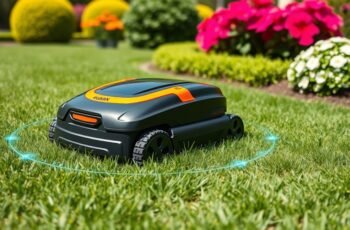
As industry professionals, we recognize that safety certification for robotic lawn mowers plays a vital role in ensuring devices operate reliably and securely. These standards involve rigorous testing and compliance checks, which directly impact user confidence and device adoption. Understanding what certifications entail and how they influence design and safety features is essential for making informed decisions. The evolving landscape of safety standards raises important questions about ongoing compliance and future innovations worth exploring.
Key Takeaways
- Safety certification verifies compliance with standards like IEC 60335-2-107 and IEC 60335-2-106, ensuring device safety and reliability.
- Recognized safety marks (CE, UL, ISO) and official verification validate that the mower meets safety and obstacle detection requirements.
- Certified safety features include emergency stops, obstacle sensors, blade shutoff mechanisms, and perimeter boundary systems.
- Certification involves rigorous testing of electrical safety, obstacle avoidance, emergency response, and durability under real-world conditions.
- Future standards will emphasize advanced sensors, AI integration, and user training to enhance safety and regulatory compliance.
What Is Robot Lawn Mower Safety Certification and Why Does It Matter?
Robot lawn mower safety certification is a formal process that verifies whether these devices meet established safety standards before they reach consumers. This certification ensures the devices minimize environmental impact by regulating noise levels, emissions, and energy consumption, contributing to eco-friendly operation. It also emphasizes the importance of thorough user training, equipping operators with knowledge to handle the mower safely and efficiently. Certification involves rigorous testing of safety features such as obstacle detection, blade stability, and emergency shutdown systems. By adhering to these standards, manufacturers demonstrate their commitment to safety, environmental responsibility, and effective user education. Ultimately, safety certification not only protects users and bystanders but also promotes sustainable practices, reinforcing trust in robotic lawn mower technology.
Key Safety Standards and Certifications for Robotic Lawn Mowers
We focus on specific safety certification requirements that guarantee robotic lawn mowers meet rigorous industry standards. Compliance with these standards is critical for effective risk mitigation and user safety. By examining key certifications, we can better understand how safety protocols are integrated into product design and testing.
Safety Certification Requirements
Ensuring safety certification for robotic lawn mowers involves strict adherence to established standards and certification processes designed to mitigate operational hazards. These requirements emphasize rigorous testing of electrical safety, mechanical integrity, and cutting system reliability, reflecting the demands of modern lawn care and robotic innovation. Certifications such as IEC 60335-2-107 specify safety protocols for domestic robotic appliances, ensuring compliance with electromagnetic compatibility and user safety. Manufacturers must demonstrate adherence through thorough documentation, risk assessments, and third-party testing. Certification bodies verify that robotic lawn mowers incorporate fail-safes, obstacle detection, and safe shutdown mechanisms. These requirements guarantee that the integration of advanced robotics in lawn care meets essential safety benchmarks, fostering consumer trust and supporting widespread adoption of robotic innovation within the industry.
Industry Standard Compliance
Adherence to industry standards is essential for certifying the safety and reliability of robotic lawn mowers, providing a clear framework for manufacturers to follow. Compliance guarantees that key safety features, such as battery longevity and user interface design, meet rigorous benchmarks. Standards like IEC 60335-2-106 specify safety requirements for robotic lawn mowers, emphasizing electrical safety and durability. Certification processes verify that devices maintain consistent battery performance over time and include safeguards against short circuits or overheating. Additionally, standards address user interface clarity to prevent operational errors, ensuring intuitive controls and clear indicator signals.
- Electrical safety and insulation requirements
- Battery longevity testing protocols
- User interface accessibility standards
- Mechanical robustness and durability
- Environmental resilience and safety measures
Risk Mitigation Strategies
Implementing thorough risk mitigation strategies is essential to safeguarding users and property when deploying robotic lawn mowers. Adherence to key safety standards ensures proper system design, including fail-safe mechanisms and obstacle detection. Emphasizing battery longevity reduces the risk of thermal events or malfunctions caused by degraded power sources, enhancing overall safety. Equally important is all-encompassing user training, which ensures operators understand safety protocols, device limitations, and emergency procedures. Certification processes verify that mowers meet strict safety and reliability criteria, minimizing hazards associated with power failures or mechanical faults. Continuous monitoring of battery performance and user competency promotes proactive risk management. Combining technical standards with effective education creates a robust safety framework, reducing incidents and fostering responsible deployment of robotic lawn mowers.
How Do Manufacturers Ensure Their Mowers Meet Safety Requirements?
Manufacturers rigorously test their robotic lawn mowers against established safety standards to confirm conformity with regulatory requirements. This process guarantees that advanced robotic technology integrates seamlessly with safety protocols essential for safe lawn maintenance. Tests focus on electrical safety, obstacle detection, and emergency stop functions, verifying consistent performance under diverse conditions. To assure adherence, manufacturers employ rigorous assessments, including simulated real-world scenarios, durability testing, and compliance with international standards. These measures ensure the mower’s safety features activate correctly and reliably. Through meticulous testing, companies demonstrate their commitment to safe operation, minimizing risks for users and bystanders alike.
- Electrical safety and insulation checks
- Obstacle detection and avoidance validation
- Emergency stop and shutdown testing
- Durability and environmental resilience assessments
- Compliance with international safety standards
Important Safety Features to Look for in Certified Robot Lawn Mowers
When selecting a certified robot lawn mower, understanding its safety features is essential to guarantee reliable and secure operation. These features should include sensors that detect the garden layout, such as boundary wires and obstacle sensors, to prevent unintended movement beyond designated areas. Additionally, integrated lift and tilt sensors are critical for immediate shutdown if the mower is lifted or tilted, reducing injury risk. A robust safety mechanism for the blade system ensures it stops promptly during anomalies. Battery lifespan also impacts safety; a longer-lasting battery reduces the risk of malfunction due to power depletion. Reliable battery management systems prevent overheating or sudden shutdowns, maintaining safe operation over time. Prioritizing these safety features ensures the mower functions securely within complex garden layouts.
How Certification Helps Protect Users and Bystanders
Certification plays a crucial role in guaranteeing that robot lawn mowers meet stringent safety standards designed to protect both users and bystanders. It enforces rigorous testing protocols that validate safety features, such as obstacle detection and emergency stop functions. Certified mowers require thorough user training programs, which equip operators to handle the equipment responsibly, reducing accidental injuries. Maintenance procedures mandated by certification ensure ongoing safety performance, preventing malfunctions that could pose risks. These standards also specify clear operational guidelines, minimizing hazards during routine use. By adhering to certification requirements, manufacturers guarantee that safety measures—like protective enclosures and sensor accuracy—are reliably implemented, fostering safe environments for all. This systematic approach considerably diminishes potential accidents involving users and bystanders alike.
Common Safety Concerns and How Certified Mowers Address Them
Despite advances in robotic technology, several safety concerns persist that require careful attention. In garden maintenance and landscaping automation, risks such as blade contact, collision with objects, and unintended operation must be mitigated. Certified robot lawn mowers address these issues through rigorous safety features, including obstacle detection sensors, emergency stop functions, and blade shutoff mechanisms. These safeguards ensure the mower ceases operation when encountering humans, pets, or obstacles, minimizing injury risks. Enhanced perimeter boundary systems prevent accidental escapes into hazardous areas. Additionally, compliance with safety standards guarantees electrical safety and reduces fire hazards. By integrating these safety measures, certified mowers markedly improve operational safety, ensuring reliable and secure automation in complex outdoor environments.
Steps to Verify a Robot Lawn Mower’s Safety Certification
To guarantee a robot lawn mower meets established safety standards, it’s essential to systematically verify its safety certification documentation and associated credentials. Begin by examining the product label for recognized safety marks, such as CE, UL, or ISO certifications, indicating compliance with international standards. Cross-reference the certification number with official agency databases. Review the manufacturer’s documentation for detailed safety testing reports, particularly those related to garden design and mowing patterns, ensuring the mower adapts safely to varied terrain. Confirm that the mower’s safety features, such as obstacle detection and emergency stop functions, are explicitly validated. Finally, verify any warranties or third-party assessments that reinforce the certification’s credibility.
- Check for official safety marks (CE, UL, ISO)
- Cross-reference certification numbers online
- Review safety testing reports related to garden design
- Confirm safety feature validations (obstacle detection, emergency stop)
- Evaluate third-party assessments or warranties
Future Trends in Safety Certification for Robotic Lawn Care Devices
Advancements in sensor technologies are anticipated to substantially improve the precision and reliability of safety assessments for robotic lawn mowers. Concurrently, evolving regulatory standards will likely establish more rigorous and thorough certification criteria. These developments will shape future safety protocols, ensuring higher operational safety and compliance.
Enhanced Sensor Technologies
As sensor technologies continue to evolve, they are becoming increasingly critical in enhancing the safety features of robotic lawn mowers. Advances in artificial intelligence enable sensors to interpret complex environmental data, improving obstacle detection and response accuracy. Integration with improved battery technology guarantees sustained sensor operation and rapid power delivery, supporting real-time safety adjustments. These developments facilitate more precise boundary recognition and hazard avoidance, reducing risks of injury or damage. Key innovations include:
- Multi-modal obstacle detection combining infrared, ultrasonic, and lidar sensors
- AI-driven algorithms for predictive hazard identification
- Enhanced proximity sensors for fine obstacle differentiation
- Real-time data processing for immediate safety responses
- Robust sensor calibration techniques to maintain accuracy over time
These enhancements collectively push the boundaries of safety certification, ensuring more reliable and intelligent robotic lawn care systems.
Regulatory Standard Evolution
How will emerging regulatory frameworks shape the future of safety certification for robotic lawn care devices? We anticipate that evolving standards will prioritize battery longevity, ensuring devices maintain operational safety over extended use cycles, reducing malfunction risks. Additionally, regulations will likely emphasize all-encompassing user training, equipping operators with essential knowledge to prevent accidents and optimize device performance. Future standards may mandate rigorous testing protocols that incorporate real-world scenarios, addressing issues like battery degradation and operator error. These developments will foster a safer environment by aligning certification processes with technological advancements, ensuring devices are both reliable and user-friendly. As standards evolve, manufacturers will need to adapt design and training programs accordingly, fostering a proactive approach to safety that anticipates future challenges in robotic lawn mower deployment.
Frequently Asked Questions
Are There International Safety Certifications for Robotic Lawn Mowers?
We confirm international safety certifications for robotic lawn mowers exist, ensuring compliance with automated gardening standards and lawn maintenance safety protocols worldwide, which guarantees reliable performance and user protection across different regions and regulatory environments.
How Often Are Safety Standards for Robotic Mowers Updated?
We update robotic mower safety standards approximately every 3-5 years, reducing safety hazards and warranty issues. These meticulous revisions guarantee compliance, enhance user protection, and address evolving technological risks effectively, safeguarding both consumers and manufacturers alike.
Can Uncertified Robotic Mowers Be Used Legally?
Uncertified mowers cannot be legally used in most jurisdictions because safety standards are mandated by law. Using uncertified mowers risks legal penalties, safety violations, and potential liability, emphasizing the importance of ensuring compliance before operation.
What Training Is Recommended for Safe Robotic Mower Operation?
We recommend thorough user training, emphasizing safety protocols, operational guidelines, and troubleshooting procedures, to guarantee safe robotic mower use. Proper understanding of safety protocols, maintenance routines, and emergency measures is essential for minimizing risks and ensuring efficient operation.
Do Safety Certifications Cover All Types of Terrains and Weather Conditions?
Safety certifications typically cover terrain adaptability and weather resilience, but they may not encompass all specific terrains or extreme weather conditions. We recommend consulting manufacturer guidelines for detailed information tailored to diverse environmental challenges.
Conclusion
In our pursuit of safer, more reliable robotic lawn care, safety certification acts as a lighthouse guiding us through the fog of uncertainty. It’s the meticulous blueprint ensuring each mower is built with precision, safeguarding our loved ones and surroundings. As technology advances, these standards evolve, illuminating a clear path forward. Trusting certified devices means anchoring ourselves in a foundation of rigorous testing and proven safety, transforming the landscape of lawn maintenance into a domain of confidence and security.