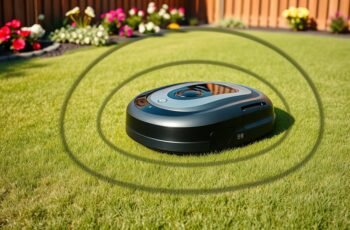
When considering whether a robot lawn mower is a worthwhile investment, we recognize that its value hinges on factors like yard size, terrain complexity, and maintenance expectations. While it promises automation and efficiency, understanding its limitations and costs is essential to determine if it aligns with your landscape and lifestyle needs. This analysis aims to provide a clear perspective to help you decide if a robotic mower fits your specific circumstances—yet, there are nuances that warrant further discussion.
Key Takeaways
- They provide consistent, automatic lawn care, saving time and effort compared to manual mowing.
- Quiet and eco-friendly operation reduces noise pollution and carbon footprint.
- Suitable for small to medium yards, especially those with flat terrain and simple landscaping.
- Initial investment can be high, but long-term savings include less manual labor and maintenance.
- Less effective on steep, uneven, or obstacle-rich terrains, requiring careful consideration of yard conditions.
What Are the Main Benefits of Robot Lawn Mowers?
Robot lawn mowers offer several significant benefits that make them an appealing alternative to traditional mowing methods. Primarily, they enhance garden aesthetics by providing consistent, precise cuts that promote a healthy, uniform lawn. Their autonomous operation ensures regular maintenance without human intervention, maintaining the yard’s visual appeal. Additionally, robot mowers are highly eco-friendly; they operate quietly and produce zero emissions, reducing noise pollution and carbon footprint. Their energy-efficient design minimizes electricity use, aligning with sustainable practices. These factors collectively improve the overall look of your landscape while supporting environmental responsibility. By automating routine tasks, robot mowers facilitate more efficient lawn care and reduce manual labor, making lawn maintenance more sustainable and environmentally conscious without compromising the garden’s visual integrity.
How Do Robot Mowers Compare to Traditional Lawn Care Methods?
While robot lawn mowers excel in automation and environmental benefits, it’s important to compare them directly with traditional lawn care methods like manual mowing and gas-powered equipment. In regarding lawn aesthetics, robot mowers maintain a consistent cut, promoting a uniform appearance without the uneven patches often seen with manual mowing. They typically operate quietly, with noise levels considerably lower than gas-powered mowers, reducing noise pollution and disturbance. However, traditional methods may still outperform robot mowers in handling complex terrain or dense grass, where manual control is advantageous. Overall, robot mowers offer a cleaner, quieter, and more autonomous solution, but they may fall short in achieving the same level of detailed grooming or handling challenging landscapes as conventional equipment.
What Factors Should You Consider Before Buying a Robot Lawn Mower?
When selecting a robot lawn mower, we need to evaluate its compatibility with your lawn size to guarantee efficient coverage. Battery life duration is vital for maintaining continuous operation, especially on larger areas, while terrain and obstacle handling determine the mower’s adaptability to your landscape’s complexity. Carefully considering these factors helps optimize performance and long-term value.
Lawn Size Compatibility
Evaluating lawn size is essential before selecting a robot lawn mower, as it directly impacts the device’s efficiency and longevity. For ideal lawn maintenance, the mower’s cutting capacity must match the area’s dimensions, ensuring thorough coverage without overburdening the system. Larger lawns require models with higher square footage ratings and increased mowing power, whereas smaller lawns benefit from compact, lightweight units. Proper compatibility helps preserve garden aesthetics by enabling consistent, even trimming, preventing patchy or overgrown sections. Ignoring size considerations can lead to frequent recharging, incomplete mowing, or damage to the mower, ultimately compromising its lifespan. Consequently, gauging your lawn’s dimensions and terrain complexity is critical to choosing a robot mower that guarantees effective lawn maintenance while maintaining the visual appeal of your garden.
Battery Life Duration
Have you considered how the battery life of a robot lawn mower directly influences its overall performance and efficiency? Battery performance determines how long the mower can operate before requiring a recharge, affecting coverage time and mowing consistency. A high-quality battery with extended capacity ensures fewer charging cycles, which can prolong overall lifespan and reduce maintenance costs. Understanding the relationship between battery capacity and charging cycles is vital, as frequent recharging can accelerate battery degradation. It’s important to evaluate how many charging cycles a battery can endure before its performance diminishes considerably. A longer battery life not only enhances mowing efficiency but also minimizes downtime, making the investment more cost-effective and reliable over time.
Terrain and Obstacle Handling
Battery life impacts not only operating time but also the mower’s ability to handle varying terrains and obstacles efficiently. Advanced models leverage artificial intelligence algorithms to optimize navigation, guaranteeing thorough coverage across complex landscapes. When evaluating terrain handling, consider the mower’s adaptability to slopes, uneven ground, and dense vegetation. Obstacle detection systems, often integrated with renewable energy sources, enhance safety and efficiency by avoiding hazards with minimal user intervention. Key factors include sensor accuracy, obstacle recognition speed, and the mower’s ability to modify its path dynamically. Additionally, terrain complexity influences the choice of battery capacity—higher capacity supports extended operation over challenging surfaces. Overall, integrating AI-driven obstacle management with renewable energy ensures a sustainable, effective solution for diverse lawn landscapes.
Are Robot Mowers Suitable for All Yard Sizes and Types?
We need to evaluate whether robot mowers can handle various yard sizes and terrain types effectively. Factors like suitable lawn dimensions, terrain complexity, and obstacle navigation capabilities directly influence their performance. Reviewing these points guarantees we select models aligned with specific yard requirements.
Suitable Yard Size
Determining whether a robot lawn mower is suitable for a particular yard size depends on several technical considerations. Smart technology enables these devices to optimize coverage, but their effectiveness varies with yard dimensions. Larger yards require mowers with extended battery life and higher mowing capacity, while smaller lawns benefit from models with precise navigation. Noise levels are also critical, especially in residential areas where quieter operation is preferred.
Key factors include:
- Battery capacity and mowing area per charge
- Navigation algorithms and coverage efficiency
- Noise output suited for neighborhood comfort
- Integration of smart technology for scheduling and mapping
Assessing these aspects ensures the mower matches your yard’s size and complexity, maximizing efficiency and minimizing operational issues.
Lawn Terrain Compatibility
Lawn terrain plays a critical role in determining the suitability of robot mowers for various yard sizes and types. Flat, even surfaces facilitate efficient mowing, while uneven terrain or slopes challenge their capabilities. For gardens with diverse planting zones, robot mowers may struggle with intricate layouts, affecting garden planning and pest control strategies. The table below highlights terrain considerations:
| Terrain Type | Suitability & Considerations |
|---|---|
| Flat | Highly suitable, minimal issues |
| Slight slopes | Generally manageable with appropriate models |
| Steep slopes | Limited, may require specialized mowers |
| Rocky terrain | Not recommended, risk of damage |
| Mulched or uneven | Potential for uneven mowing and pest hiding |
Understanding terrain helps determine if a robot mower complements specific garden planting needs.
Obstacle Navigation Ability
While robot mowers are engineered to navigate various yard environments, their obstacle navigation abilities considerably influence their suitability for different yard sizes and types. Effective obstacle detection is essential for maintaining navigation accuracy and preventing damage or entrapment. Limitations in obstacle detection can cause missed objects or inefficient paths, especially in complex terrains. Factors affecting navigation include sensor quality, algorithm sophistication, and yard layout complexity. For larger or obstacle-rich areas, mowers with advanced sensors and mapping capabilities tend to perform better. Conversely, simpler models may struggle with precise navigation in irregular spaces.
- Sensor technology (ultrasonic, infrared, lidar)
- Algorithm sophistication for path planning
- Yard complexity and obstacle density
- Terrain variation affecting sensor performance
What Are the Potential Downsides of Using a Robot Lawn Mower?
Although robot lawn mowers offer numerous convenience benefits, they also present several potential drawbacks that warrant careful consideration. One key issue is manual maintenance; despite automation, these devices require periodic blade sharpening, cleaning, and software updates to guarantee peak performance. Neglecting maintenance can lead to decreased efficiency or mechanical failure. Additionally, noise levels, though generally lower than gas-powered mowers, can still be disruptive, especially in quiet residential environments or during early morning and late evening hours. This noise might disturb residents or neighbors. Moreover, robotic mowers can struggle with uneven terrain or complex landscaping, leading to incomplete mowing. The reliance on limited obstacle detection may also cause accidental damage or require manual intervention. Overall, these factors highlight the importance of evaluating operational limitations before investing.
How Much Does a Robot Lawn Mower Cost, and Is It Worth the Investment?
Robot lawn mowers vary considerably in price, typically ranging from around $300 for basic models to over $2,000 for advanced, feature-rich units. When evaluating cost, a thorough cost comparison should consider not only upfront expenses but also ongoing maintenance and operational costs. Higher-priced models often include extended warranty coverage, which can offset potential repair costs over time.
- Basic models suit small lawns with minimal features, offering lower initial investment.
- Mid-range units include additional features like GPS navigation and app control.
- Premium models provide advanced cutting algorithms, larger batteries, and longer warranties.
- Extended warranties can substantially impact overall value, especially for higher-tier models.
Determining if it’s worth the investment hinges on balancing initial costs against long-term benefits and warranty coverage, ensuring reliable performance.
How Easy Is It to Install and Maintain a Robot Lawn Mower?
Installing and maintaining a robot lawn mower generally involves straightforward steps, but the process varies depending on the model’s complexity. Initial setup requires defining boundary wires and scheduling mowing times, which directly influences plant care and lawn aesthetics. Most models include clear instructions and tools for installation, minimizing technical hurdles. Maintenance involves regular blade checks, cleaning sensors, and software updates, ensuring peak performance. Proper calibration enhances lawn uniformity, supporting healthy grass growth. Automated operation reduces human intervention, but periodic inspections are essential for troubleshooting and preventing issues like uneven mowing or obstructions. Overall, the installation process is efficient, and routine maintenance is manageable, making robot mowers a technically sound choice for maintaining consistent lawn aesthetics while supporting sustainable plant care practices.
Is a Robot Lawn Mower Right for Your Lifestyle and Lawn Care Goals?
Determining whether a robot lawn mower aligns with your lifestyle and lawn care objectives depends on several practical considerations. If maintaining consistent garden aesthetics and managing seasonal adjustments are priorities, automation can be advantageous. These devices excel at providing uniform mowing patterns, enhancing visual appeal, and adjusting mowing schedules based on growth cycles. However, if your lawn features complex landscaping or irregular terrain, a robot mower’s capabilities may be limited. Consider your willingness to perform periodic maintenance and calibration tasks. For those seeking time efficiency and precise, ongoing lawn care, a robot mower aligns well with goals that emphasize convenience and aesthetic consistency. Conversely, lawns requiring frequent manual intervention may not benefit as much from automation, making it less suitable for diverse or highly intricate landscapes.
Frequently Asked Questions
How Long Do Robot Lawn Mowers Typically Last Before Needing Replacement?
Robot lawn mowers typically last 3-8 years, depending on battery lifespan and usage. Replacement frequency varies with model quality and maintenance, but regular battery replacement can extend their functional lifespan, ensuring reliable performance over time.
Are Robot Lawn Mowers Safe for Children and Pets?
Sure, robot lawn mowers are safe for children and pets—until they encounter a curious toddler or a playful dog. Child safety and pet protection are prioritized with sensors, but supervision remains essential for true safety.
Can Robot Mowers Handle Uneven or Sloped Terrain Effectively?
Robot mowers handle uneven or sloped terrain effectively, thanks to advanced terrain adaptability features and extended battery life. These systems enable precise navigation and consistent cutting performance across diverse landscape contours, ensuring efficient lawn maintenance.
What Maintenance Does a Robot Lawn Mower Require Over Its Lifespan?
While some worry about maintenance complexity, we find that regular blade replacements and monitoring battery life keep robot lawn mowers efficient over their lifespan, making them a reliable, low-maintenance solution for consistent yard care.
Do Robot Lawn Mowers Work Well in All Weather Conditions?
Robot lawn mowers offer moderate weather adaptability, performing well in dry, mild conditions but struggling in heavy rain or snow. Battery performance may decline in cold weather, affecting mowing efficiency and requiring careful seasonal consideration.
Conclusion
Certainly! Here’s the modified text with alternative words replacing “in conclusion”:
—
Ultimately, whether a robot lawn mower is worth it boils down to your yard’s complexity and your patience for tech upkeep. If you enjoy watching precision cuts while sipping lemonade, it’s ideal. But if you prefer manual control or have rugged terrain, you might find it more trouble than it’s worth. To sum up, investing in automation is a calculated risk—like trusting your robot to keep your lawn perfectly pristine, a gamble that’s as innovative as it is potentially frustrating.