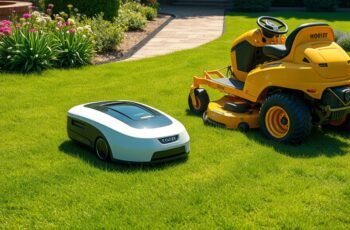
When considering robotic mowers for home use, it’s essential to evaluate key factors such as performance, safety features, and overall reliability. With a range of models offering varying levels of sophistication, understanding their differences can markedly impact your lawn’s maintenance and your convenience. As we explore the options, we’ll highlight what makes some models stand out and how to select the best fit for your specific needs, ensuring your investment is well-informed.
Key Takeaways
- Compare performance metrics like cutting precision, battery life, and terrain handling to select a reliable model for your lawn size.
- Consider safety features such as obstacle detection, boundary sensors, and automatic shutdown for child and property protection.
- Evaluate ease of installation, user interface, and smart scheduling options for convenient setup and operation.
- Review cost differences between budget and premium models, factoring in features, build quality, and technological advancements.
- Assess durability and environmental resistance to ensure the mower performs well in various weather conditions and terrains.
What Are Robotic Mowers and How Do They Work?
Robotic mowers are autonomous devices designed to maintain lawns with minimal human intervention, utilizing advanced navigation and cutting technologies. These machines operate through sensors and boundary wires that define the mowing area, ensuring precise coverage without damaging garden landscaping. Their cutting systems are engineered for consistent, high-quality results, which directly impact lawn aesthetics by producing an even, well-manicured surface. The automation allows for frequent mowing, promoting healthier grass growth and a lush appearance. By integrating GPS and obstacle detection, robotic mowers adapt to complex yard layouts, making them effective for various garden landscaping needs. Their efficiency and precision support the ongoing effort to create visually appealing outdoor spaces with minimal effort, transforming traditional lawn care into a streamlined, technologically advanced process.
Key Features to Consider When Choosing a Robotic Mower
When selecting a robotic mower, we focus on battery life and charging times to guarantee uninterrupted operation over large areas. We also consider cutting width and height adjustments, which directly impact efficiency and suitability for different lawn types. Analyzing these key features helps us identify models that balance performance with user-specific needs.
Battery Life and Charging
Since battery life directly impacts how much ground a mower can cover before needing to recharge, it’s essential to evaluate this feature carefully. Longer battery life allows for more consistent mowing sessions, ensuring better lawn aesthetics and reducing the need for frequent recharging. A mower with quick-charging capabilities can maximize uptime, especially for larger lawns. Additionally, consider how battery performance varies with different gardening accessories and terrain.
- Battery capacity (measured in mAh or Ah)
- Charging time duration
- Number of recharge cycles before battery degradation
- Power management features for efficiency
- Compatibility with spare or replaceable batteries
Understanding these factors helps homeowners select a robotic mower that balances battery endurance with effective, hassle-free operation for maintaining a pristine lawn.
Cutting Width and Height
Cutting width and height are essential specifications that directly influence a robotic mower’s efficiency and suitability for your lawn. A wider cutting width allows the mower to cover more ground quickly, reducing mowing time and minimizing disruptions to your lawn’s appearance. Conversely, a narrower width offers better maneuverability around obstacles and intricate lawn decorations. Adjustable cutting height is equally important, enabling you to tailor the grass length for ideal lawn health and aesthetic appeal. Weather resistance enhances the mower’s durability, especially in regions with frequent rain, ensuring consistent performance without damage. Properly balancing these features ensures your mower maintains a neat, well-groomed lawn while withstanding environmental challenges, ultimately supporting effective lawn decoration and long-term maintenance.
Comparing Top Robotic Mower Models: Performance and Reliability
When comparing top robotic mower models, we focus on cutting precision and efficiency to guarantee consistent lawn results, as well as battery life and durability for long-term reliability. We analyze how each model performs under various conditions to determine their effectiveness and resilience. This approach helps us identify which mowers deliver ideal performance and dependability over time.
Cutting Precision and Efficiency
Robotic mowers have advanced considerably in recent years, with many models now competing closely in terms of cutting precision and efficiency. When evaluating performance, we focus on how well they maintain lawn aesthetics through precise, even cuts, and how efficiently they cover large areas. The user interface plays a vital role, influencing ease of programming and adjustments. Top models feature adaptive cutting algorithms that optimize coverage and minimize overlap.
- Precision sensors ensure accurate navigation around obstacles
- Adaptive cutting height for varied grass types
- Smart scheduling for ideal mowing times
- Intuitive, touchscreen interfaces for quick setup
- Consistent performance across different terrains
These factors highlight the importance of both cutting accuracy and user-friendly controls in selecting a reliable robotic mower.
Battery Life and Durability
Battery life and durability are key factors that determine a robotic mower’s long-term performance and reliability. As batteries undergo continual charge cycles, battery degradation can reduce runtime and overall efficiency, making it essential to choose models with robust battery management systems. Effective power management minimizes unnecessary energy drain, extending operational periods and delaying degradation. Higher-quality batteries often feature advanced thermal regulation and protective circuitry that prevent overheating and prolong lifespan. Durability also depends on the battery’s ability to withstand environmental factors like moisture and temperature fluctuations. We analyze how top models balance battery longevity with consistent power output, ensuring homeowners experience reliable mowing without frequent replacements. Ultimately, understanding these nuances helps select a mower that maintains peak performance over years of use.
How Much Do Robotic Mowers Cost? Budget vs. Premium Options
Robotic mowers vary markedly in price, reflecting differences in features, build quality, and brand reputation. When evaluating cost, it’s essential to *take into account* how pricing strategies align with market trends, which influence consumer expectations and product tiers. Budget options typically start around $500, offering basic mowing functions, limited customization, and lower durability. Premium models, costing $1,500 or more, incorporate advanced features like GPS navigation, app control, and weather sensors. The price gap highlights the value placed on technological sophistication and reliability in higher-end models.
Robotic mower prices vary widely, reflecting features, quality, and brand reputation.
- Budget models suit small, simple lawns with minimal features
- Premium options often include smart technology and enhanced durability
- Market trends show increasing integration of AI and connectivity
- Pricing strategies aim to balance affordability with feature set
- Cost variations often reflect brand reputation and warranty coverage
Ease of Use and Setup: What Homeowners Need to Know
While many homeowners assume that advanced technology automatically complicates setup, most modern robotic mowers are designed with user-friendly installation processes. The installation process typically involves simple steps like laying boundary wires and configuring the user interface, which is often intuitive and easy to navigate. The user interface varies across models, with some offering touchscreen controls, mobile app integration, or straightforward button menus. These features streamline setup and daily operation, reducing the need for technical expertise. Additionally, clear instructions and minimal components contribute to a seamless experience. Overall, contemporary robotic mowers emphasize ease of use, ensuring homeowners can complete installation quickly without sacrificing functionality. This focus on straightforward setup makes robotic mowing accessible, even for those less familiar with smart technology.
Battery Life and Charging: Ensuring Continuous Lawn Care
Since continuous lawn maintenance depends heavily on a mower’s ability to operate efficiently over extended periods, understanding battery life and charging features is vital. Longer battery life ensures consistent mowing, maintaining ideal lawn aesthetics while minimizing interruptions. Fast-charging capabilities reduce downtime, allowing the mower to resume work quickly, which is essential for larger lawns. Battery longevity also impacts environmental impact, as longer-lasting batteries reduce waste and replacement frequency.
- Battery capacity (measured in mAh) influences runtime
- Quick-charge features for minimal downtime
- Battery health indicators for maintenance planning
- Compatibility with eco-friendly charging stations
- Impact of seasonal temperatures on battery performance
Safety Features and Maintenance Requirements
Are safety features and maintenance requirements adequately designed to guarantee reliable and secure operation of robotic mowers? We believe they are, especially with advancements in sensor technology and child safety measures. Modern mowers incorporate obstacle detection sensors to prevent collisions, and edge sensors help avoid damage to property. Child safety is prioritized through features like automatic shutdown if children are nearby or if the mower is lifted. Maintenance is straightforward, typically involving blade checks and sensor cleaning, which ensures consistent performance and safety. Regularly updating firmware and inspecting safety components are essential for ongoing reliability. Overall, these features and requirements work together to minimize risks, providing homeowners with peace of mind while maintaining a secure, efficient lawn-care process.
Which Robotic Mower Is Best for Different Lawn Sizes and Types?
Choosing the right robotic mower depends heavily on your lawn’s size and terrain, as these factors directly influence device performance and efficiency. For small, flat lawns, compact models with limited battery capacity suffice, enabling quick coverage and easy maneuvering. Medium-sized lawns benefit from mowers with adjustable cutting heights and longer battery life, supporting ongoing lawn fertilization and maintaining healthy grass. Large or uneven terrains require robust, all-terrain models equipped with GPS navigation and higher torque to navigate complex landscaping features seamlessly. Additionally, consider models with adaptive sensors for obstacle detection in diverse terrains. Properly matching mower specifications to your lawn’s unique characteristics ensures *best* cutting performance, supports effective garden landscaping, and promotes consistent lawn fertilization, resulting in a healthier, more manageable outdoor space.
Making the Final Decision: Tips for Choosing the Right Robotic Mower
Making the final decision on a robotic mower involves carefully weighing various technical specifications against your lawn’s specific needs. Key factors include features like smart scheduling, which allows the mower to adapt mowing times based on your routine and lawn conditions, maximizing efficiency and convenience. Noise reduction is equally important, especially if you value peace and quiet during operation or have close neighbors. Consider models with advanced noise mitigation technologies to minimize sound levels. Additionally, evaluate battery life, cutting height adjustments, and terrain handling capabilities to guarantee compatibility with your yard’s size and complexity. By analyzing these technical details and aligning them with your priorities, you can select a robotic mower that offers excellent performance, convenience, and comfort tailored to your lawn’s unique requirements.
Frequently Asked Questions
How Do Robotic Mowers Handle Uneven or Sloped Terrain?
Robotic mowers handle uneven terrain through advanced terrain adaptation and incline management systems, enabling them to navigate slopes safely while maintaining efficient cutting performance; their sensors and dynamic algorithms adapt to varying inclines for ideal coverage.
Are Robotic Mowers Suitable for All Grass Types?
Like a chameleon adapting seamlessly, robotic mowers suit most grass types, promoting grass regeneration with minimal mower noise. We analyze their performance, noting that dense or coarse grass may require specific models, but overall, versatility remains high.
What Warranty and Support Options Are Available?
We prioritize extensive warranty policies and robust customer service, ensuring prompt support and coverage for repairs or replacements. Our detailed support options include extended warranties and accessible customer care, giving homeowners confidence in their robotic mower investments.
How Do Robotic Mowers Perform in Extreme Weather Conditions?
In the age of knights and dragons, robotic mowers face tough weather; their battery life diminishes, and noise levels increase. We find that extreme conditions can hinder performance, requiring robust design for consistent operation and durability.
Can Robotic Mowers Be Integrated With Smart Home Systems?
Robotic mowers can indeed integrate with smart home systems, offering smart home compatibility and voice control integration. We analyze this feature as a valuable convenience, enabling seamless operation and automation, though compatibility varies across brands and models.
Conclusion
In our analysis, robotic mowers streamline lawn care, saving homeowners an average of 8 hours weekly—time better spent enjoying your outdoor space. With advancements in navigation and safety features, these devices are becoming increasingly reliable across various lawn sizes and terrains. Choosing the right model depends on understanding your specific needs and budget. By carefully evaluating features and costs, you can make an informed decision that guarantees efficient, eco-friendly maintenance for years to come.