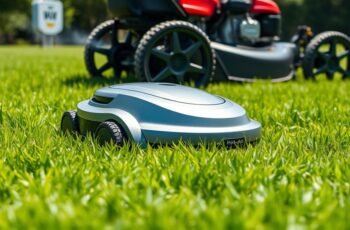
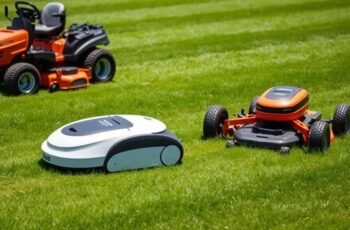
Studies indicate that approximately 65% of homeowners with lawns under half an acre are now considering automated alternatives. As we analyze the technical merits of robot mowers versus traditional models, it’s clear that factors like terrain, maintenance, and long-term costs play vital roles in decision-making. Understanding these distinctions is essential for making an informed choice, especially as new technologies continue to evolve and impact the landscape of lawn care.
Key Takeaways
- Robot mowers offer automatic, hands-free operation ideal for busy schedules, while traditional mowers require manual effort and supervision.
- Eco-friendly robot mowers have lower emissions and noise, making them better for environmentally conscious users.
- Initial costs are higher for robot mowers, but lower ongoing maintenance can make them more cost-effective long-term.
- Traditional mowers perform better on large, uneven, or complex terrains that robot mowers may struggle to navigate.
- Ease of use favors robot mowers with simple setup and minimal maintenance, whereas traditional mowers demand more technical skill and effort.
What Are the Main Differences Between Robot Mowers and Traditional Lawn Mowers?
What are the main differences between robot mowers and traditional lawn mowers? Robot mowers leverage artificial intelligence to navigate and adapt to complex yard layouts efficiently, unlike traditional mowers that rely on manual operation or basic mechanical guidance. They utilize advanced sensors and algorithms for obstacle detection and boundary recognition. Battery technology is central to their operation, providing cordless, eco-friendly power with quick recharge cycles and longer lifespan. In contrast, traditional mowers depend on internal combustion engines or corded electric motors, which involve higher emissions and maintenance. Robot mowers automate mowing schedules, reducing human intervention, while traditional mowers require active user engagement. Ultimately, the integration of AI and improved battery tech makes robot mowers a technological evolution, emphasizing automation, efficiency, and sustainability.
How Do Costs Compare for Buying and Maintaining Each Type?
When comparing costs, the initial purchase price of robot mowers tends to be higher than traditional lawn mowers, but maintenance expenses vary considerably. Robot models often incur lower long-term operational costs due to reduced labor and fewer parts needing replacement. Evaluating these financial factors helps determine which option offers better long-term cost efficiency.
Purchase Price Differences
The initial purchase price of robot mowers generally exceeds that of traditional lawn mowers, though the gap narrows with advanced models. This difference largely stems from emerging battery technology, which influences both cost and performance. High-quality batteries, essential for longer runtime and durability, notably impact price, especially in premium models. Additionally, brand reputation plays a vital role; established brands often command higher prices due to proven reliability and technological innovation. While traditional mowers require a one-time purchase, robot mowers tend to involve a higher upfront investment, reflective of their sophisticated electronics and battery systems. However, as battery technology advances and new brands enter the market, the initial price gap may decrease, making robot mowers increasingly accessible for consumers seeking automation and efficiency.
Maintenance Expense Variations
Maintenance expenses for robot mowers and traditional lawn mowers differ considerably in scope and frequency. Robot mowers typically incur ongoing costs related to battery life, which affects replacement intervals and performance, especially as batteries degrade over time. They generally require less regular maintenance but may need battery replacements more frequently than traditional engines need oil changes or blade sharpening. Warranty coverage is another factor influencing costs; robot mowers often come with limited warranties that may not cover battery wear, leading to additional expenses. Conversely, traditional mowers usually have more extensive warranties covering engine components but demand more frequent, labor-intensive maintenance tasks. Overall, robot mower maintenance costs tend to be lower initially but can escalate with battery replacement, while traditional mowers involve consistent maintenance expenses over their lifespan.
Long-Term Cost Efficiency
Evaluating long-term cost efficiency requires examining both initial purchase prices and ongoing maintenance expenses over the lifespan of each mower type. Robot mowers often have higher upfront costs but benefit from low energy consumption and smart technology that optimize operation, reducing operational costs over time. Traditional lawn mowers typically incur lower initial expenses but may require more frequent maintenance, fuel, and manual labor, increasing long-term costs.
- Initial purchase price disparities
- Energy consumption differences
- Maintenance and repair expenses
- Smart technology integration benefits
- Cost savings through automation features
Which Mower Is Easier to Use for Beginners?
When evaluating ease of use for beginners, setup and installation are critical factors, as straightforward procedures minimize initial barriers. User interface simplicity influences how quickly new users can operate and troubleshoot the equipment effectively. Additionally, maintenance requirements determine the ongoing effort needed to keep each mower functional, impacting overall user experience.
Setup and Installation
Is setting up a robot mower or a traditional lawn mower more straightforward for beginners? Overall, a robot mower generally offers a more streamlined installation process, but it requires initial boundary setup and programming. A traditional lawn mower involves assembling components and ensuring proper fuel or battery installation, which can be more labor-intensive.
Key considerations include:
- Complexity of boundary wire installation for robot mowers
- Software configuration and calibration processes
- Physical setup and maintenance ease
- Durability of lawn mower components under initial use
- Long-term reliability and repair considerations
While robot mowers demand precise boundary delineation, they tend to be easier to install once set up, thanks to minimal physical adjustments. Conversely, traditional lawn mowers, although straightforward initially, involve more mechanical setup and ongoing durability concerns.
User Interface Simplicity
User interface design plays a significant role in determining which mower is more accessible for beginners. When comparing robot mowers and traditional lawn mowers, simplicity features become essential. Robot mowers typically boast intuitive interfaces with minimal buttons and clear displays, reducing user error. In contrast, traditional mowers often require manual operation with complex controls, which can overwhelm novices. To illustrate:
| Feature | Robot Mower | Lawn Mower |
|---|---|---|
| User interface | Touchscreens, app connectivity | Manual controls, dials |
| Simplicity features | Pre-programmed mowing schedules | Manual start, multiple levers |
| Ease of use | Designed for minimal input | Requires technical knowledge |
This analysis highlights that robot mowers are generally easier for beginners due to streamlined interfaces and user-friendly simplicity features.
Maintenance Requirements
Determining which mower is easier for beginners often hinges on their maintenance requirements. Robot mowers generally demand less hands-on upkeep, with battery life being a key factor; longer-lasting batteries reduce the frequency of replacements. Conversely, traditional lawn mowers require regular engine oil changes, blade sharpening, and filter replacements. Warranty coverage also influences usability; all-encompassing warranties simplify troubleshooting and reduce repair costs.
- Robot mower maintenance involves minimal adjustments, primarily battery management.
- Traditional mowers require routine oil changes, blade sharpening, and filter replacements.
- Battery life directly impacts operational longevity and replacement frequency.
- Warranty coverage can mitigate the complexity of addressing mechanical failures.
- Ease of maintenance for beginners favors systems with straightforward, predictable upkeep.
How Do Robot Mowers and Lawn Mowers Impact Lawn Health and Maintenance?
Robot mowers and traditional lawn mowers directly influence lawn health and maintenance through their cutting mechanics and frequency. Regular, precise cutting promotes even grass growth, optimizing lawn nutrient absorption and reducing thatch buildup. However, excessive mowing can lead to soil compaction, especially with heavier traditional mowers, impairing water infiltration and root development. Robot mowers typically operate more frequently at lower cutting heights, which encourages healthier turf by maintaining consistent grass length and minimizing stress. This approach enhances nutrient cycling and prevents uneven growth. Conversely, traditional mowers often require less frequent use, risking uneven cuts and potential soil compaction if used improperly. Overall, the mowing pattern and frequency considerably impact soil health, soil aeration, and the long-term vitality of the lawn.
What Are the Key Factors to Consider When Choosing a Mower?
When selecting a mower, several critical factors influence the decision-making process, ensuring that the chosen equipment effectively meets lawn maintenance needs. Key considerations include the mower’s impact on garden aesthetics, with precision cutting preserving visual appeal. Mower safety is paramount, requiring features like blade guards and automatic shutoff to prevent accidents. Power source and battery life are essential for efficiency, especially for larger areas. Cutting height adjustment and blade quality affect lawn uniformity and health, while ease of operation influences ongoing maintenance. Ultimately, compatibility with lawn size and terrain complexity determines suitability, whether choosing a traditional mower or a robot mower. These factors collectively guide a strategic choice aligned with safety standards and aesthetic goals.
Are Robot Mowers Suitable for All Lawn Sizes and Types?
Are robot mowers truly versatile enough to handle all lawn sizes and types? Their effectiveness depends heavily on lawn size and terrain types. For smaller gardens, most robot mowers excel due to their precise navigation and efficient cutting systems. However, when considering larger lawns, their battery life and boundary detection capabilities become critical factors. Many models are designed to cover extensive areas, but coverage time may increase substantially with size. Terrain types also influence suitability; flat, even surfaces are ideal, while uneven or hilly terrain can challenge some models. Certain robot mowers feature specialized sensors and adaptive algorithms to navigate complex terrain, but their performance may still be limited on extreme slopes or highly irregular surfaces. Overall, suitability varies based on specific lawn parameters.
What Are the Pros and Cons of Each Mower for Busy Homeowners?
For busy homeowners seeking efficient lawn maintenance, weighing the pros and cons of robot mowers versus traditional lawn mowers is essential. Robot mowers offer consistent, time-saving operation, especially useful for maintaining intricate garden designs and making seasonal adjustments effortless. However, they require upfront investment and regular software updates to optimize performance. Conventional lawn mowers excel in handling large, varied terrains and are generally more flexible for diverse garden designs, but demand more manual labor and time. Robot mowers may struggle with complex layouts, while traditional mowers may be less efficient during busy schedules. Both require consideration of long-term operational costs and maintenance needs. Ultimately, the choice hinges on balancing automation benefits against manual control, garden complexity, and seasonal needs.
- Efficiency in maintaining intricate garden design
- Adaptability to seasonal adjustments
- Initial investment versus ongoing costs
- Suitability for varied terrain and lawn size
- Maintenance complexity and frequency
How Do Noise Levels and Environmental Impact Differ?
Have you ever considered how the noise levels and environmental impacts of robot mowers compare to traditional lawn mowers? A noise comparison reveals that robot mowers operate at markedly lower decibel levels, often around 60-70 dB, compared to gas-powered mowers exceeding 90 dB. This reduced noise contributes to less noise pollution and disturbance. Regarding environmental footprint, robot mowers typically use rechargeable batteries, emitting no direct emissions during operation, consequently minimizing air pollution. In contrast, gas mowers release carbon dioxide and other pollutants, contributing more heavily to environmental degradation. The eco-friendliness of robot mowers stems from their energy efficiency and quieter operation, which collectively lead to a smaller environmental footprint. Therefore, robot mowers offer a more sustainable and less disruptive alternative for lawn maintenance.
Which Mower Offers Better Long-Term Value and Return on Investment?
While noise levels and environmental impact are important considerations, evaluating long-term value and return on investment (ROI) provides a more thorough picture of a lawn mower’s overall efficiency. Robot mowers, with their smart technology, optimize cutting patterns and maintenance schedules, reducing operational costs over time. They often feature lower energy consumption, translating into lower utility bills and enhanced sustainability. Conversely, traditional lawn mowers typically incur higher fuel or electricity costs and require more frequent manual maintenance, diminishing ROI.
Robot mowers offer better long-term value through smarter technology and lower operational costs.
- Durability and lifespan of the equipment
- Maintenance frequency and costs
- Energy efficiency and consumption rates
- Technological advancements and upgrades
- Resale or residual value of the mower
Frequently Asked Questions
How Do Robot Mowers Handle Uneven or Sloped Terrains?
Robot mowers handle uneven terrain through advanced terrain adaptation, adjusting cutting height and speed, while obstacle navigation sensors detect slopes and obstacles, ensuring safe, efficient mowing on varied and sloped terrains without compromising performance or safety.
Can Robot Mowers Be Used in All Weather Conditions?
Like a weather vane, our robot mowers adapt to various conditions, but they’re best in dry, mild weather. Smart navigation and battery longevity are compromised by rain, snow, or extreme heat, limiting year-round usability for ideal performance.
What Safety Features Do Robot Mowers Have to Prevent Accidents?
Robot mowers incorporate safety features like obstacle detection, automatic shut-off, and boundary sensors. Their battery life guarantees continuous operation, while low noise levels minimize disturbance, collectively preventing accidents and fostering safe, efficient lawn maintenance.
How Often Do Robot Mowers Require Blade Sharpening or Replacement?
We typically check blade sharpness every few months, depending on battery maintenance and cutting height. Regularly sharpening or replacing blades guarantees ideal performance, maintains cutting quality, and prolongs the mower’s lifespan, especially as cutting height adjustments influence blade wear.
Are There Any Legal Restrictions on Using Robot Mowers in Residential Areas?
We’ve found that legal restrictions on robot mower use vary by jurisdiction, often addressing privacy concerns and safety regulations; it’s essential for users to check local laws to guarantee compliance and mitigate potential legal issues.
Conclusion
Ultimately, choosing the right mower hinges on your lawn’s size, terrain, and lifestyle. While robot mowers offer hands-free convenience and eco-friendly operation, they may fall short on larger, uneven grounds. Traditional mowers provide flexibility and power but require more effort. By analyzing these factors critically, you can envision a well-maintained lawn, whether it’s the quiet hum of a robot or the robust cut of a traditional mower — each tailored to your specific needs.