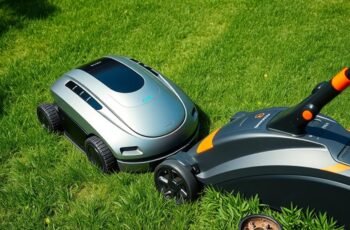
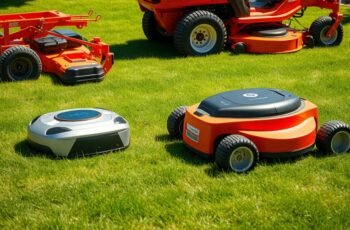
When considering whether a robot mower outperforms a ride-on mower, we need to examine multiple factors, including performance, costs, maintenance, and environmental impact. Both options have distinct advantages and limitations depending on yard size and terrain complexity. Understanding these differences can help you make an informed choice tailored to your specific needs, but determining which is ultimately better requires a closer look at how each fits into your landscape and lifestyle.
Key Takeaways
- Robot mowers offer automated, precise, and quiet operation, ideal for large or complex lawns with minimal manual effort.
- Ride-on mowers provide greater power and manual control, suitable for rugged terrains and highly intricate landscapes.
- Robot mowers have higher initial costs but lower long-term maintenance and energy expenses, with environmental benefits due to electric operation.
- Ride-on mowers are generally more affordable upfront but incur higher ongoing fuel, maintenance, and emissions costs.
- Robot mowers excel in aesthetics with uniform cuts and reduced noise, whereas ride-on mowers may leave uneven terrain and produce more noise and emissions.
How Do Robot Mowers and Ride-On Mowers Differ in Performance?
While both robot mowers and ride-on mowers serve the primary function of maintaining lawns, their performance characteristics differ considerably. Robot mowers excel in precision and consistency, often delivering a uniform cut thanks to advanced sensors and programmable schedules. Their aesthetic design is typically sleek and compact, blending seamlessly into garden environments. Ride-on mowers, however, provide higher power and speed, making them suitable for larger or more rugged terrains. Brand reputation plays a vital role here; reputable brands tend to prioritize durability, cutting efficiency, and user-friendly features. While robot mowers focus on quiet operation and minimal maintenance, ride-on mowers emphasize performance and capacity. Understanding these differences helps us evaluate how each mower aligns with specific lawn care needs and aesthetic preferences.
Which Mower Costs More to Purchase and Operate Long-Term?
When comparing long-term costs, we find that initial purchase prices for robot mowers are generally higher than ride-on models, though this gap can vary based on features and brand. Maintenance and repair expenses also differ, with robot mowers often requiring specialized parts and services, while ride-on mowers may have more readily available repairs but higher fuel costs. Additionally, energy and power expenses tend to favor ride-on mowers due to their larger engines and fuel consumption, but the automation of robot mowers can offset some operational costs over time.
Initial Purchase Price Differences
The initial purchase price of a robot mower generally exceeds that of a traditional ride-on mower, primarily due to the advanced technology and automation features embedded in robotic models. These include sensors, GPS navigation, and smart algorithms, which contribute to higher costs. When considering aesthetics comparison, robot mowers often have a sleek, minimalist design that blends seamlessly into landscaped environments, whereas ride-on mowers tend to be larger and more conspicuous. Additionally, noise level is a significant factor; robot mowers operate quietly, reducing disturbance, while ride-on mowers produce louder noise, often requiring additional considerations for noise ordinances. Overall, the initial investment for a robot mower is higher, but it offers benefits like discreet operation and modern design, which may justify the premium for many users.
Maintenance and Repair Costs
Maintenance and repair costs play a significant role in determining the long-term affordability of either mower type. Robot mowers generally have lower ongoing maintenance, thanks to fewer moving parts, but battery life can impact repair costs over time. Ride-on mowers may require more frequent servicing, especially for engine components, and repairs tend to be more expensive. Noise levels also influence repair needs; louder engines often mean more wear and tear. Below is a comparison:
| Cost Factor | Robot Mower | Ride-On Mower | Notes |
|---|---|---|---|
| Initial Cost | Lower | Higher | Long-term, costs vary |
| Maintenance | Minimal, battery checks | Frequent, engine tune-ups | Battery replacements over time |
| Repair Expenses | Usually cheaper | More expensive | Engine repairs or parts replacement |
| Battery Life Impact | Critical for operation | Less relevant | Affects longevity of robot mower |
| Noise Levels | Quiet | Noisy | Noise influences wear |
Energy and Power Expenses
Although robot mowers typically have higher initial purchase prices, their long-term operating costs tend to be lower due to minimal energy consumption and fewer mechanical components that require power. They generally use rechargeable batteries with a longer lifespan, which reduces replacement costs over time. Additionally, robot mowers operate at lower noise levels, allowing for extended use without disturbance, and consume considerably less electricity compared to ride-on mowers. Maintenance for battery health is essential, but modern models often feature smart charging systems that prolong battery life. Conversely, ride-on mowers rely on fuel or large engines, incurring ongoing fuel costs and higher emissions. The lower energy needs and quieter operation make robot mowers more economical over the long term, despite their higher upfront investment.
- Battery lifespan directly impacts replacement costs and efficiency
- Noise levels influence usability during quieter hours
- Energy consumption affects electricity bills
- Fuel costs and emissions for ride-on mowers are higher
- Maintenance frequency varies based on mechanical complexity
What Maintenance Tasks Are Required for Each Type of Mower?
While both robot mowers and ride-on mowers require regular upkeep to perform ideally, their maintenance routines differ notably due to their distinct designs and functionalities. Robot mowers generally need less frequent maintenance, focusing on blade sharpening and cleaning sensors to maintain lawn aesthetics. Battery health checks are essential for consistent performance, and software updates guarantee maximum operation. Safety considerations involve inspecting boundary wires and verifying blades are secure. Ride-on mowers demand more extensive maintenance, including oil changes, air filter replacements, and belt inspections to sustain cutting quality. Regularly checking tire pressure and lubrication prevents breakdowns, while verifying the safety features like emergency stops are functional is vital. Overall, ride-on mowers require more hands-on maintenance, but both types benefit from consistent upkeep to guarantee safe operation and excellent lawn aesthetics.
How User-Friendly Are Robot Mowers Compared to Ride-On Models?
Robot mowers are often considered more user-friendly than ride-on models due to their automated operation and minimal hands-on involvement. Their intuitive user interfaces typically simplify setup and daily use, often featuring mobile apps or onboard controls for easy programming. Safety features, such as obstacle detection and automatic shutoff, enhance user confidence and reduce risk. Additionally, robot mowers require less physical effort, making them suitable for users with mobility issues.
- Easy-to-navigate control panels or smartphone apps
- Minimal manual adjustments needed during operation
- Built-in sensors for obstacle avoidance
- Automatic charging and scheduling capabilities
- Clear, accessible safety features for peace of mind
Which Mower Is Better for Large or Complex Lawns?
When comparing robot and ride-on mowers for large or complex lawns, we focus on coverage and navigation capabilities, as well as terrain adaptability and power. Robot mowers excel in precise, automated coverage but may struggle with intricate layouts or uneven terrain, whereas ride-on mowers offer more manual control and power for challenging landscapes. Evaluating these factors helps determine which mower best suits the specific demands of extensive or complicated lawns.
Coverage and Navigation Capabilities
Contouring large or intricate lawns presents unique challenges that test the capabilities of both robot and ride-on mowers. When evaluating coverage and navigation, robot mowers excel with their systematic, grid-like patterns, ensuring thorough mowing that enhances lawn aesthetics. They utilize sensors and boundary wires to navigate complex shapes, although their coverage can be limited by obstacles or narrow passages. Ride-on mowers, on the other hand, rely on operator control, offering flexibility in maneuvering around obstacles, but may be less consistent in coverage. Factors such as mower ergonomics influence user experience, with robot mowers providing quieter operation and minimal physical input. Conversely, robot mowers’ limited ability to adapt to dense or irregular terrains can hinder their suitability for large, complex lawns.
- Precise boundary detection
- Obstacle avoidance systems
- Systematic mowing patterns
- Limited in tight spaces
- User-controlled navigation
Terrain Adaptability and Power
Large or complex lawns demand equipment that can handle varied terrain and maintain consistent power throughout the mowing process. Robot mowers equipped with smart technology adapt better to uneven surfaces, adjusting their blades and speed as needed, while ride-on mowers often rely on powerful engines for consistent performance. Battery efficiency in robot mowers ensures longer operation on challenging terrain, reducing downtime. Consider the following:
| Terrain Type | Suitable Mower Type |
|---|---|
| Uneven, hilly areas | Robot mower with adaptive tech |
| Flat, open lawns | Ride-on mower with high power |
| Mixed terrain | Hybrid approach or advanced robot |
Ultimately, robot mowers excel in terrain adaptability due to their smart tech, but ride-on mowers provide raw power for larger, more demanding landscapes.
What Are the Environmental Impacts of Robot vs. Ride-On Mowers?
Since robot mowers are typically electric, they tend to have a smaller carbon footprint compared to traditional ride-on mowers, which mainly run on gasoline or diesel. This reduction in emissions benefits the environment by decreasing air pollution and greenhouse gases. Additionally, robot mowers contribute positively to garden aesthetics by providing consistent, precise trimming that maintains a neat appearance without disrupting the landscape. They also produce markedly less noise, reducing noise pollution and creating a more peaceful outdoor environment. However, the environmental impact also depends on the energy source used for charging. Some considerations include:
- Lower greenhouse gas emissions
- Reduced noise pollution
- Less soil disturbance
- Efficient energy use
- Potential battery disposal concerns
Which Mower Offers Better Value for Your Yard and Budget?
When choosing between a robot mower and a ride-on mower, evaluating their overall value involves considering both initial costs and long-term expenses relative to the benefits they provide. Aesthetic appeal plays a significant role; robot mowers often produce a more uniform, manicured look that enhances yard beauty with minimal effort. Conversely, ride-on mowers may create a more traditional appearance but can leave uneven cuts if not maintained properly. Noise levels are a vital factor—robot mowers operate quietly, reducing disturbance and allowing for more flexible mowing times, which adds value over time. While robot mowers typically have higher upfront costs, their lower maintenance and energy expenses can offset this. Ultimately, the better value depends on yard size, desired aesthetic, and budget constraints.
Frequently Asked Questions
Can Robot Mowers Handle Uneven Terrain Effectively?
Robot mowers can handle uneven terrain reasonably well, thanks to their battery efficiency and advanced sensors, which enhance cutting precision and stability. However, extremely rough or steep areas may challenge their capabilities, requiring manual intervention.
Are Robot Mowers Suitable for All Grass Types?
Robot mowers suit most grass types, but thick, dense grass may challenge their cutting ability, and mower noise varies; some models are quieter, yet thick grass might require more frequent mowing or a more powerful machine.
How Do Robot Mowers Perform in Wet Weather Conditions?
In wet weather, robot mowers may face reduced battery life and increased noise levels, impacting performance and efficiency. We recommend avoiding mowing in heavy rain to prevent damage and guarantee safety, as wet grass can clog blades and sensors.
What Safety Features Do Robot Mowers Include?
Robot mowers include safety features like obstacle sensors (used in 90% of models), emergency stop buttons, and boundary wires. With impressive battery life and low noise levels, these features guarantee safe, efficient, and quiet operation for users and pets alike.
Do Robot Mowers Require Wi-Fi or App Connectivity?
Robot mowers typically require Wi-Fi or app connectivity for manual operation, scheduling, and monitoring, though some models with longer battery life can operate offline. Connectivity enhances control but isn’t always essential, depending on user preferences and mower features.
Conclusion
In the end, whether a robot mower or ride-on is better depends on your lawn’s personality. If your yard’s a delicate ballet, the robot’s precision dance wins. But if it’s a rugged wilderness, the ride-on’s brute strength rules. Think of it as choosing between a silent, eco-friendly ninja or a rugged, manual bulldozer. Either way, your lawn’s fate is sealed—just don’t forget to feed your new robotic minion or wrestle that hefty beast.