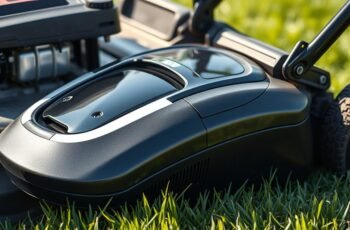
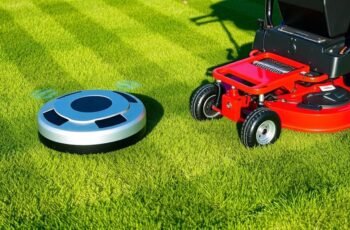
When selecting between robotic and ride-on mowers for sloped terrain, we must consider their specific capabilities and limitations in handling varying inclines. Understanding how each mower type performs on different slopes involves analyzing stability, power, and potential turf impact. This comparison reveals critical factors that influence efficiency and safety, prompting us to evaluate which option best suits different landscape requirements. The decision hinges on more than just terrain, guiding us toward the most appropriate solution for each application.
Key Takeaways
- Robotic mowers excel on steep slopes (above 15°) due to stability, while ride-on mowers perform better on gentle slopes up to 15°.
- Ride-on mowers offer faster coverage and longer runtime on moderate inclines, unlike battery-limited robotic models.
- Robotic mowers have precise navigation and low center of gravity, reducing turf damage and soil compaction risks.
- Ride-on mowers provide more power and control for uneven or complex terrains but can cause soil compaction and noise issues.
- Proper terrain assessment and maintenance are essential to optimize safety and efficiency for both mower types on slopes.
How Do Robotic and Ride-On Mowers Handle Sloped Terrain?
When it comes to handling sloped terrain, robotic and ride-on mowers employ different mechanical and design strategies to maintain stability and cutting performance. Robotic mowers rely heavily on automated navigation systems that adapt to terrain variations, utilizing sensors and algorithms to guarantee consistent coverage. Their design emphasizes low center of gravity and wheel traction to prevent slippage on inclines. Battery efficiency is critical; optimized power management allows robotic mowers to operate longer on slopes without compromising stability. Ride-on mowers, however, utilize heavier frames and specialized tires designed for grip and balance, with some models incorporating self-leveling decks. Both types focus on stability and efficiency, but robotic mowers’ reliance on advanced navigation and battery management distinguishes their approach to sloped terrain.
Pros and Cons of Robotic Mowers for Slopes
Robotic mowers offer a range of advantages for sloped terrains, primarily due to their precise navigation systems and low center of gravity, which enhance stability on inclines. Automated navigation algorithms enable these machines to accurately follow complex terrain contours, minimizing the risk of slippage or tipping. Additionally, their low center of gravity contributes to improved balance on slopes. However, there are notable downsides. Battery efficiency can be a limiting factor, as steep inclines demand more energy, reducing operating time and necessitating frequent recharging. This can impact overall productivity, especially on larger or more challenging slopes. While robotic mowers excel in precision and stability, their reliance on battery power and the need for careful calibration mean they may not be suitable for all sloped terrains, particularly those with extreme inclines or uneven surfaces.
Advantages and Limitations of Ride-On Mowers on Sloped Lawns
Ride-on mowers are highly effective for maintaining sloped lawns due to their powerful engines and robust construction, which enable them to handle various terrains with relative ease. Their advantages include consistent mowing performance, the ability to cover large areas efficiently, and superior control on uneven surfaces. However, limitations exist; they can negatively impact lawn aesthetics if not properly managed, especially on sharp inclines, and often generate higher noise levels, which may disturb nearby environments. Additionally, their weight can cause soil compaction on sensitive slopes, affecting turf health.
- Enhanced stability and control on moderate slopes
- Greater mowing speed and efficiency
- Potential for soil compaction and turf damage
- Elevated noise levels impacting surroundings
- Challenges in precision trimming on complex contours
Which Mower Is Better for Different Types of Slopes?
Determining the most suitable mower for different slope conditions requires careful consideration of the terrain’s steepness and complexity. For gentle slopes (up to 15 degrees), ride-on mowers excel due to their high mowing speed and extended battery life, enabling efficient coverage. Conversely, for steeper terrains (above 15 degrees), robotic mowers with specialized incline capabilities are preferable, as they offer better stability and safety.
| Slope Range | Recommended Mower | Key Factors |
|---|---|---|
| 0-15° | Ride-on | Mowing speed, battery life |
| 15-30° | Robotic Mower | Stability, incline handling |
This analysis highlights that ride-on mowers suit less steep areas with high mowing speed, while robotic models excel on steeper or complex terrains requiring precision and safety.
Tips for Maintaining and Operating Mowers on Sloped Areas
Maintaining and operating mowers on sloped terrain requires careful attention to safety protocols and regular equipment checks to guarantee peak performance. To optimize cutting precision and battery longevity, verify the mower’s blades are sharp and properly aligned, minimizing strain during operation. Regularly inspect the battery health, as frequent use on slopes can accelerate degradation, reducing runtime. Use appropriate safety measures, such as stabilizers or wheel locks, to prevent slipping or tipping. Adjust cutting height settings to avoid uneven terrain stress. Additionally, monitor motor temperature and hydraulic functions for robotic models.
- Keep blades sharp for consistent cutting precision
- Regularly check and calibrate safety sensors
- Manage battery charge cycles carefully
- Use stabilizers to prevent slippage
- Inspect hydraulic components for wear
Frequently Asked Questions
Are Robotic Mowers Suitable for Extremely Steep Slopes?
Robotic mowers are generally unsuitable for extremely steep slopes due to limited terrain versatility and safety concerns. Their battery longevity can also be compromised on challenging inclines, making ride-on mowers a more reliable choice for such terrains.
How Do Weather Conditions Affect Mower Performance on Slopes?
Like a delicate balance on a tightrope, weather impacts slope safety and mower performance. Rain, wind, and moisture reduce traction, risking slips and system errors, emphasizing the need for careful weather condition assessments before operation on slopes.
Can Robotic Mowers Handle Uneven or Rocky Terrain?
Robotic mowers generally struggle with uneven or rocky terrain due to limited terrain adaptability, which can compromise mower durability. They excel on smooth surfaces but often require rugged models for challenging landscapes, ensuring consistent performance and longevity.
What Safety Features Do Ride-On Mowers Have for Slopes?
Ride-on mowers feature safety mechanisms like seat sensors, emergency shut-offs, and stability controls to prevent accidents on slopes. Their battery life supports consistent mowing, ensuring precision and safety during extended operations on uneven terrain.
How Do Mowing Costs Compare Between Robotic and Ride-On Options?
We find robotic mowers typically cost 30% less over five years than ride-on options due to lower maintenance expenses. This highlights their superior cost efficiency, making them a smart, economical choice for long-term landscape management.
Conclusion
Ultimately, selecting the best mower depends on your slope’s profile and maintenance needs. For instance, a gentle hillside may benefit from robotic mowers’ precision and low impact, while steeper areas might require ride-on mowers for efficiency—though with caution to avoid turf damage. By analyzing terrain specifics and operational constraints, we can tailor a mowing strategy that maximizes safety, efficiency, and turf health, ensuring long-term landscape sustainability.