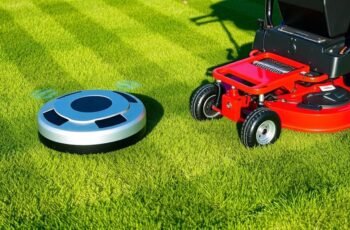
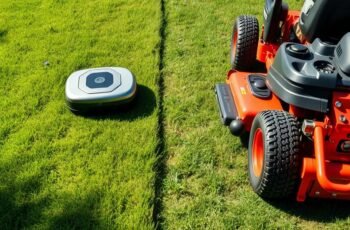
When managing large lawns, combining robotic mowers with ride-on equipment often becomes necessary for efficiency and thoroughness. Robotic models excel in regular, precise trimming but face limitations with vast, uneven, or heavily vegetated areas. Understanding how these tools complement each other is vital for optimizing lawn care. We’ll explore the capabilities of robotic mowers on large properties and what features to take into account for effective integration, which might just change how you approach lawn maintenance.
Key Takeaways
- Robotic mowers excel for small to medium lawns but may struggle with very large or complex terrains requiring ride-on mowers.
- Ride-on mowers are preferred for large lawns with uneven terrain or obstacles that challenge robotic navigation.
- Robotic mowers often need manual intervention or ride-on mowers for tasks like landscaping or heavy-duty mowing.
- Large lawns with dense or tall grass may require ride-on mowers for efficient and quicker coverage.
- Combining robotic mowers with ride-on models optimizes lawn care for extensive areas and diverse landscaping needs.
How Do Robotic Mowers Handle Large Lawns That Typically Require Ride-On Mowers?
How effectively do robotic mowers manage large lawns that traditionally require ride-on mowers? Modern robotic mowers are engineered for scalability, utilizing advanced navigation algorithms and boundary detection to cover expansive areas efficiently. They operate autonomously, often integrating automated watering systems that optimize lawn hydration, reducing manual effort. Solar energy-powered models enhance sustainability by harnessing sunlight, enabling prolonged operation without external power sources. These mowers typically feature multiple cutting zones and adaptive terrain management, ensuring uniform grass maintenance across large landscapes. Their precision minimizes soil disturbance and promotes healthy growth. Overall, robotic mowers equipped with automated watering and solar energy capabilities demonstrate a reliable, eco-friendly alternative to conventional ride-on mowers, effectively managing large lawns with minimal human intervention.
Key Features to Look for in Robotic Mowers for Expansive Lawns
When selecting a robotic mower for expansive lawns, identifying key features that enhance coverage, efficiency, and reliability is crucial. Essential attributes include extended battery longevity to guarantee prolonged operation without frequent recharges, and advanced safety features such as obstacle detection and automatic shutoff for user protection. Additionally, robust navigation systems enable precise, thorough coverage. The table below summarizes these vital features:
| Feature | Description | Benefit |
|---|---|---|
| Battery Longevity | Large capacity batteries for longer mowing sessions | Reduces downtime, increases coverage |
| Safety Features | Obstacle sensors, emergency stop mechanisms | Ensures user and pet safety |
| Navigation System | GPS or boundary wire integration | Accurate, efficient lawn coverage |
| Durability | Weather-resistant, rugged build | Reliable operation in varied conditions |
| Connectivity | App control, remote diagnostics | Enhanced user control and monitoring |
Comparing Robotic Mowers and Ride-On Mowers: Which Is Better for Big Yards?
Choosing between robotic mowers and ride-on mowers for large yards depends on several critical factors, including lawn size, terrain complexity, and maintenance preferences. Robotic mowers excel in maintaining consistent cutting patterns, reducing manual effort, and integrating seamlessly with garden decor, especially in landscaped areas. They are energy-efficient and require minimal ongoing maintenance, but may struggle with complex terrain or large open spaces. Ride-on mowers, on the other hand, provide faster coverage of expansive lawns and handle uneven terrain more effectively. They often feature larger cutting decks, making lawn watering and other landscaping tasks more efficient. Ultimately, the decision hinges on yard topography, aesthetic considerations, and the level of automation desired, ensuring ideal lawn health and minimal upkeep.
Setting Up and Maintaining a Robotic Mower for Large-Scale Lawn Care
Setting up a robotic mower for large-scale lawn care requires careful planning and precise installation to guarantee peak performance. Proper boundary wire placement and scheduling are essential for ideal operation. Regular maintenance ensures consistent battery life and minimizes noise levels, critical for large areas. To facilitate efficient mowing, monitor the battery’s remaining capacity, scheduling recharges before depletion. Noise levels should be assessed to avoid disturbances, especially in shared spaces. Consider the following setup:
| Step | Action | Consideration |
|---|---|---|
| Boundary configuration | Install boundary wires around perimeter | Ensure complete coverage |
| Charging station placement | Position centrally for accessibility | Reduce downtime |
| Software configuration | Set mowing schedule and zones | Optimize battery use |
| Routine maintenance | Clean blades and check components | Maintain noise levels and battery health |
| Performance monitoring | Track battery life and noise periodically | Adjust settings as needed |
Common Challenges With Robotic Mowers on Large Lawns and How to Overcome Them
Operating robotic mowers on large lawns presents distinct challenges related to boundary management, obstacle movement, and system reliability. Proper boundary setup is critical to prevent the mower from crossing into undesired areas, which can interfere with integrated garden design elements. Steering through complex terrains and obstacles, such as trees or flower beds, requires advanced sensors and precise programming to avoid damage and ensure complete coverage. System reliability depends on consistent maintenance and robust hardware, especially on expansive grounds where failures impact overall performance. Additionally, large lawns may influence wildlife impact, necessitating careful planning to minimize disruption. Overcoming these challenges involves optimizing boundary wire placement, selecting models with sophisticated obstacle detection, and designing the landscape to facilitate efficient mowing while respecting local ecosystem considerations.
Frequently Asked Questions
Can Robotic Mowers Handle Uneven Terrain on Large Lawns?
Robotic mowers handle uneven terrain well, thanks to advanced terrain adaptability features, but their efficiency depends on battery longevity. We recommend models with robust suspension and high-capacity batteries for ideal performance on large, irregular lawns.
How Long Does a Robotic Mower Typically Run Before Needing a Recharge?
Think of a robotic mower’s battery life as a marathon runner’s stamina—it typically lasts 1 to 2 hours before needing a recharge. Charging stations guarantee continuous operation, seamlessly swapping out power for uninterrupted lawn maintenance.
Are Robotic Mowers Suitable for Multi-Zone Large Gardens?
Robotic mowers suit multi-zone large gardens well, enhancing garden design and lawn aesthetics through precise, automated mowing. They efficiently handle complex layouts, ensuring consistent coverage across zones, but require strategic boundary setup for ideal performance.
What Safety Features Do Large-Area Robotic Mowers Include?
Large-area robotic mowers include safety sensors that detect obstacles and humans, automatically stopping blades to prevent accidents, along with emergency stops for immediate shutdown, ensuring safe operation across expansive, multi-zone lawns.
How Do Robotic Mowers Perform in Different Weather Conditions?
Robotic mowers demonstrate strong weather adaptability, maintaining seasonal performance through advanced sensors and weather-resistant components. They efficiently navigate varying conditions, ensuring consistent cutting and safety, even during rain or extreme temperatures.
Conclusion
In the landscape of lawn care, robotic mowers symbolize precision and autonomy, quietly tending to the smaller patches while ride-on mowers stand as the guardians of scale and power. Together, they form a symbiotic ecosystem where technology meets tradition. By understanding their roles and complementing each other, we guarantee every inch of our lawns receives ideal care. This harmony between innovation and strength is the key to mastering large-scale lawn maintenance efficiently and effectively.