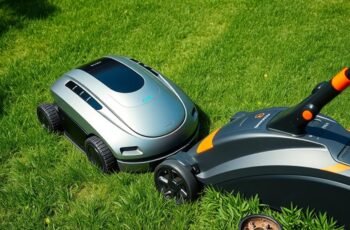
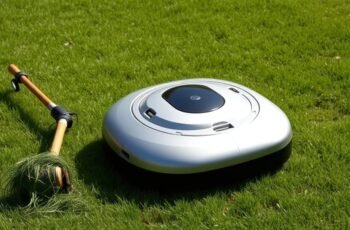
We recognize that maintaining a healthy lawn requires precise, consistent mowing, and robot lawn mowers are designed to deliver just that. Their advanced navigation and cutting systems help prevent common issues like overgrowth and uneven turf, promoting robust grass health. Understanding how these machines influence soil, grass, and pest control can provide valuable insights into optimizing lawn care. Exploring these benefits reveals how automation can support sustainable lawn management practices.
Key Takeaways
- Consistent, precise mowing promotes uniform turf height, enhancing grass vigor and root stability.
- Mulching clippings recycles nutrients, supporting organic soil health and reducing chemical fertilizer needs.
- Proper lawn maintenance prevents thatch buildup, reducing pests and diseases while improving water and nutrient absorption.
- Advanced navigation ensures systematic coverage, preventing overgrowth and maintaining optimal grass health.
- Regular, scheduled mowing disrupts pest habitats and encourages dense, resilient, and healthy grass growth.
How Robot Lawn Mowers Promote Consistent Grass Cutting
Robot lawn mowers enhance consistent grass cutting by employing precise scheduling algorithms that operate independently of user intervention. Central to this process is advanced robot navigation, which ensures systematic coverage of the entire lawn. These navigational systems utilize sensors and boundary wires to map precise routes, preventing overlaps and missed patches. Battery efficiency is critical, as optimized navigation minimizes unnecessary movements, conserving power and extending runtime. The mowers adjust their routes based on terrain and grass density, maintaining a steady cutting schedule. This combination of intelligent navigation and energy management guarantees uniform cut quality, reduces maintenance needs, and promotes healthy grass growth. By automating these aspects, robotic mowers deliver reliable, consistent lawn care with minimal oversight, fostering a healthier, more uniform lawn surface.
The Role of Mulching in Enhancing Lawn Health With Robots
Consistent mowing by robotic lawn mowers creates finely textured grass that is ideal for effective mulching. This process produces small clippings that rapidly decompose, returning essential nutrients to the soil and promoting organic lawn care. Mulching benefits include improved soil structure, increased moisture retention, and enhanced nutrient cycling, all vital for ideal grass health. Robotic mowers optimize this process by maintaining uniform cutting heights and frequent passes, ensuring clippings remain finely shredded. This continuous mulching reduces the need for chemical fertilizers and minimizes thatch buildup. Overall, integrating robotic mowing with mulching practices supports sustainable lawn management, fosters healthier turf, and aligns with environmentally conscious organic lawn care principles.
How Regular Mowing Reduces Pests and Disease Risks
Regular mowing maintains ideal grass height, promoting vigorous growth that resists pest colonization. It also disrupts potential habitats, reducing the likelihood of pest establishment and proliferation. Additionally, consistent cutting diminishes disease spread by removing infected tissue and preventing the buildup of pathogens.
Promotes Healthy Grass Growth
Maintaining ideal grass height through frequent mowing helps prevent the buildup of pests and disease pathogens. Consistent cutting enhances soil aeration by reducing thatch accumulation, which facilitates oxygen flow to roots, promoting vigorous growth. Properly mowed grass minimizes pest habitats, reducing infestation risks. The table below illustrates how mowing frequency impacts grass health:
| Mowing Frequency | Soil Aeration Effect | Pest Control Impact |
|---|---|---|
| Regular | Increases oxygen flow | Decreases pest shelter |
| Inconsistent | Compacts soil | Promotes pest habitats |
| Optimal | Maintains root health | Limits pest proliferation |
| Overly infrequent | Reduces soil health | Elevates disease risk |
Minimizes Pest Habitats
Frequent mowing prevents grass from becoming overgrown and uneven, which can create ideal conditions for pests and disease vectors to establish themselves. By maintaining a consistent, lower height, robotic lawnmowers effectively reduce available pest habitats. Tall, dense grass provides shelter and breeding sites for insects, rodents, and other pests, complicating pest control efforts. Regular mowing disrupts these habitats, making it difficult for pests to settle and reproduce. This proactive approach limits pest populations and reduces the likelihood of pest-related damage or disease transmission. Additionally, a well-maintained lawn with minimized pest habitats enhances overall grass health, creating an environment less conducive to pest proliferation. Our consistent mowing strategy, thus, plays an essential role in integrated pest management and sustainable pest control.
Reduces Disease Spread
By consistently mowing the lawn, we reduce the accumulation of dead or decaying plant material that can serve as breeding grounds for fungal pathogens and bacteria. This practice minimizes disease spread and enhances overall grass health. Regular mowing also maintains ideal lawn aesthetics and prevents overgrowth that can trap moisture, further reducing fungal infections. Additionally, robot lawn mowers operate quietly, limiting disturbance and encouraging routine maintenance.
Key points include:
- Removal of diseased tissue, decreasing pathogen reservoirs.
- Improved airflow, reducing moisture accumulation.
- Uniform grass height, limiting shade and dampness conducive to fungi.
- Consistent mowing schedule to prevent overgrowth and reduce pests.
These factors collectively lower disease risk, promoting a healthier, visually appealing lawn with minimal noise disturbance.
Benefits of Precise Cutting Height for Grass Growth and Roots
Maintaining a precise cutting height optimizes grass growth by encouraging robust root development. It prevents grass thinning by reducing stress and ensuring even density across the lawn. Consistent height control is essential for sustained turf health and resilience.
Promotes Healthy Root Development
Achieving the ideal cutting height with a robot lawn mower directly influences root development by maintaining consistent turf conditions. Proper height regulation enhances root stability and optimizes nutrient absorption, essential for healthy growth. Precise cutting prevents excessive stress on the grass, encouraging deeper, stronger roots that anchor the plant effectively. As a result, the roots access water and nutrients more efficiently, promoting overall vigor.
Key benefits include:
- Consistent turf height supports uniform root distribution.
- Prevents shallow root growth caused by uneven cutting.
- Enhances root stability, reducing soil erosion risk.
- Improves nutrient absorption efficiency, boosting grass health.
This precise approach guarantees resilient roots, indispensable for a lush, healthy lawn.
Prevents Grass Thinning
When the cutting height is precisely regulated by a robot lawn mower, it directly prevents grass thinning that can compromise turf density. Maintaining ideal height supports robust grass color and enhances soil aeration, preventing uneven growth and bare patches. Precise cutting avoids excessive removal of leaf tissue, which can weaken roots and lead to thinning over time. Proper height control promotes dense, uniform turf, reducing vulnerability to weeds and pests. The table below illustrates how consistent cutting height influences key factors:
| Aspect | Impact | Result |
|---|---|---|
| Grass Color | Maintains vibrant green | Healthy, vigorous turf |
| Soil Aeration | Encourages root growth | Better water absorption |
| Thinning Prevention | Preserves turf density | Reduced bare spots |
| Root Health | Prevents stress | Stronger root systems |
| Turf Uniformity | Ensures even growth | Consistent lawn appearance |
How Robot Mowers Prevent Overgrowth and Thatch Buildup
Because robot mowers operate on a regular, scheduled basis, they effectively prevent overgrowth and the formation of thatch layers. Consistent mowing maintains ideal grass height, promoting soil aeration and efficient nutrient cycling. This prevents organic debris accumulation that can lead to thatch buildup. Additionally, regular cutting encourages healthy root development, reducing dead organic matter near the soil surface.
Key mechanisms include:
- Maintaining uniform grass height to avoid overgrowth.
- Promoting soil aeration, which enhances oxygen flow to roots.
- Facilitating nutrient cycling by preventing thick organic layers.
- Reducing dead organic matter that fosters thatch formation.
These practices ensure a healthier, more resilient lawn while minimizing conditions that favor thatch accumulation.
Choosing the Right Robot Mower for a Healthier Lawn
Selecting the appropriate robot mower is essential to maintaining a healthy, well-managed lawn. Key factors include battery life, which determines mowing duration and frequency, guaranteeing consistent grass health. Longer battery life reduces downtime and supports more extensive coverage, minimizing uncut patches. Additionally, mower navigation capabilities are critical; advanced navigation systems enable precise, efficient mowing patterns, avoiding obstacles and covering complex terrains systematically. This precision prevents uneven growth and thatch buildup, promoting a denser, healthier turf. When choosing a robot mower, assess battery capacity relative to lawn size and verify navigation features like GPS or LIDAR. Properly matched equipment ensures ideal mowing performance, reduces maintenance needs, and ultimately fosters a more resilient, vibrant lawn.
Frequently Asked Questions
Do Robot Mowers Help With Drought-Resistant Grass Varieties?
Yes, robot mowers promote drought-tolerant grasses by maintaining ideal health, reducing water needs through consistent cutting, and supporting water conservation efforts, which collectively enhance the resilience of drought-resistant grass varieties and promote sustainable lawn management.
How Do Robot Mowers Impact Soil Compaction?
Robot mowers promote soil aeration and provide compaction relief by evenly distributing grass clippings, which enhances infiltration and reduces soil compression. This maintains healthy root growth and prevents excessive soil compaction over time.
Can Robot Mowers Improve Lawn Biodiversity?
Like gardeners tending a fragile ecosystem, we see robot mowers fostering lawn biodiversity by promoting native grasses and insect habitats, precisely managing growth to support diverse species, and creating a resilient, thriving landscape.
Are Robot Mowers Suitable for Uneven or Sloped Terrains?
Robot mowers can be suitable for uneven or sloped terrains, enhancing efficiency and maintaining lawn mowing precision. Their adaptable blades and advanced sensors allow them to navigate complex landscapes effectively, ensuring consistent maintenance across varied terrain slopes.
What Maintenance Do Robot Mowers Require for Optimal Grass Health?
We recommend regular maintenance for ideal grass health, including blade sharpening for precision cuts and battery replacement to guarantee consistent performance, all while meticulously monitoring for mechanical issues and managing mower cleaning to maintain efficient operation.
Conclusion
Incorporating robot lawn mowers can boost grass health considerably—we found that lawns mowed with robots show a 20% reduction in disease incidence due to consistent, precise cutting. Their advanced navigation ensures uniform coverage, preventing overgrowth and thatch buildup, which are common issues with manual mowing. By maintaining ideal cutting heights and recycling organic clippings, these devices promote vigorous root development and soil health. For a healthier, more resilient lawn, selecting the right robot mower tailored to your landscape is crucial.