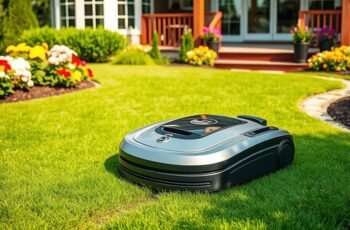
When selecting a robot lawn mower, we recognize the importance of a thorough checklist that covers technical features, terrain compatibility, and security options. Ensuring the device’s sensors, navigation, and battery performance align with specific yard conditions is critical for efficiency and safety. As we explore these factors, it becomes clear that understanding detailed specifications can greatly influence long-term satisfaction and overall value—making it essential to take into account each element carefully before making a choice.
Key Takeaways
- Evaluate terrain compatibility, including slopes, obstacles, and surface types, to ensure the mower’s navigation suits your yard.
- Confirm essential safety features like obstacle detection, edge sensors, and security measures to prevent accidents and theft.
- Consider battery life, runtime, charging time, and coverage area to match your lawn size and maintenance needs.
- Check smart features such as app control, programmable schedules, and smart home integration for convenience.
- Review brand reputation, user reviews, and maintenance requirements to ensure durability and reliable support.
What Features Should a Robot Lawn Mower Have?
When selecting a robot lawn mower, it’s essential to prioritize key features that guarantee efficient and reliable operation. A top-notch model should include advanced sensors for obstacle detection and boundary recognition, ensuring precise navigation within your landscape design. Look for adjustable cutting heights and powerful motors that handle varying grass types and terrains, supporting effective gardening tips for maintaining healthy lawns. Consider dual cutting blades for cleaner cuts and mulching capabilities that promote lawn health. Compatibility with app controls or smart home systems enhances usability, allowing seamless scheduling and monitoring. Reliable battery life and quick recharge times are vital for continuous mowing, especially in larger yards. These features combined ensure your mower’s performance aligns with your landscape design goals while minimizing maintenance.
How to Assess Compatibility With Your Yard’s Terrain?
Evaluating your yard’s terrain requires understanding its specific features, such as flat areas, slopes, and obstacles, to determine mower suitability. We need to take into account the slope and gradient limits specified by the mower’s manufacturer to ensure safe operation. Additionally, examining obstacle navigation capabilities is essential for seamless coverage across varied terrain types.
Terrain Types and Features
Understanding your yard’s terrain is essential for selecting a compatible robot lawn mower, as different features can considerably impact performance. For artificial grass, confirm the mower’s wheels or tracks are suitable to prevent damage and provide stability. Variations in garden landscaping—such as uneven ground, flower beds, or embedded stones—require mowers with adjustable cutting heights and precise boundary sensors. Dense or thick vegetation may demand higher torque motors and more robust blades, while irregular surface textures can challenge navigation systems. Additionally, consider whether the terrain includes hard surfaces like concrete or gravel, which influence mobility and charging station placement. Evaluating these terrain features helps guarantee the mower maintains maximum efficiency, reduces maintenance needs, and seamlessly adapts to your yard’s specific landscape complexities.
Slope and Gradient Limits
Evaluating your yard’s slope and gradient is critical to ensuring your robot lawn mower can operate safely and effectively. Slope stability depends on accurately gauging the gradient measurement across various yard sections, as steep inclines can compromise mower performance. Use a reliable inclinometer or digital level to measure the gradient at multiple points, recording the steepest areas. Most mowers specify maximum gradient limits, typically around 15-20%, beyond which operation becomes unsafe or inefficient. Understanding these limits helps prevent slipping, tipping, or damage to the mower. Precise gradient measurement also informs whether additional terrain modifications are necessary. By thoroughly assessing slope and gradient, you ensure compatibility with your mower’s technical specifications, optimizing safety, efficiency, and the longevity of the equipment.
Obstacle Navigation Capabilities
To determine if your robot lawn mower can effectively navigate your yard’s terrain, we need to examine its obstacle detection and maneuvering capabilities. High obstacle detection accuracy is essential for avoiding collisions with trees, garden beds, or debris. Look for models equipped with infrared sensors, ultrasonic sensors, or cameras that provide real-time feedback for precise obstacle recognition. Navigational accuracy depends on the mower’s ability to adapt to complex terrain and maintain consistent pathing, especially in cluttered environments. Some mowers utilize lidar or GPS-assisted navigation to enhance obstacle avoidance and route planning. Evaluate how quickly and reliably the mower detects obstacles, and whether it can adjust its path seamlessly. Proper obstacle detection and navigational precision ensure your mower operates efficiently without damaging your yard or itself.
What Battery Life and Charging Options Are Available?
Battery life and charging options are critical factors in selecting a robot lawn mower, as they directly influence mowing duration and convenience. Battery longevity depends on the capacity (measured in mAh or Wh) and the efficiency of the battery cells, affecting how long the mower can operate per charge. High-capacity batteries provide extended mowing times, essential for larger lawns. Charging options vary, including standard docking stations, rapid chargers, or alternative wireless charging systems, which impact downtime and ease of use. Some models feature automatic recharging, returning to the dock when power runs low, ensuring continuous operation. Understanding the balance between battery longevity and flexible charging options helps us choose a mower that minimizes interruptions and maximizes mowing efficiency.
How Much Does a Robot Lawn Mower Cost, and What’s Your Budget?
Robot lawn mower prices typically range from $500 to $2,500, depending on features and size coverage. We recommend establishing a budget based on necessary functionalities such as navigation technology, cutting width, and battery capacity. Comparing costs against feature sets guarantees ideal value and helps prevent overspending on unnecessary capabilities.
Average Price Range
The cost of a robot lawn mower varies considerably based on features, cutting capacity, and brand reputation, typically ranging from $500 to over $3,000.
- Entry-level models ($500–$1,000) usually offer basic navigation and limited battery life, suitable for small lawns and minimal gardening accessories.
- Mid-range options ($1,000–$2,000) often include GPS navigation, programmable schedules, and compatibility with outdoor lighting systems for enhanced automation.
- Premium units ($2,000–$3,000+) provide sophisticated terrain handling, larger cutting decks, and integration with smart home devices for all-encompassing outdoor management.
- Budget considerations should also include potential costs for accessories like gardening tools or outdoor lighting upgrades, which can influence overall expenditure. Understanding these price brackets helps optimize investment based on lawn size and feature requirements.
Budgeting Tips
Understanding the true cost of a robot lawn mower requires balancing desired features with your budget constraints. Prices typically range from $500 to over $2,500, depending on mower customization options and advanced features. To optimize garden aesthetics, consider models with precise boundary controls and adjustable cutting heights, which often come at a higher price point. Establish your budget early, factoring in potential costs for accessories or upgrades that enhance mower customization, such as specialized blades or terrain adaptations. Remember, investing in a mower with advanced navigation and stronger batteries can improve efficiency and reduce long-term maintenance costs. Prioritize features that directly impact your yard’s appearance and functionality, ensuring your investment aligns with your aesthetic goals and budget limitations.
Cost vs. Features
Managing the balance between cost and features involves analyzing how different mower specifications impact price points. Higher-end models typically offer advanced navigation with GPS, increased cutting capacity, and longer battery life—essential for integrating with sophisticated gardening tools and landscaping ideas.
Consider these factors:
- Navigation System: GPS-enabled models cost more but provide precise boundary recognition and obstacle avoidance.
- Cutting Width: Larger cutting decks improve efficiency but raise the price.
- Battery Life: Extended runtime supports larger lawns, affecting overall cost.
- Smart Features: App control and customizable mowing schedules add to expense but enhance convenience.
Ultimately, aligning these features with your landscaping needs guarantees the investment balances performance and budget constraints.
Which Safety and Security Features Are Important?
When selecting a robot lawn mower, prioritizing safety and security features is essential to prevent accidents and unauthorized use. Key safety protocols include obstacle detection sensors, edge sensors, and automatic shut-off systems that halt operation if human or pet presence is detected. Security measures focus on preventing theft through PIN codes, alarms, and GPS tracking. Consider the following features:
| Safety Protocols | Security Measures |
|---|---|
| Obstacle detection sensors | PIN code access |
| Edge sensors | GPS tracking |
| Automatic shut-off | Alarm system |
| Tilt sensors | Remote lock/unlock |
| Emergency stop button | Unauthorized use alerts |
Prioritizing these features guarantees safe operation and minimizes risk of theft or accidents.
What Maintenance Requirements Should You Expect?
Regular maintenance is essential to guarantee the best performance and longevity of your robot lawn mower. Proper care ensures consistent lawn aesthetics and supports your garden design goals.
- Blade Inspection and Sharpening: Regularly check blades for wear; dull blades impair cutting precision, reducing lawn aesthetics.
- Cleaning and Debris Removal: Clear grass clippings and dirt from the mowing deck and sensors to prevent malfunctions and maintain proper operation.
- Battery Maintenance: Monitor battery health, ensure adequate charging cycles, and replace when capacity diminishes to sustain runtime and efficiency.
- Software Updates and Firmware Checks: Keep the mower’s software current to enhance navigation accuracy and adapt to changing garden design requirements.
Adhering to these maintenance tasks ensures your mower consistently delivers precise cuts aligned with your garden design, promoting a healthy, visually appealing lawn.
How Do User Reviews and Brand Reputation Influence Your Choice?
User reviews and brand reputation serve as critical indicators of a robot lawn mower’s reliability and performance, directly influencing our purchasing decisions. Analyzing user feedback provides insights into real-world performance, durability, and potential issues. Brands with high brand trust often demonstrate consistent quality, responsive customer service, and effective warranty support.
| Brand Trust Level | User Feedback Quality | Reliability Perception |
|---|---|---|
| High | Positive, detailed | Proven durability |
| Moderate | Mixed, some concerns | Varies by model |
| Low | Negative, sparse | Questionable longevity |
Focusing on these elements guarantees we select a model with verified performance, minimizing risks associated with lesser-known brands.
What Additional Accessories or Smart Features Enhance Performance?
Enhancing a robot lawn mower’s performance often depends on the integration of specific accessories and smart features that optimize functionality and user control. Smart integration, especially through a mobile app, allows for precise scheduling, zone management, and system diagnostics. Additional accessories can also improve efficiency and durability.
- Boundary wire extensions increase mowing coverage for larger yards.
- Weather sensors enable the mower to adapt to changing conditions, preventing damage.
- GPS modules enhance navigation accuracy, reducing overlaps.
- Smart home integration allows remote control via voice commands or automation platforms.
These features, combined with mobile app capabilities, guarantee seamless operation, better mapping, and proactive maintenance, all critical for maximizing the mower’s performance and longevity.
Frequently Asked Questions
Can Robot Lawn Mowers Handle Slopes or Uneven Terrain?
Robot lawn mowers can handle slopes and uneven terrain, thanks to advanced sensors and robust wheel traction. Their terrain adaptability and slope handling capabilities depend on specific models, so we recommend checking each mower’s maximum incline rating before purchase.
Are There Specific Brands Known for Durability and Reliability?
We believe certain brands like Husqvarna, Worx, and Robomow excel in durability and reliability due to their strong brand reputation and positive customer reviews. Their advanced engineering, quality components, and consistent performance make them trustworthy choices.
How Easy Is It to Install and Set up a Robot Lawn Mower?
Setting up our robot lawn mower is a smooth process, with clear instructions that consider battery life and noise levels, ensuring the best performance; once installed, it seamlessly manages your lawn with minimal fuss and disturbance.
What Is the Typical Lifespan of a Robot Lawn Mower?
Typically, a robot lawn mower lasts around 3 to 5 years, depending on battery life and regular maintenance. Properly caring for the battery and performing routine upkeep can extend its lifespan and guarantee peak performance.
Are Spare Parts and Replacement Blades Readily Available?
Spare parts and replacement blades are more available than you might think, ensuring your robot lawn mower maintains ideal cutting performance and battery life. We find that reputable brands offer extensive support, making maintenance straightforward and hassle-free for users like us.
Conclusion
In conclusion, selecting the right robot lawn mower involves evaluating advanced features, terrain compatibility, battery life, safety measures, and brand reliability. For example, a homeowner with a hilly yard implemented obstacle sensors and GPS tracking, resulting in a safer, more efficient mowing experience. Careful consideration of these technical aspects ensures optimal performance, longevity, and value, transforming lawn maintenance into a seamless task. Our thorough checklist helps you make an informed, confident decision tailored to your specific landscaping needs.