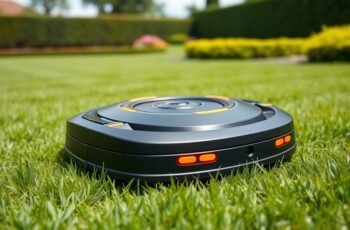
Imagine a robot mower as a vigilant guard, constantly scanning its surroundings to prevent accidents. Safety sensors are the quiet but essential systems that enable this vigilance, using advanced technologies like infrared and ultrasonic detection to identify obstacles and boundaries in real time. Without these sensors, the mower’s ability to operate safely and efficiently would be compromised. Understanding how these systems work and their limitations is vital for anyone considering autonomous lawn care solutions.
Key Takeaways
- Safety sensors monitor surroundings using infrared, ultrasonic, or bump detection to prevent collisions and ensure user safety.
- Boundary recognition relies on boundary wires or alternative methods like GPS to keep the mower within designated areas.
- Emergency stop features allow immediate halting of mower operation during hazards or malfunctions.
- Regular sensor maintenance, cleaning, and proper alignment are essential for accurate obstacle detection.
- Future innovations include multi-sensor fusion and AI for enhanced obstacle detection and safety response.
How Do Robot Mower Safety Sensors Keep You Safe?
Robot mower safety sensors actively detect obstacles and prevent accidents by continuously monitoring the mower’s surroundings. These sensors utilize infrared, ultrasonic, or bump detection technology to identify objects in real-time, halting the mower before contact occurs. This system not only enhances safety but also preserves battery longevity by avoiding unnecessary movements and collisions that drain power. Additionally, the sensors are integrated with a user interface, allowing operators to customize safety parameters and receive alerts if obstacles are detected. The interface provides clear feedback, ensuring users understand the mower’s status and safety functions. Overall, these safety sensors create a reliable, efficient operation, minimizing risks and ensuring safe, automated lawn maintenance.
Obstacle Detection: How Robot Mowers Avoid Collisions
To effectively avoid collisions, robot mowers rely on a combination of advanced obstacle detection technologies that actively scan their environment. These systems utilize sensors such as ultrasonic, infrared, or lidar, which require precise sensor calibration to guarantee accuracy. Proper calibration aligns sensor signals with real-world distances, optimizing obstacle avoidance. When an obstacle is detected, the mower’s control system processes the data to determine if a collision is imminent, prompting it to change course. This real-time obstacle detection is essential for safe operation, preventing damage to both the mower and objects in its path. Continuous sensor calibration and responsive obstacle avoidance algorithms enable the mower to navigate complex terrains efficiently while maintaining safety standards.
Boundary Recognition: Keeping Mowers Within Your Lawn Limits
Boundary wire setup is essential for defining the mower’s operational perimeter, ensuring it recognizes lawn limits accurately. Detecting these limits involves sensors that respond to the wire signals, but boundary failures can occur due to wire damage or interference. Understanding how to handle boundary failures helps maintain reliable containment and prevents the mower from straying outside designated areas.
Boundary Wire Setup
Setting up the boundary wire is a crucial step in guaranteeing your mower stays within designated lawn areas. Proper boundary customization involves laying the wire around your lawn’s perimeter, creating a physical boundary that the mower’s sensors recognize. It’s essential to follow precise installation guidelines to maintain consistent sensor calibration, which impacts boundary detection accuracy. Correctly calibrated sensors respond reliably to the boundary wire’s electromagnetic signals, preventing the mower from crossing into restricted zones. During setup, we recommend testing the sensor response after wiring, adjusting the boundary wire if needed to optimize detection. This ensures the mower’s safety sensors operate effectively, reducing the risk of boundary breaches and guaranteeing a smooth, autonomous mowing process. Proper boundary wire setup is fundamental to reliable and safe robotic mower operation.
Detecting Lawn Limits
Ensuring that your robotic mower stays within designated lawn boundaries relies on its ability to accurately detect limits. Modern boundary recognition methods include magnetic sensors, GPS technology, and advanced boundary wire systems that integrate with your garden landscaping layout. These sensors help the mower identify the edge of your lawn, preventing it from wandering into unwanted areas or near lawn watering zones. Magnetic sensors detect embedded magnets along the perimeter, while GPS provides precise boundary mapping. Boundary wires create invisible fences that the mower’s sensors recognize, maintaining consistent turf coverage. Proper detection of lawn limits not only protects garden landscaping but also minimizes the risk of damaging irrigation systems. Accurate limit detection is essential for efficient, safe mowing and maintaining the integrity of your lawn’s design.
Handling Boundary Failures
When boundary recognition systems fail, it becomes vital to implement effective strategies for handling these errors to prevent the mower from exceeding designated limits. Boundary failure often results from sensor malfunction, where the boundary wire or sensors do not accurately detect lawn edges. To address this, regular system diagnostics are essential for identifying sensor malfunctions early. Manual boundary recalibration can correct misalignments caused by boundary wire shifts or damage. Additionally, incorporating multiple boundary detection methods—such as infrared sensors or GPS-based systems—reduces reliance on a single sensor type and mitigates failures. In cases of persistent boundary failure, temporary physical barriers or remote supervision can guarantee safety and containment. These measures help maintain the integrity of boundary recognition despite sensor malfunctions, guaranteeing reliable mower operation within designated limits.
Emergency Stop Features and Their Role in Safety
Emergency stop features are crucial components of robot mower safety systems, designed to immediately halt operation in hazardous situations. They serve as essential elements of emergency protocols, ensuring rapid response to potential dangers. These features comply with safety regulations that mandate quick shutdown mechanisms to prevent injuries or damage. Typically, emergency stops are accessible via physical buttons or remote triggers, enabling users to activate the halt function instantly. This immediate cessation of movement minimizes risks during malfunctions, obstacle detection failures, or human interference. By integrating these robust emergency protocols, manufacturers enhance overall safety, ensuring compliance with industry standards. Properly designed emergency stop features are indispensable for creating a secure mowing environment and providing peace of mind to users.
Types of Sensors Used in Robot Mowers Explained
Robot mowers rely on an array of sensors to navigate safely and operate efficiently within their environments. These sensors include boundary, obstacle detection, and tilt sensors, each critical for precise operation. Boundary sensors detect wire or boundary markers, requiring regular sensor calibration to maintain accuracy. Obstacle detection sensors use infrared, ultrasonic, or laser technology to identify objects in the mower’s path, ensuring safe navigation. Tilt sensors monitor the mower’s orientation, preventing tipping accidents. Outdoor durability is essential for all these sensors, as they must withstand weather conditions, dirt, and debris over time. Proper sensor calibration and robust outdoor durability guarantee consistent performance, safety, and reliability, allowing the mower to adapt to varying terrains and environmental factors seamlessly.
How Sensors Differ Between Various Robot Mower Models
Different robot mower models incorporate a variety of sensors that vary considerably in type, placement, and sophistication, reflecting their intended用途 and price point. Higher-end models often feature advanced sensors requiring precise calibration to ensure safety and optimal performance. These sensors may include ultrasonic, infrared, or lidar systems, with calibration processes adjusted via software updates to maintain accuracy over time. Budget models typically use simpler bump or contact sensors, less reliant on calibration but still crucial for obstacle detection. The differences also extend to sensor placement; some models position sensors at the mower’s perimeter, others integrate them internally. Understanding these distinctions helps in selecting a mower that balances sensor sophistication with your specific lawn needs.
| Model Type | Sensor Features |
|---|---|
| Premium | Advanced sensors, calibration via software updates |
| Mid-range | Mixed sensor types, moderate calibration needs |
| Budget | Basic bump/contact sensors, minimal calibration |
Troubleshooting Common Sensor Issues in Robot Mowers
Sensor issues are among the most common causes of performance problems in robot mowers, often resulting from misalignment, dirt buildup, or software glitches. To troubleshoot, start by inspecting the sensors for dirt or debris and clean them gently with a soft cloth. Misaligned sensors can cause incorrect readings; realign them carefully according to the manufacturer’s instructions. Sensor calibration is also vital; recalibrate sensors periodically to guarantee accurate detection of obstacles and boundaries. Software glitches can interfere with sensor operation, so check for available software updates and install them promptly, as updates often include bug fixes and performance improvements. If issues persist after cleaning and calibration, resetting the mower or consulting the user manual for advanced troubleshooting steps may be necessary.
Enhancing Safety: Tips for Maintaining Your Mower’s Sensors
Maintaining your mower’s sensors is essential for reliable operation and safety. Regular cleaning removes dirt and debris that can impair sensor performance, while proper alignment guarantees accurate obstacle detection. Consistent attention to these factors helps optimize your mower’s safety features and prolongs sensor lifespan.
Regular Sensor Cleaning
Regularly cleaning your mower’s safety sensors is essential to guarantee peak performance and safety. Dirt, debris, or grass clippings can obstruct sensor surfaces, impairing their ability to detect obstacles accurately. This buildup can interfere with sensor calibration, leading to false detections or missed hazards. We recommend inspecting sensors frequently, especially after adverse weather effects like rain or high humidity, which can accelerate dirt accumulation. Use a soft, damp cloth to gently wipe sensor surfaces, avoiding harsh chemicals that could damage sensitive components. Maintaining clean sensors ensures reliable obstacle detection and prevents unnecessary shutdowns. Consistent cleaning not only preserves sensor function but also helps sustain ideal operational calibration, reducing the risk of accidents caused by sensor malfunction.
Proper Sensor Alignment
Have you checked whether your mower’s safety sensors are properly aligned? Proper sensor alignment is essential for optimal performance and safety. Incorrect sensor installation can cause misreads, reducing the mower’s ability to detect obstacles. To guarantee accurate sensor calibration, start by inspecting the sensor positions, making sure they face directly outward and are free from obstructions. Adjust the sensors if needed, following the manufacturer’s specifications. Proper alignment involves aligning sensors at the correct angles so they can reliably detect objects in their designated zones. Regularly verify sensor calibration after adjustments or cleaning, as misaligned sensors can compromise safety. Maintaining precise sensor installation helps your mower operate efficiently while minimizing the risk of accidents or damage.
Future Innovations in Robot Mower Safety Technology
As technology advances, the future of robot mower safety sensors promises to incorporate more sophisticated and adaptive systems that considerably improve operational security. Innovations will likely focus on enhanced autonomous navigation, allowing mowers to better interpret complex terrains and dynamically avoid obstacles. AI integration will enable real-time decision-making, improving responsiveness to unexpected hazards and reducing false alarms. These advancements will also facilitate predictive maintenance, minimizing downtime. To achieve this, key developments may include:
- Multi-sensor fusion for more accurate obstacle detection
- Machine learning algorithms for adaptive safety responses
- Real-time environment mapping for improved navigation accuracy
These innovations will make robot mowers safer, more reliable, and capable of operating seamlessly in diverse environments.
Frequently Asked Questions
Can Robot Mower Sensors Detect Pets or Children Nearby?
Our robot mower sensors can detect pets and children nearby through pet detection technology and child safety features, ensuring the mower stops or redirects, providing a safer lawn experience and preventing accidents with little ones or furry friends.
How Do Sensors Function in Different Weather Conditions?
Sensors adapt to weather variations through calibration adjustments, maintaining accuracy in rain, sun, or snow, thanks to weather-resistant designs. This guarantees reliable detection and safe operation across diverse environmental conditions, protecting both users and pets.
Are There Safety Sensors Specific to Certain Lawn Types?
We find that safety sensors are generally universal, but lawn terrain and sensor calibration influence effectiveness. Specific lawn types may require calibration adjustments, ensuring sensors accurately detect obstacles across varied terrains, enhancing safety and operational reliability.
What Is the Lifespan of a Robot Mower’s Safety Sensors?
We find that robot mower safety sensors typically last 3-5 years, depending on sensor durability and maintenance. For example, neglecting regular cleaning can reduce lifespan; proactive upkeep guarantees reliable operation and extended sensor functionality.
Can Sensors Be Upgraded or Replaced to Improve Safety?
Yes, sensors can be upgraded or replaced to enhance safety through sensor calibration and firmware updates, ensuring peak performance. Regular calibration and firmware updates improve sensor accuracy, responsiveness, and compatibility, ultimately boosting your robot mower’s safety features.
Conclusion
Just like a finely tuned sensor array keeps a robot mower precise and safe, regular maintenance guarantees it performs at peak efficiency. Think of it as tuning a musical instrument—neglect can cause discord, while proper care maintains harmony. As technology advances, these sensors become even smarter, much like a vigilant conductor guiding an orchestra. Staying proactive with sensor upkeep not only protects your investment but ensures your lawn stays beautifully manicured, safely and efficiently.