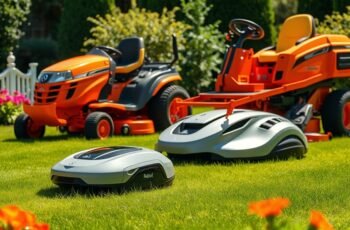
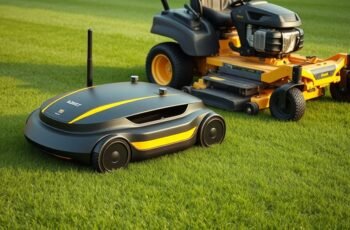
When choosing between a robot lawn mower and an electric mower, we must consider factors like automation, cost, and lawn complexity. Both options offer distinct advantages and limitations that can substantially impact maintenance routines and overall efficiency. Understanding these differences is vital to making an informed decision tailored to specific landscape needs and budget constraints. As we analyze these tools, it becomes clear that the right choice depends on more than just initial investment.
Key Takeaways
- Robot mowers offer autonomous operation with smart navigation, while electric mowers require manual handling and operation.
- Robot mowers are better suited for irregular or obstacle-rich lawns; electric mowers excel on large, flat, uniform areas.
- Initial costs are higher for robot mowers but may save money over time; electric mowers are generally more affordable upfront.
- Robot mowers operate quietly and reduce physical effort, whereas electric mowers can be louder and demand user manual effort.
- Both are eco-friendly, but robot mowers typically consume less energy and require less maintenance than electric mowers.
What Are the Main Differences Between Robot and Electric Lawn Mowers?
While both robot and electric lawn mowers are designed to automate lawn maintenance, they differ considerably in their operational mechanisms and functionality. Robot mowers typically feature a compact, self-guided system with boundary sensors and programmed mowing patterns, whereas electric mowers rely on manual operation with corded or battery-powered engines. Color options for robot mowers are often limited to sleek, modern designs, while electric mowers come in a broader range of colors, reflecting brand identity. Brand reputation plays an essential role; trusted brands in robot mowers emphasize advanced navigation technology and reliability, whereas established electric mower brands focus on durability and power efficiency. These distinctions influence user experience, maintenance, and overall performance, making the choice dependent on specific lawn needs and brand credibility.
How Do Robot Lawn Mowers Perform on Different Types of Lawns?
Robot lawn mowers are engineered to adapt to a variety of lawn conditions, but their performance can vary considerably depending on the turf’s characteristics. For example, on flat, uniform lawns, they maintain consistent mowing patterns, promoting even lawn aesthetics. However, on uneven or hilly terrain, their ability to navigate and cut efficiently may be compromised, affecting both mowing quality and pattern uniformity. Thick, dense grass can challenge their cutting capacity, potentially leading to incomplete coverage or uneven growth. Conversely, lawns with irregular textures or obstacles require advanced sensors for ideal performance. Overall, robot mowers excel on well-maintained, predictable surfaces, but their effectiveness diminishes with complex or challenging lawn types, impacting the desired mowing patterns and overall lawn aesthetics.
Comparing Cost: Which Mower Fits Your Budget Better?
When evaluating the overall cost of lawn maintenance, understanding the upfront and ongoing expenses of robot lawn mowers versus electric mowers is essential. Robot mowers typically have higher initial costs due to advanced technology and battery longevity, but their lower operational costs can offset this over time. Additionally, their quieter noise levels reduce disturbance, which might influence long-term satisfaction and potential noise-related costs. Electric mowers usually have lower upfront prices, but their ongoing expenses include battery replacements and higher energy consumption. Battery longevity plays a critical role in determining long-term value, as frequent replacements increase costs. Overall, while electric mowers may be more budget-friendly initially, robot mowers’ durability and silent operation may provide better value depending on your specific needs.
Ease of Use: Setting Up and Maintaining Robot vs Electric Mowers
We find that setup complexity and time vary considerably between robot and electric mowers, with robots often requiring initial boundary wire installation and programming, while electric mowers typically need minimal assembly. Maintenance demands differ: robots generally need regular component checks and software updates, whereas electric mowers require blade sharpening and battery care. User-friendliness hinges on control interfaces, where robots offer advanced apps and automation, contrasting with the straightforward operation of electric mowers.
Setup Complexity and Time
While both robot and electric mowers aim to simplify lawn maintenance, their setup processes differ considerably in complexity and duration. Robot mowers require detailed boundary mapping, configuring navigation algorithms, and ensuring adequate battery life for autonomous operation, which can be time-consuming initially. Electric mowers, on the other hand, involve straightforward setup—plugging in, attaching the cutting deck, and adjusting height settings—resulting in a quicker, less complex process. Additionally, noise levels are a factor during setup, especially for robot mowers that may need calibration in quieter environments. Key considerations include:
- Boundary wire installation and zone mapping for robots
- Initial battery charge and system calibration
- Minimal setup time for electric mowers, with quick assembly
Maintenance Requirements and Ease
Maintenance requirements and ease of use markedly differ between robot and electric mowers, impacting long-term convenience and operational efficiency. Robot mowers demand ongoing attention to battery longevity, as battery degradation affects runtime and mowing consistency. Regular cleaning of sensors and blades ensures peak performance, while battery replacement may be necessary after several years. Noise levels are generally lower for robot mowers, reducing disturbance, but they still require periodic maintenance to sustain minimal noise output. Electric mowers, on the other hand, typically involve simpler maintenance—primarily blade sharpening or replacement and battery care if cordless. They tend to have fewer components prone to wear, making them simpler to maintain over time. Overall, robot mowers require more systematic upkeep, but offer automated operation, whereas electric mowers focus on straightforward, manual upkeep.
User-Friendliness and Controls
Setting up and operating robot and electric mowers involves distinct user interfaces and control mechanisms that considerably influence ease of use. Robot mowers typically feature a digital control panel with touchscreen or app-based interfaces, requiring initial configuration of boundaries and schedules. They often include remote diagnostics and customizable programming, but may demand a learning curve for users unfamiliar with smart devices. Electric mowers generally utilize a straightforward control panel with manual controls, such as levers or buttons, making setup and operation more intuitive.
- Simplicity of interface: manual controls versus digital touchscreen or app.
- Customization: programmable schedules and remote management in robot mowers.
- Maintenance of control systems: software updates for robots versus physical adjustments for electric mowers.
How Do Robot Mowers Save Time and Effort?
Robot mowers automate the entire lawn maintenance process, substantially reducing manual labor requirements. Their ability to operate independently allows continuous, scheduled mowing without human intervention. Consequently, they optimize time efficiency while maintaining consistent lawn quality.
Automates Lawn Maintenance
By automating the routine task of mowing, robot lawn mowers substantially reduce the time and physical effort required for lawn care. They operate autonomously, maintaining consistent lawn aesthetics through scheduled, precise cutting patterns. This automation minimizes human intervention, ensuring a well-manicured appearance without manual effort. Additionally, robot mowers are equipped with sensors that optimize coverage, avoiding missed patches and uneven cuts. Their low noise levels allow operation during early mornings or late evenings, reducing disruption. Remarkably, their ability to adapt to different grass heights and terrain complexities enhances overall maintenance efficiency.
- Consistent mowing schedules improve lawn uniformity
- Sensor systems optimize coverage and reduce energy waste
- Low noise levels enable flexible operational hours
Reduces Manual Labor
Automating lawn maintenance considerably reduces the manual effort required from homeowners. Robot mowers systematically handle mowing, which minimizes the physical labor involved and maintains consistent lawn aesthetics. Their precise navigation and cutting algorithms ensure even coverage, reducing the need for frequent adjustments or manual interventions. Additionally, the durability of these mowers enhances their reliability over time, decreasing maintenance and replacement efforts. Unlike traditional electric mowers, robot mowers operate autonomously, allowing homeowners to allocate time to other tasks. This automation not only streamlines the mowing process but also guarantees a uniform, well-kept appearance with minimal effort. Consequently, robot mowers markedly alleviate the manual workload, making lawn care more efficient and less labor-intensive.
Operates Independently
How exactly do robot mowers operate independently to save time and effort? They utilize advanced smart navigation systems to map and adapt to the lawn’s layout, ensuring efficient coverage without human intervention. These mowers optimize their routes based on obstacle detection and terrain analysis, reducing unnecessary passes. Their battery life plays a critical role, as high-capacity batteries enable longer mowing sessions, minimizing recharging downtime. To maintain autonomy, they incorporate features such as:
- Real-time obstacle detection and avoidance
- Scheduled mowing routines via app control
- Automated return to charging stations when battery is low
This integration of smart navigation and battery management allows robot mowers to perform consistent, precise cuts with minimal oversight, effectively freeing users from manual labor and routine maintenance.
Evaluating Safety Features and Risks of Both Mower Types
While both robot lawn mowers and electric mowers incorporate safety features to mitigate hazards, their design approaches and risks differ considerably. Robot mowers rely on obstacle sensors, automatic shut-offs, and boundary wires, but pose risks if sensors fail or are obstructed. Electric mowers prioritize blade guards, emergency stop buttons, and low-voltage systems, reducing injury risk but increasing exposure to electrical hazards. Battery longevity influences safety; degraded batteries may overheat, while noise levels vary, affecting user awareness of operational hazards. The table below compares key safety aspects:
| Feature | Robot Mower | Electric Mower | Risks & Considerations |
|---|---|---|---|
| Safety sensors | Obstacle detection, boundary wires | Blade guards, emergency stops | Sensor failure, electrical faults |
| Battery reliability | Long-lasting, monitored | Rechargeable, monitored | Overheating, fire hazards |
| Noise levels | Generally quieter | Varies, typically louder | Noise-induced discomfort, awareness |
| User interaction | Minimal, automated | Manual controls, alerts | User error, failure to respond |
Which Mower Is Better for Large or Complex Landscapes?
When evaluating options for large or complex landscapes, the decision hinges on the mower’s ability to efficiently navigate varied terrain and obstacle-dense areas. Robot lawn mowers excel in adaptive navigation, leveraging mapping algorithms suitable for intricate landscape design. They can handle seasonal adjustments by recalibrating their paths to accommodate growth patterns or obstacles. Electric mowers, often equipped with wider cutting decks and more powerful motors, are better suited for extensive, uniform areas but may struggle with complex layouts. Factors influencing choice include:
- Navigation technology, such as GPS or boundary wire systems
- Terrain adaptability, including slopes and uneven ground
- Ease of seasonal adjustments for maintaining landscape integrity
Ultimately, the most effective mower depends on the landscape’s complexity and the adaptability of its navigation features.
Environmental Impact: Robot vs Electric Mowers
We compare the energy consumption of robot and electric mowers to assess their efficiency and ongoing operational costs. Additionally, we examine their emissions and overall carbon footprint to understand their environmental impacts. Analyzing these factors helps identify which mower presents a more sustainable choice.
Energy Consumption Differences
Among various factors influencing their environmental impact, the energy consumption patterns of robot lawn mowers and electric mowers exhibit notable differences. Robot mowers generally depend on advanced battery technology, which impacts their overall energy efficiency. Their design prioritizes low power draw through optimized algorithms and precise navigation, reducing unnecessary energy use. Conversely, electric mowers may consume more energy during operation due to larger motors and less refined energy management systems. Key considerations include:
- Battery technology influences recharge cycles and longevity, affecting overall energy use.
- Energy efficiency varies based on motor design, with robot mowers typically optimized for minimal power consumption.
- The operational pattern, such as mowing frequency and duration, further impacts total energy consumption for each type.
These factors collectively determine the environmental footprint related to their energy use.
Emissions and Carbon Footprint
Both robot lawn mowers and electric mowers substantially influence their environmental footprint through their emissions and overall carbon footprint, yet their impacts differ markedly due to design and operational factors. Robot mowers typically feature longer battery lifespans, which reduces the frequency of battery replacements and associated environmental impacts. Conversely, electric mowers often produce lower noise levels, contributing to reduced noise pollution, but their manufacturing and disposal can generate notable emissions. While both devices emit no direct exhaust gases during operation, the production phase—especially battery manufacturing—significantly affects their carbon footprints. Overall, robot mowers may have a slightly higher impact due to battery lifecycle considerations, but their quieter operation offers an environmental advantage by minimizing noise pollution.
Troubleshooting Common Issues With Robot and Electric Lawn Mowers
When troubleshooting issues with robot and electric lawn mowers, it’s vital to systematically diagnose common faults to minimize downtime and maintain peak performance. Key areas often include battery longevity, blade durability, and motor function. To accurately identify problems, consider these factors:
- Battery health: Check for reduced runtime or failure to hold charge, which indicates aging or degraded cells.
- Blade condition: Examine for dullness, chips, or uneven wear, which compromise cutting efficiency.
- Motor performance: Listen for unusual noises or inconsistent movement, signaling potential electrical or mechanical faults.
Addressing these issues proactively guarantees peak operation and extends equipment lifespan. Regular maintenance and diagnostics are essential for early detection and effective troubleshooting.
Making the Right Choice: Factors to Consider Before Buying
Choosing the right lawn mower requires careful consideration of several technical factors to guarantee peak performance and long-term value. Key considerations include mower capabilities, size compatibility, and maintenance needs, all impacting lawn aesthetics and seasonal maintenance.
| Factor | Importance | Consideration |
|---|---|---|
| Power & Cutting Capacity | Ensures clean cuts and minimal clogging | Match mower power with lawn density and terrain |
| Battery Life or Fuel | Affects mowing duration and efficiency | Opt for batteries with sufficient runtime or fuel tank size |
| Ease of Use & Maintenance | Influences long-term usability | Prioritize models with accessible parts and smart features |
Frequently Asked Questions
How Long Do Robot Lawn Mowers Typically Last Before Replacement?
Robot lawn mowers typically last 3-8 years, depending on battery lifespan and maintenance costs. Regular upkeep extends their longevity, but eventually, battery degradation and component wear require replacement or upgrades to maintain peak performance.
Can Electric Mowers Handle Thick or Wet Grass Effectively?
Electric mowers struggle with thick or wet grass, often clogging or stalling, as dense or damp conditions hinder cutting efficiency; their power and blade design limit handling of challenging grass thickness and wet grass handling.
What Are the Warranty Options for Both Mower Types?
We find that warranties typically cover battery longevity and maintenance costs, with robot mowers often offering extended coverage due to advanced electronics, while electric mowers emphasize motor durability. Regular maintenance can extend warranty benefits for both types.
Are There Specific Brands Known for Better Robot Mower Reliability?
We’ve found that brands like Husqvarna and Worx have strong reputations for reliable robot mowers, backed by extensive repair services. Their consistent performance and solid brand reputation make them top choices for durability and long-term maintenance.
How Do Noise Levels Compare During Extended Use?
Like a knight’s steady vigilance, robot mowers maintain lower noise levels during extended use, offering quieter operation than electric mowers. Our analysis shows robot mowers consistently produce less noise, making them more suitable for prolonged, noise-sensitive environments.
Conclusion
Ultimately, choosing between a robot and electric mower depends on our lawn’s complexity and our priorities. Like a well-balanced equation, each offers distinct advantages—automation and quiet operation for the robot, simplicity and control for the electric. By analyzing our landscape and budget, we can make an informed decision that optimizes efficiency and sustainability. After all, selecting the right mower is not just about cutting grass but about cultivating a smarter, more eco-friendly approach to lawn care.