Did you know that the placement of your robot lawn mower’s charging base can considerably impact its efficiency and safety? Proper installation involves more than just finding a convenient spot; it requires precise positioning to ensure reliable docking and minimal interference. Understanding the factors that influence ideal setup can prevent common issues and extend your mower’s lifespan. Let’s explore how to identify the best location and secure your station for consistent, trouble-free operation.
Key Takeaways
- Choose a flat, stable, weather-resistant location near the mower’s typical working area for optimal charging and navigation.
- Clear the installation zone of debris, rocks, and vegetation; prepare an even surface to support the base’s stability.
- Connect the base to a dedicated, properly grounded power source matching voltage requirements, securing cables safely.
- Position the base away from metal objects, electronic interference, and high traffic areas to ensure reliable operation.
- Secure the base firmly with weather-resistant anchors and periodically verify signal strength and alignment with the mower.
Why Proper Installation of Your Robot Lawn Mower Charging Base Matters
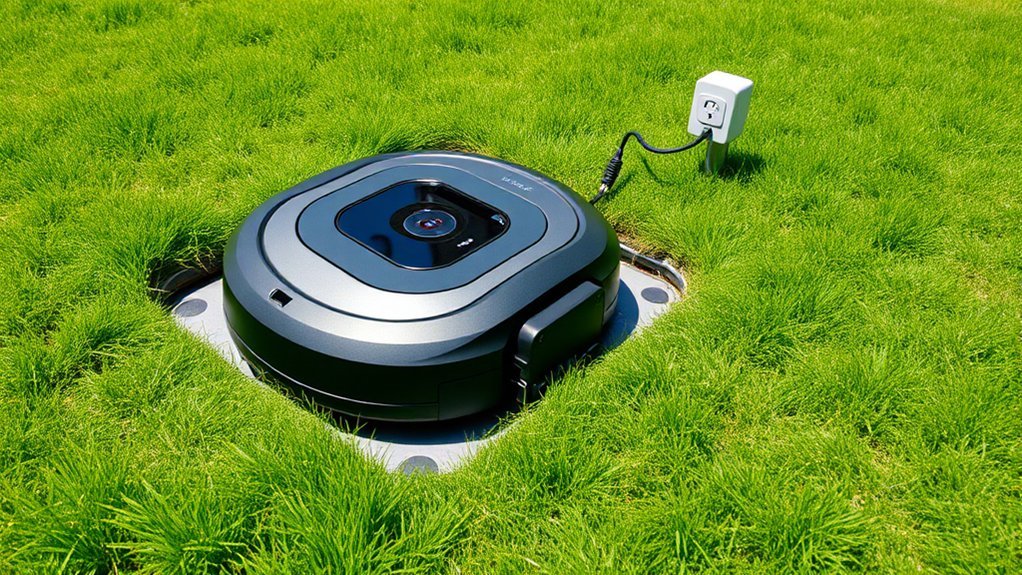
Why is proper installation of your robot lawn mower’s charging base so essential? Correct placement guarantees ideal interaction with your garden design, enabling efficient mowing patterns and consistent coverage. An improperly installed base can disrupt the mower’s navigation, leading to uneven cuts and missed areas. Additionally, precise positioning minimizes interference with lawn aeration activities, preventing obstructions that could impair both processes. A stable, level installation guarantees reliable charging and reduces the risk of connection failures. Proper setup also enhances safety by preventing accidental tipping or movement of the base. Ultimately, meticulous installation aligns with your lawn’s structural and aesthetic goals, ensuring the robot mower operates seamlessly while supporting overall garden health and maintenance efficiency.
Choosing the Best Location for Your Charging Station
Selecting the most suitable location for your robot lawn mower’s charging station is essential to guarantee efficient operation and ease of access. Proper placement minimizes travel time, prevents obstructions, and ensures reliable charging. Consider integrating the station into your garden landscaping by selecting a sheltered, level area that resists weather influences. Weather considerations include avoiding direct sunlight, rain exposure, and areas prone to flooding. The ideal spot maintains clear pathways and is accessible for maintenance. The following table visualizes potential placement options:
| Location Type | Key Features | Weather Impact |
|---|---|---|
| Under a pergola | Partial shade, sheltered | Reduced weather exposure |
| Near a shed | Protected from wind and rain | Stable environment |
| Against a wall | Level, wind-blocking surface | Minimal weather influence |
| Garden corner | Discreet, accessible | Moderate weather risk |
| Open lawn edge | Easy access, unobstructed | Higher weather exposure |
Preparing Your Lawn and Surroundings for Installation
Before installing the charging station, we must thoroughly prepare the lawn and surrounding area to guarantee ideal operation and ease of maintenance. Proper preparation ensures excellent robot navigation, preserves garden aesthetics, and minimizes future disruptions.
- Conduct lawn aeration to reduce soil compaction, improving mower traction and ensuring consistent cutting patterns near the charging base.
- Clear debris, rocks, and obstructions from the installation zone to prevent mechanical jams and ensure smooth navigation.
- Trim surrounding vegetation to maintain clear pathways and prevent overgrowth from interfering with the charging station’s sensor detection.
These steps promote a clean, even surface, enhance performance, and support long-term maintenance simplicity, all essential for a seamless charging station setup.
Connecting the Charging Base to Power and Ensuring Safety
We begin by verifying that the power source matches the charging base’s voltage and current requirements to guarantee proper operation. It’s essential to implement safety precautions, such as grounding the outlet and inspecting cables for damage, to prevent electrical hazards. Accurate connection and safety measures are critical for reliable performance and user safety.
Power Source Compatibility
Ensuring proper power source compatibility is essential for safe and reliable operation of the robot lawn mower’s charging base. Compatibility directly influences battery lifespan and charging speed, impacting overall performance. To optimize these factors, consider the following:
- Verify voltage and current ratings match the manufacturer’s specifications to prevent power surges that could degrade battery health.
- Use a dedicated power circuit to avoid fluctuations that may reduce charging efficiency and shorten battery lifespan.
- Ensure the power supply provides consistent, stable voltage, which directly affects charging speed and the longevity of the charger components.
Adhering to these specifications guarantees efficient energy transfer, maintaining the optimal battery lifespan and fast charging cycles necessary for dependable operation.
Safety Precautions Implementation
Connecting the charging base to power requires strict adherence to safety protocols to prevent electrical hazards. We confirm the power outlet is properly grounded and use weather-resistant, appropriately rated extension cords if necessary, maintaining a safe distance from garden aesthetics to avoid damage. Proper insulation of all connections minimizes risk, and we verify that the voltage matches the manufacturer’s specifications. Securing cables neatly prevents tripping hazards and pest prevention issues, as exposed wiring can attract pests or compromise garden aesthetics. We also position the base away from high-traffic areas and moisture sources, reducing electrical risks and maintaining visual appeal. Following these precautions guarantees a safe installation, preserves garden aesthetics, and minimizes pest attraction, creating an efficient and hazard-free environment for our robotic mower.
Properly Positioning the Charging Base for Optimal Performance
To achieve reliable charging and uninterrupted operation, it’s essential to position the robot lawn mower’s charging base in a location that balances accessibility with ideal signal reception. Proper placement ensures consistent docking, minimizes navigation errors, and maintains garden aesthetics through landscaping integration. Consider these factors:
Position the charging base for easy access, strong signal, and seamless garden integration for optimal mower performance.
- Proximity to the mowing area: Place the base within a clear path, avoiding obstructions that could impair signal strength or cause physical interference.
- Signal clarity: Ensure the base is positioned free from metal objects or electronic devices that could disrupt communication.
- Aesthetic harmony: Integrate the station seamlessly into the landscape, preserving garden aesthetics while maintaining functional accessibility.
Optimal positioning enhances performance, supports landscaping design, and sustains efficient lawn maintenance.
Securing the Charging Station to Prevent Tipping or Movement
Securing the charging station firmly in place is essential to prevent tipping or movement during operation or adverse weather conditions. To achieve this, we recommend anchoring the station with appropriate fasteners suited for your surface type, such as ground anchors for soil or mounting brackets for concrete. Incorporate weather-resistant hardware to withstand moisture and temperature fluctuations, maintaining stability over time. While integrating the station into garden decor, make certain that the installation does not compromise its secure positioning, especially in windy conditions. Proper anchoring minimizes vibrations and shifting, enhancing operational reliability. Consistent weather resistance and secure attachment reduce the risk of damage, guaranteeing the charging base remains stable and functional, regardless of outdoor environmental factors.
Configuring Your Robot Mower to Recognize the Charging Base
To guarantee reliable recognition, we start by verifying proper placement of the charging base according to manufacturer specifications. Next, we connect the power supply correctly, ensuring stable electrical contact. Finally, we initiate the robot’s recognition sequence through the control interface to enable accurate docking.
Ensuring Proper Base Placement
Have you positioned the charging base correctly to guarantee reliable recognition by your robot mower? Proper placement is critical to maintain garden aesthetics and assure weather resistance. To optimize recognition, consider these factors:
- Location proximity: Place the base near the mower’s typical operation zone, avoiding obstacles that could hinder signal transmission.
- Flat, stable surface: Guarantee the base sits on a level, weather-resistant surface to prevent movement or damage, preserving both function and garden aesthetics.
- Clear line of sight: Avoid placing the base behind large objects or dense foliage, which could interfere with the mower’s sensors and signal detection.
Accurate placement ensures seamless operation, reliable docking, and long-term weather durability, all essential for efficient lawn maintenance.
Connecting Power Correctly
How do we guarantee that your robot mower recognizes and connects to the charging base reliably? Ensuring proper power connection is critical. We verify that the charging base’s power supply is correctly wired and stable, preventing voltage fluctuations that could interfere with recognition. Proper power connection supports consistent battery maintenance, helping your mower retain ideal battery health for reliable operation. Additionally, establishing a stable Wi Fi connectivity link allows the mower to receive updates and communicate status, which enhances recognition accuracy. We recommend checking for secure connections, ensuring no loose wires, and confirming that the power source provides the correct voltage. Reliable power connection combined with stable Wi Fi connectivity ensures the mower’s sensors and communication modules function correctly, facilitating seamless recognition of the charging base.
Initiating Recognition Sequence
Once the charging base is properly powered and connected, we initiate the recognition sequence by configuring the robot mower’s settings to identify and communicate with the base station. This process guarantees proper robot maintenance and ideal communication for efficient operation. To enhance reliability, we recommend verifying the following:
- Software updates: Confirm the mower’s firmware is current, enabling seamless recognition and communication with the charging base.
- Recognition parameters: Adjust the mower’s settings to accept the base station’s signal, ensuring accurate identification.
- Calibration routines: Run any necessary calibration procedures to maximize signal strength and positioning, reducing the risk of miscommunication during operation.
Performing these steps guarantees the mower properly recognizes the charging base, streamlining maintenance processes and maintaining system integrity.
Troubleshooting Common Installation Issues and How to Fix Them
When installing the robot lawn mower’s charging base, several common issues can arise that hinder proper operation. Wireless connectivity problems often stem from interference or inadequate signal strength, which prevents the mower from recognizing the base. Confirming the base is within ideal range and free from obstructions can resolve this. Additionally, poor battery maintenance affects charging efficiency; regularly inspecting and cleaning the charging contacts ensures a reliable connection. If the mower fails to dock properly, verify that the base’s power source is stable and that the wiring is secure. Firmware updates may also improve connectivity and charging performance. Addressing these issues systematically enhances the overall functionality, guaranteeing seamless operation and minimizing downtime caused by installation errors.
Tips for Maintaining and Repositioning Your Charging Base Over Time
Regular maintenance and strategic repositioning of your charging base are essential to guarantee peak performance of your robot lawn mower. To optimize operation, consider the following:
- Garden Layout: Confirm the base remains accessible and unobstructed, especially in high-traffic areas, and adjust its position as your landscape evolves.
- Weather Considerations: Move the base indoors or to a sheltered location during extreme weather conditions to prevent corrosion and moisture damage.
- Periodic Reassessment: Regularly verify the base’s signal strength and alignment with the mower’s navigation pattern, repositioning if necessary to maintain efficient charging cycles.
Frequently Asked Questions
How Do I Update My Robot Mower’s Firmware After Installation?
We update our robot mower’s firmware through the dedicated app, ensuring software compatibility by checking for updates regularly. Follow on-screen instructions precisely to complete the firmware update, maintaining peak performance and security.
Can I Install Multiple Charging Bases for Larger Lawns?
Yes, we can install multiple stations to enhance lawn scalability. Multiple stations allow seamless coverage of larger areas by enabling the mower to switch between charging bases efficiently, optimizing mowing times and maintaining consistent performance across extensive lawns.
What Should I Do if My Mower Doesn’t Return to the Station?
If your mower doesn’t return, we recommend troubleshooting connectivity issues and verifying ideal placement of the charging station. We meticulously check signal strength and position to guarantee seamless docking, enhancing operational efficiency and preventing future return failures.
Are There Specific Weather Considerations During Installation?
We recommend considering weather precautions and installation timing, avoiding installation during rain or extreme temperatures, to guarantee proper setup. Clear the area of debris and wait for ideal weather conditions for precise, secure placement of the charging base.
How Often Should I Inspect or Clean the Charging Base?
We recommend inspecting and cleaning the charging station monthly, following a strict cleaning schedule. During maintenance, check for debris, dust, or corrosion, ensuring the best contact and functionality, which prolongs the station’s lifespan and maintains efficient robot operation.
Conclusion
Just as a lighthouse guides ships safely home through shifting tides, a well-installed charging base guarantees your mower navigates your yard effortlessly. Precision in placement, secure connections, and ongoing adjustments create a reliable anchor in your garden’s landscape. By maintaining this steady foundation, we enable our robotic helpers to operate efficiently and safely, illuminating the path toward a pristine, well-managed lawn amid the ever-changing terrain. Proper installation is the beacon of consistent, peak performance.